


Quick Summary
The top high school linemen drills build stance, first step, hand placement and footwork. Start with a three-point stance hold, get-off on the snap count, and the shuffle step with hands, then add sled drive blocks and agility ladder work.
- Hold a three-point stance for 10 seconds and repeat five times to build balance.
- Run ten get-off reps per session on the snap count to sharpen your first step.
- Practice drive blocks on a sled or bag for three sets of five repetitions.
- Time the 5-10-5 shuttle every 4 to 6 weeks to track change-of-direction progress.
Table of Contents
- Why Linemen Drills Matter at the High School Level
- Offensive Line Drills for High School Football
- Defensive Line Drills for High School Football
- Football Lineman Footwork Drills
- Offensive Line Hand Placement Drills
- Setting Up Safe Practice Sessions and Progressions
- Scheduling Your Next Step Toward a Stronger Line Game
- Frequently Asked Questions
Why Linemen Drills Matter at the High School Level
Linemen decide most high school games before the ball is snapped. A lineman who wins his stance, fires off the ball and keeps his hands inside the defender controls the line of scrimmage. One who false-starts or lunges loses the play before it starts.
That is why the best high school programs spend real practice time on linemen drills. The work builds the fundamentals that every other skill depends on: balance, hand placement, use and first-step quickness. A lineman who has drilled these movements thousands of times reacts instinctively in a game.
Coaches also face a practical problem. Linemen often get less individual attention than skill players, so a structured drill routine helps athletes improve even when the coach is busy with the rest of the team.
Offensive Line Drills for High School Football
Offensive linemen win by controlling the space in front of them. The drills below focus on the first moves that determine whether a block succeeds.
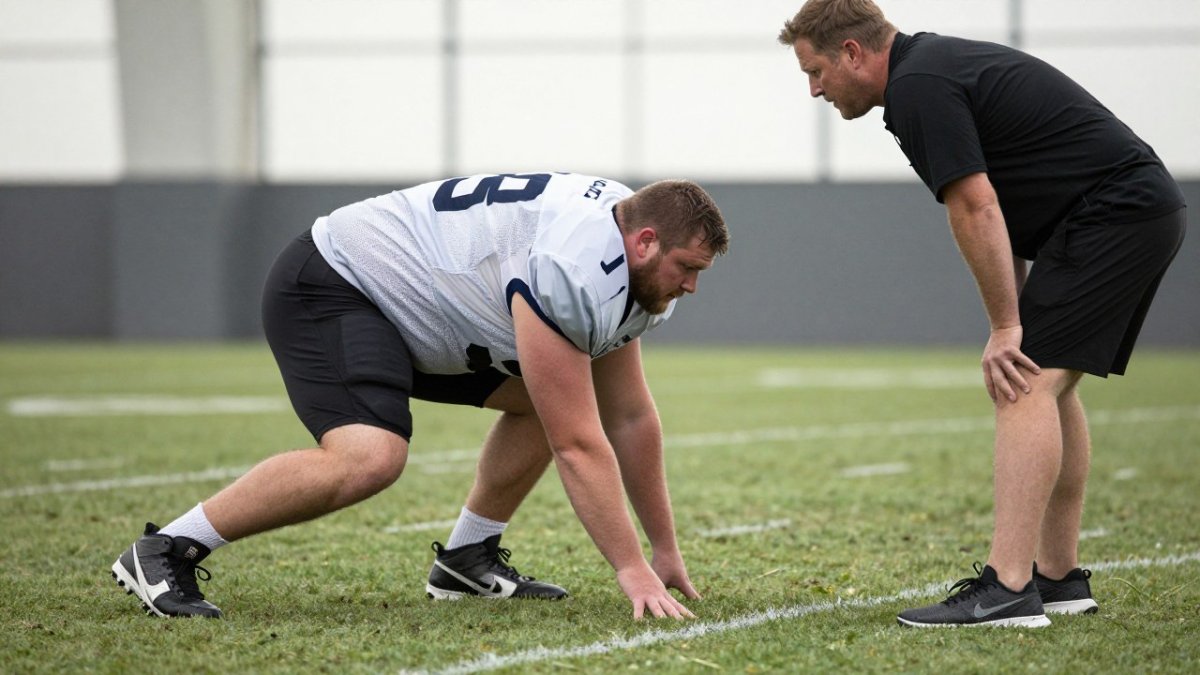
Drills 1-5: Stance, First Step and Run Blocking
1. Three-point stance hold. Set up in a balanced stance with the hand down, knees bent and weight over the balls of the feet. Hold for 10 seconds, then reset. Repeat five times. The goal is a stance you can hold without wobbling.
2. Get-off on the snap count. Have a partner call the count while you fire out low, with your first step landing under your hips. Watch for a false start. Ten reps per session is a solid target.
3. Shuffle step with hands. Shuffle laterally while keeping your hands in front at chest height. Keep your knees bent and your feet from crossing. This builds the lateral movement needed to mirror a defender.
4. Drive block on a sled or bag. Strike the sled with your hands inside the shoulder pads, then drive your legs through the contact. Keep your back flat and your head up. Aim for three sets of five repetitions.
5. Fold block walkthrough. Practice the fold block at half speed with a partner, focusing on the exchange of responsibility. A common mistake is rushing the exchange and losing use. Slow down until the footwork is clean, then add speed.
The drills below each target a specific skill, so the table gives a quick summary of what each one builds and how to run it.
| Drill | Focus | Key Detail |
|---|---|---|
| Three-point stance hold | Balanced stance | Hold 10 seconds, repeat five times |
| Get-off on the snap count | First step | Ten reps per session |
| Shuffle step with hands | Lateral movement | Hands at chest height, knees bent |
| Drive block on a sled or bag | Drive through contact | Three sets of five reps |
| Fold block walkthrough | Exchange of responsibility | Slow down until footwork is clean |
Defensive Line Drills for High School Football
Defensive linemen need explosive first steps and the ability to shed blockers. These drills build those skills.
Drills 6-8: Get-Off, Rush Moves and Pursuit
6. Get-off burst. From a three-point stance, explode forward on the snap for five yards. Concentrate on driving the first step low and hard. Repeat for 8 to 10 reps.
7. Swim and rip moves. Against a pad or partner, practice the swim move (arm over the blocker’s shoulder) and the rip move (arm under and through). Work on speed of hands more than power at first.
8. Pursuit angles. Sprint from the line to a cone set 10 yards downfield at an angle, then change direction. Good pursuit angles separate effective defensive linemen from ones who chase the play from behind.
Football Lineman Footwork Drills
Footwork ties every line technique together. Lineman footwork drills should be practiced daily, even during short sessions. For a deeper look at the footwork used in pass protection, see offensive line pass protection footwork. The drills below are designed for high school athletes and include exact setup, coaching cues, and repetition schemes.
1. Agility Ladder Series (10 minutes). Set up a 10-yard agility ladder on turf or tape lines on a gym floor. Perform three patterns: high knees (one foot per rung), lateral quick steps (two feet per rung, staying low), and in-and-out (one foot in, one foot out). Coaching cues: keep the chest over the knees, push off the balls of the feet, and avoid crossing feet on lateral patterns. Perform each pattern for 2 sets of 20 seconds, with 30 seconds rest.
2. Mirror Drill (5 minutes). Pair athletes of similar size. One partner leads with lateral shuffles, backpedals, and forward steps within a 5-yard box; the other mirrors the movement while staying low with hands ready. Switch every 30 seconds for 4 total reps. Coaching cue: focus on the leader’s hips, not their feet, to react faster.
3. Kick-Slide Progression (8 minutes). For pass protection, start in a two-point stance with hands at chest height. Kick-slide laterally to a cone 5 yards away, maintaining a wide base and keeping the inside foot pointed at the target. Perform 6 reps per side, then add a reactive element: a partner points left or right and the athlete kick-slides in that direction. Coaching cue: the first step should be short and quick, not a lunge.
4. Cone Weave (5 minutes). Set five cones in a zigzag pattern 2 yards apart. Weave through the cones using a low shuffle, keeping shoulders square to the line of scrimmage. Perform 4 reps, resting 45 seconds between reps. This builds change-of-direction skill specific to blocking angles.
Measurable benchmarks. Time the 5-10-5 shuttle (pro agility) every 4-6 weeks. Also track the number of clean reps in the mirror drill, if an athlete can mirror for 30 seconds without crossing feet or standing up, they are ready for more advanced work.
Watch out: Linemen who move their feet quickly in practice are harder to beat when a rusher gets around the edge, but if the chest rises or feet cross during lateral work, slow down until the mechanics are clean.
Offensive Line Hand Placement Drills
Hand placement decides whether a lineman controls a defender or gets pushed back. Hands should land inside the defender’s chest plate, with thumbs up and elbows tight.
Try these drills:
- Hand punch on a bag: Strike a bag with inside hands, keeping elbows bent and feet moving. Ten reps per set.
- Hand fight with a partner: Work for inside use without locking out. The goal is control, not a shoving match.
- Hand strike recovery: After a missed punch, reset hands within one second. Quick resets prevent defenders from rolling you.
Coaches should watch for hands that drift outside or wide. Wide hands give defenders an easy route to shed the block.
Setting Up Safe Practice Sessions and Progressions
High school linemen vary widely in physical development, so a safe session starts with an honest assessment of each athlete’s training age. A freshman who has never worn pads needs different work than a senior with three years of varsity experience.
Warm-up (10-12 minutes). Begin with dynamic movements that raise core temperature and prepare the joints for contact: leg swings, walking lunges with a twist, high-knee skips, and bodyweight squats. Static stretching before explosive work can temporarily reduce power output, so save long holds for after practice.
Progression stages. Introduce every drill in three stages:
- Walk-through (no contact, no speed). Athletes rehearse footwork and hand placement at quarter speed. A coach checks that the stance is balanced and hands are inside the frame.
- Half-speed with bags or sleds. Add resistance and movement, but keep the focus on mechanics. If form breaks, return to stage one.
- Full-speed contact. Only after an athlete demonstrates clean technique for multiple reps at half speed should full contact be introduced. A common pattern is to require two consecutive error-free sessions at stage two before advancing.
Workload and recovery. Sled and bag work should be counted in total reps per session. Heavy contact reps should be limited and rest taken between sets to preserve form, with the exact volume set by the coaching staff. After a heavy contact day, schedule a lighter technique or film session within 24-48 hours. Sleep and nutrition matter as much as any drill;
Supervision and safety standards. All contact drills should be supervised by a coach trained in proper technique and emergency procedures. The National Federation of State High School Associations (NFHS) provides sport-specific guidelines that many state associations adopt; check your state’s high school athletic association for local rules on contact limits and acclimatization periods. During summer heat, follow heat-acclimatization protocols: gradual exposure over 7-14 days, frequent water breaks, and monitoring for signs of heat illness.
Measurable benchmarks. Track each athlete’s progress with simple, repeatable tests: a 10-yard get-off time (electronic timing if available), a 5-10-5 shuttle for change of direction, and a hand-placement accuracy score (e.g., 8 out of 10 reps with hands inside the chest plate). Re-test every 4-6 weeks. Watching for consistent improvement over several weeks is more useful than pushing for maximum effort every day.
Watch out:
Scheduling Your Next Step Toward a Stronger Line Game
Drills build skill, but structure builds progress. Athletes who want to advance beyond these fundamentals can look at a progressive training program designed specifically for linemen, and the O Linemen Progressive Training 1 program builds directly on the techniques covered above.
Athletes ready to take a second step can continue with O Linemen Progressive Training 2, which moves into more advanced technique and conditioning. Before committing, families can review what’s included in the linemen programs to see how each session is structured. Those ready to start can also check where linemen programs are located to find a training option near home.
Start with the fundamentals in this guide, track your progress each week, and build toward the next stage when your technique is consistent.
Frequently Asked Questions
What are some good drills for youth football linemen?
Start with fundamentals that build body control before adding resistance. Stance holds, short shuffle steps along a line of cones and hand-placement repetitions with a partner build the base that later drills depend on. Keep sessions short, focus on technique over speed and let athletes repeat each movement until it looks clean. Adjust distances and intensity so every player can complete the work with correct form, and stop any drill when form breaks down.
How can high school linemen improve their first step?
The first step comes from a balanced stance, weight slightly forward and a quick, decisive push off the back foot. Practice get-off repetitions from a three-point stance on a whistle, keeping the eyes up and the first step short and driving. Pair these with sled or resistance work so the explosive start transfers to contact, and film a few reps to check that the hips stay under the shoulders.
How can a lineman improve hand placement and blocking technique?
Hands should land inside the defender’s frame, with palms on the chest or shoulder pads, and the elbows kept tight. Partner drills with a hand shield or pad let linemen work on punch timing and strike location without full contact. Coaches should check that the hands stay inside, the feet keep moving and the hips stay low through the block, correcting one element at a time before adding speed.
How often should high school football linemen practice position drills?
Most high school linemen do well with position-drill work two to three times per week during the season and more often during the off-season, with rest days built in. Keep each session focused and bring workload down when technique starts to slip. Adjust volume to the athlete’s age, experience and recovery, and make sure coaches supervise every rep.