
Table of Contents
- Building the Foundation: Coaching Offensive Line Stance and Start
- Essential Offensive Line Blocking Drills for Every Practice
- Offensive Line Pass Protection Techniques That Hold Up
- Developing Athletic Traits: Footwork, Agility, and Explosiveness
- Strength Training and Mobility Protocols for Linemen
- The Mental Game: Cognitive Processing and In-Game Adjustments
- Common Mistakes That Stall Lineman Development
- Conclusion: Building Complete Offensive Linemen
- Frequently Asked Questions
Last Updated: October 4, 2026
Building the Foundation: Coaching Offensive Line Stance and Start
Football coaching for offensive linemen starts with the stance. At QB Factory, we tell linemen on day one: your stance is a loaded spring that decides the first contact.
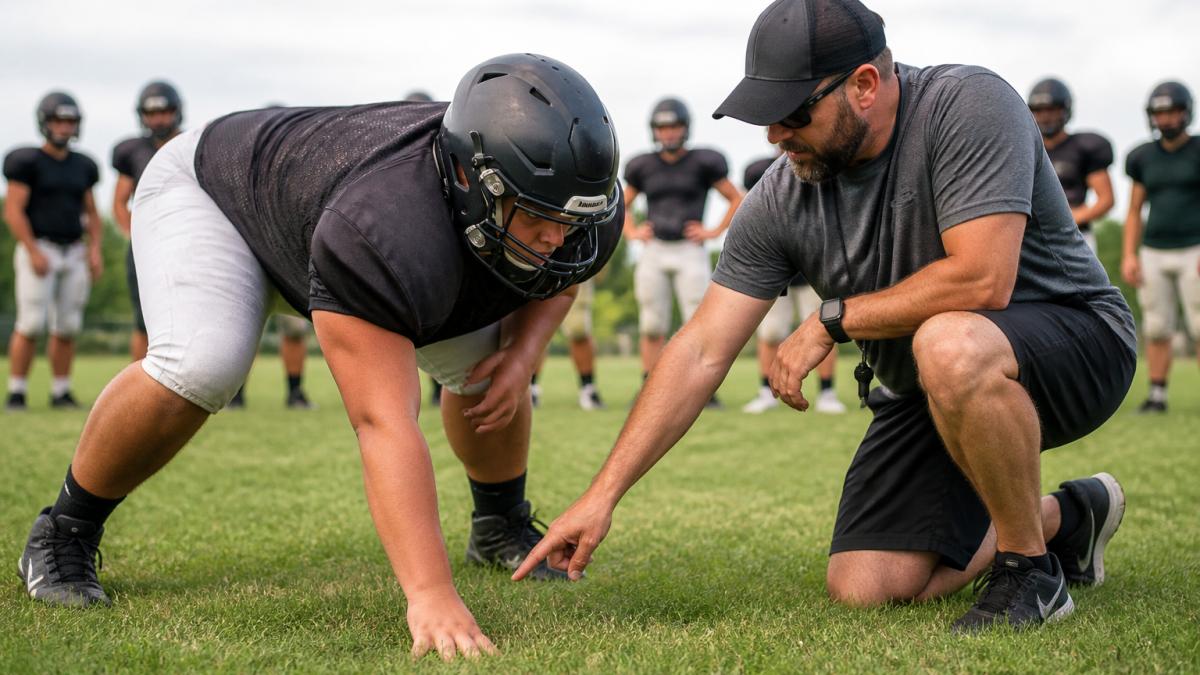
Here is our checklist for every rep:
- Flat back, eyes up, neck neutral
- Weight balanced across both feet
- Free hand ready to strike, not resting
Most young linemen copy what they see on TV, but the pros sit lower and coil tighter than a high schooler needs to. Start simple, then add complexity.
The Three-Point Stance Checklist
The stance fails in small ways: a hand too far forward pulls weight onto your fingertips, and a rounded back kills your pad level before the snap. Coaches should check five points every rep:
- Hand placement directly under the shoulder
- Flat back from hips to head
- Knees bent, not locked
A bad stance poisons every drill that follows.
First-Step Mechanics That Win the Line of Scrimmage
The first step is the whole play for a lineman. Get it right and you control the line of scrimmage; get it wrong and you are chasing from the snap. Three rules govern it:
- Step with the near foot on run plays, the inside foot on pass sets
- Keep the step short and violent, not long and lazy
- Stay low through the step, never rise up
Film your linemen from the side, not the front. A side angle shows whether the first step is truly low and explosive. Front angles hide a rising hip, which is the most common stance flaw we see.
Essential Offensive Line Blocking Drills for Every Practice
Offensive line blocking drills should build from simple to complex, and every drill must train a real game skill. We run drills in sequence: stance, first step, then contact. Here is how we order a practice block:
| Drill | Skill Trained | Reps Per Practice |
|---|---|---|
| Stance and start | Posture, first step | 10-15 |
| Board drill | Footwork, use | 10 |
| Hand placement | Strike and lockout | 15 |
| Reach block | Lateral quickness | 8-10 |
| Down block | Angle and hip drive | 8-10 |
Run Blocking Drills: Inside Zone and Gap Scheme
Inside zone is a run concept where the lineman blocks an area, not a specific defender, reading the defensive front on the move.
The zone scheme rewards patience: linemen take a lateral first step, stay on track, and find the second level linebacker. The gap scheme is the opposite, asking for a specific defender and angle with pulling linemen leading the way.
Reach Block and Down Block Progressions
The reach block asks a lineman to get his head across a defender lined up outside him, the hardest block in football, demanding speed, use, and hand placement at once. The down block is simpler: block the first defender inside you with a sharp angle and hip drive. Progress the reach block in three stages:
- Walk-through at half speed, no defender
- Live defender at three-quarter speed
- Full-speed rep with a real defensive front
A lineman who cannot reach a bag cannot reach a linebacker.
Offensive Line Pass Protection Techniques That Hold Up
Offensive line pass protection techniques decide whether your quarterback survives the pocket. The best pass protectors never lunge, they mirror the defender, stay balanced, and strike only when the rusher commits. Pass protection is built on a quick backpedal and a firm punch.
Hand Placement and Pad Level in Pass Sets
Hand placement wins pass sets: inside hands to the defender’s chest, thumbs up, elbows tight, and outside hands never reach because a reaching hand gets swatted. Pad level matters just as much, the lower man wins the engagement, and a lineman who stands up gives the rusher a free lane.
Two cues we use every rep:
- “Thumbs up, elbows in”
- “Low man wins”
Reading Defensive Fronts and Picking Up Blitzes
A lineman must read the defensive front before the snap: count the defenders in the box, find the second level, identify who is coming. Blitz pickup is mental, the lineman who talks through protection rules with his quarterback and center will pick up more blitzes than the stronger player who never looks up.
Developing Athletic Traits: Footwork, Agility, and Explosiveness
Footwork, agility, and explosiveness are trainable, and they separate good linemen from great ones. Biomechanics tells us power starts in the ground and travels up through the hips. Three athletic traits every lineman should build:
- Footwork: ladder drills, cone drills, and stance-to-step work
- Agility: lateral shuffles, change-of-direction drills, mirror drills
- Explosiveness: short sprints, broad jumps, and med ball throws
Train these in the off-season; in-season, maintain them with short, sharp reps.
Strength Training and Mobility Protocols for Linemen
Strength training for linemen should build the whole chain: hips, core, shoulders, and grip. Strength training without mobility creates stiff, injury-prone players, so pair the two from day one and organize training around movement patterns rather than body parts.
Movement Patterns That Transfer to the Field
Every lift should map to a position a lineman holds during a rep:
- Hip hinge: Trap bar deadlift, Romanian deadlift, kettlebell swing. Trains the hip drive that powers a down block and a vertical pass set.
- Squat pattern: Front squat, back squat, split squat. Builds the base that keeps pad level low through contact.
- Upper body push: Bench press, incline press, close-grip bench. Develops the punch and lockout in pass protection.
A simple weekly split that covers these patterns:
| Day | Focus | Example Exercises |
|---|---|---|
| Monday | Lower body power | Trap bar deadlift, front squat, split squat |
| Tuesday | Upper body push/pull | Bench press, barbell row, overhead press |
| Thursday | Lower body volume | Back squat, Romanian deadlift, walking lunge |
| Friday | Upper body volume + core | Incline press, pull-up, Pallof press, suitcase carry |
Sets and reps depend on the phase. Off-season: 3-5 sets of 3-6 reps on primary lifts for strength, 3 sets of 8-12 on accessories for muscle base. In-season: cut volume roughly in half and keep intensity moderate.
Quarterback Registration (Required) →
Mobility Protocols for Long-Term Joint Health
Mobility work is not optional for linemen. Repeated deep knee bends, hip rotation, and shoulder extension stress the ankles, hips, thoracic spine, and shoulders, and without a maintenance routine that stress accumulates. A daily 10-minute routine that addresses the positions linemen hold most:
- Ankle dorsiflexion: Knee-to-wall drill, 2 sets of 10 per side. Tight ankles force the knee inward and shift stress to the hip and lower back.
- Hip openers: 90/90 hip stretch, half-kneeling hip flexor stretch, 2 sets of 30 seconds per side. Hip mobility directly affects pad level and reach block range.
- Thoracic rotation: Open book drill, quadruped t-spine rotation, 2 sets of 8 per side. A stiff upper back limits the ability to turn and seal a defender.
Skipping mobility work is the most common mistake we see in young linemen. Tight hips and ankles force the body to compensate, and that compensation shows up as a knee or lower back injury during the season. A 10-minute daily routine is the cheapest insurance a lineman can buy.
In-Season Maintenance vs. Off-Season Development
The off-season is for building; in-season is for maintaining. A common error is training hard in-season and resting in the off-season, when the opposite is true.
- Off-season (8-12 weeks): 4 lifting days per week, progressive overload on primary lifts, full mobility routine daily.
- In-season (weekly): 2 lifting days per week, moderate intensity, mobility routine daily, extra focus on recovery and sleep.
- Transition (2-4 weeks): Active recovery, light movement, address nagging joint issues before the next training block.
Fueling Functional Mass
Building mass is not the goal, functional mass is. A lineman who adds 20 pounds of fat will be slower and more injury-prone; one who adds 10 pounds of muscle in the right places will be more explosive and durable. Aim for roughly 1 gram of protein per pound of body weight daily, spread across 4-5 meals, with carbohydrates timed around training.
Strength and mobility are not separate programs. They are two halves of the same system. Train the movement patterns, maintain the joints, and fuel the work. That is how linemen stay on the field.
The Mental Game: Cognitive Processing and In-Game Adjustments
The mental game is where most linemen plateau. Cognitive processing speed, how fast a lineman reads and reacts to a defensive look, decides who plays on Friday night and who sits. Here is how to train it.
Pre-Snap Reads: What to Look For Before the Ball Is Snapped
A lineman has roughly 5-8 seconds between the huddle and the snap, enough to gather three critical pieces of information:
- Box count: How many defenders are within 5 yards of the line of scrimmage? This tells the lineman whether the defense is loaded against the run or spread out to defend the pass.
- Defensive front: Is it an odd front (a nose tackle over the center) or an even front (two defensive tackles over the guards)? The front determines the blocking scheme.
- Second-level alignment: Where are the linebackers? Stacked behind the defensive line, or shifted to one side? This reveals blitz intent.
Young linemen often look only at the defender across from them. The best scan the entire front in a consistent order, box count, front, second level, until it becomes automatic.
Post-Snap Confirmation and Adjustment
The pre-snap read is a prediction; the post-snap reaction is the confirmation. A lineman must process what he sees in the first two steps and adjust if the prediction was wrong.
Three common post-snap adjustments:
- Blitz pickup: If a linebacker or safety walks up late, the lineman must communicate the change to the man next to him and pass off the stunt.
- Twist/stunt recognition: If the defensive tackle slants inside and the end loops outside, the lineman must stay on the inside threat and let the outside rusher go to the running back or tight end.
- Second-level climb: On a zone run, if the linebacker fills the gap the lineman expected to block, he must adjust his track and find the next threat.
The key mechanism is visual processing speed. A lineman who needs 1.5 seconds to recognize a stunt gives up a sack; one who recognizes it in 0.5 seconds passes it off cleanly.
Training Cognitive Processing Speed
You cannot train mental speed with physical reps alone. You need drills that force the brain to read and react under time pressure:
- Whiteboard walk-through: Draw a defensive front on a whiteboard. Ask the lineman to call out the box count, the front, and his assignment. No movement, just processing.
- Film study with pause: Watch game film and pause before the snap. Ask the lineman to make his pre-snap read out loud. Then play the clip and see if his prediction was correct.
- On-field walk-through: Align a defense at half speed. The lineman makes his read and takes his first step. No contact.
- Live reps with a coach calling the front: A coach signals a front, the lineman reads it, and the ball is snapped. The lineman must communicate his adjustment to the man next to him before the snap.
- Full-speed team reps: The final stage. The lineman reads, adjusts, and executes at game speed.
Communication: The Lineman’s Leadership Role
The center and quarterback get most of the credit for protection calls, but guards and tackles must communicate adjustments to each other. A silent offensive line is a broken offensive line. A simple system that works:
- Center: Makes the initial protection call based on the front.
- Guards: Echo the call and identify any second-level threats.
- Tackles: Confirm the edge protection and call out any late blitzers.
Communication is a skill, and like any skill, it improves with repetition.
The mental game is not a mystery. It is a set of trainable skills: pre-snap reads, post-snap adjustments, and communication. Train them with the same deliberate progression you use for footwork and hand placement, and the game will slow down.
Common Mistakes That Stall Lineman Development
Most lineman development stalls for the same handful of reasons. Fix these and progress speeds up.
- Chasing big lifts before mastering technique
- Skipping the stance and first step in favor of contact drills
- Ignoring hand placement because it feels like a small detail
The linemen who improve fastest are not the strongest or the fastest. They are the ones who master fundamentals first and add complexity only when the basics hold up under pressure.
Conclusion: Building Complete Offensive Linemen
Building a complete lineman takes patience, a real plan, and coaching that treats footwork, strength training, and the mental game as one system.
At QB Factory, we train linemen the same way we train quarterbacks and receivers: with a progressive formula that builds mechanics, then adds game-speed decision-making.
If your athlete is ready to train like a college prospect, apply today and start building the complete lineman.
Frequently Asked Questions
What are the fundamental blocking progressions for offensive linemen?
Blocking progressions start with stance and first step, then move to hand placement and engagement, and finish with sustain and finish. Coaches should teach the inside zone first because it builds footwork, leverage, and second-level awareness. From there, add gap scheme concepts like power and counter. Each progression should be drilled in sequence before adding a defensive front. This layered approach helps linemen react instead of think during games.
How do you coach proper hand placement for offensive linemen?
Hand placement starts with the elbows tight and hands inside the framework of the defender’s chest. Coaches should drill the punch from a static stance before adding movement. A common cue is ‘thumbs up, elbows in.’ In pass protection techniques, the inside hand strikes first to control the rusher’s momentum. Reps with a partner using a heavy bag or sled build the muscle memory needed for game day.
What is the role of mental preparation in offensive line play?
Mental preparation separates good linemen from great ones. Reading defensive fronts, recognizing blitz packages, and adjusting protection calls happen before the snap. Coaches can build this through classroom sessions and film study. Programs that combine physical drills with cognitive processing work, like those at QB Factory, help linemen react faster under pressure. Mental reps reduce hesitation and improve communication across the front five.
What are the most effective drills for improving O-line footwork?
The most effective footwork drills include the lateral slide, the kick-slide for pass protection, and the inside zone step. Coaches should run these daily with a focus on keeping a wide base and low pad level. The first step should be short and powerful, not long and slow. Adding a cone or line to the drill gives players a visual target. Film review after each session helps linemen see where their feet break down.