


Table of Contents
- Why Youth Quarterback Fundamental Drills Matter in 2026
- What You’ll Need: Equipment and Practice Space
- Building a Youth Quarterback Practice Plan
- Quarterback Warm-Up Drills: Start Every Session Right
- Footwork and Dropback Fundamentals
- Throwing Mechanics and Release Point
- Quarterback Accuracy Drills That Build Precision
- Quarterback Decision-Making Drills for Game Day
- Frequently Asked Questions
Last Updated: October 9, 2026
Why Youth Quarterback Fundamental Drills Matter in 2026
The position has changed fast. Coaches at every level now ask young passers to read coverage, move in the pocket, and throw on the run.
That is the whole argument of this guide. Drills are not punishment work you squeeze in before the fun stuff.
Below, we break down a full practice plan you can run this week. It covers warm-ups, footwork, throwing mechanics, accuracy work, and decision-making.
Fundamentals are not a phase young quarterbacks grow out of. They are the skill that keeps improving every season, which is why we run them at every age level we coach.
What You’ll Need: Equipment and Practice Space
A youth quarterback practice needs less gear than most parents expect. A football, a set of cones, and a partner for catching are enough to run almost every drill in this guide. The bigger variable is space, and how you set it up changes what you can train.
Here is the full list we recommend:
- Footballs: One game ball for each quarterback, plus a spare. Younger players (ages 7-10) do better with a youth-size ball they can grip properly. A ball that is too big forces a two-hand grip and throws off release point.
- Cones: Six to ten flat cones. Use them for footwork ladders, target lines, and throwing-lane markers.
- A net or wall: For solo throwing work when no receiver is available. A rebounder net or a sturdy wall both work.
- A partner: A parent, sibling, or teammate to catch and return throws. For route-based drills, a second partner helps.
- Cleats: For outdoor sessions on grass. Turf shoes work on synthetic surfaces.
- Water: Non-negotiable, especially in warm months.
Setting Up by Space
Backyard (10-by-20-yard patch of grass). This is enough for footwork ladders, spot throws, and short dropbacks.
Field or turf. Full dropbacks, route-based throwing, and pocket movement all fit here.
Small group (3-6 players). Rotate stations: one group on footwork ladders, one on spot throws, one on route timing.
Indoor (garage, basement, gym). Footwork and light throwing only. Skip deep dropbacks on concrete. Check ceiling height before any overhead throwing.
Check the surface first. Holes and hard patches are how ankles get rolled. On grass, walk the area before the athlete does.
Mark your throwing line with a cone, not a crack in the pavement. Young quarterbacks drift without a fixed reference point, and a cone gives them something to reset against on every rep.
Scaling by Age
A 7-year-old and a 14-year-old can run the same drill with different parameters. Shorten distances, reduce reps, and slow the tempo for younger players. For ages 7-10, keep throws under 15 yards and cap sessions at 30-40 minutes. For ages 11-13, extend to 20 yards and 45 minutes. For ages 14 and up, full distance and 60 minutes with rest breaks.
The equipment does not change much. The setup and volume do.
Building a Youth Quarterback Practice Plan
A youth quarterback practice plan is a written sequence of drills with set times, so every session hits the same core skills in the same order. Structure beats intensity at this age.
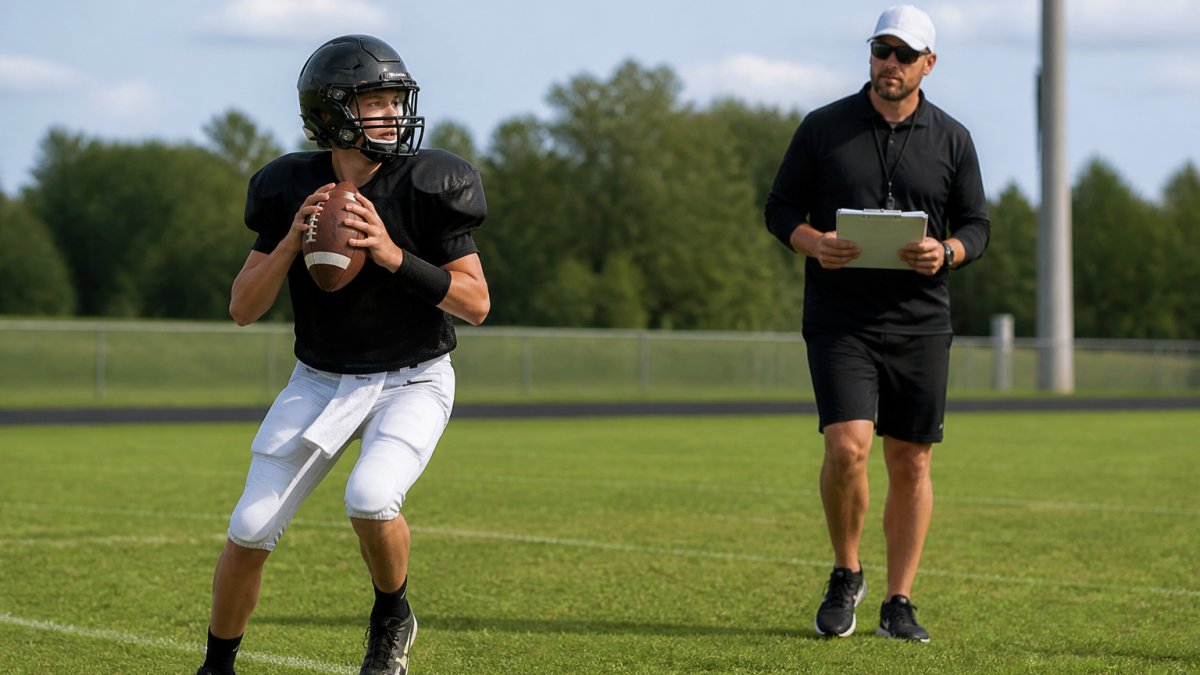
Build the week around a simple rotation:
| Session Focus | Time | What It Trains |
|---|---|---|
| Warm-up and footwork | 10 min | Balance, stance, quick feet |
| Throwing mechanics | 10 min | Grip, arm motion, follow-through |
| Accuracy work | 15 min | Target throwing, release point |
| Decision-making | 10 min | Reads, progressions, pressure |
Three rules keep the plan honest:
- Same order every session. Routine builds muscle memory.
- Short reps, full focus. Ten crisp throws beat thirty sloppy ones.
- End on a win. Finish with a drill the athlete does well.
Adjust volume by age. Players ages 7-10 should throw far less per session than a 14-year-old. Watch for tired arms and shut it down early.
Quarterback Warm-Up Drills: Start Every Session Right
Quarterback warm-up drills prepare the joints and muscles for throwing, and they double as a footwork refresher. Ten minutes is plenty.
Run this sequence in order:
- Jog and skip, 2 minutes. Loosen the legs.
- Arm circles, 30 seconds each direction. Small to large.
- Band or towel pulls, 1 minute. Works the shoulder and upper back.
- High knees and butt kicks, 1 minute each. Quick feet.
- Body-weight squats, 10 reps. Wakes up the hips and knees.
- Light toss, 20 throws at 10 yards. Start short, build distance.
The light toss matters most. Young quarterbacks want to launch deep balls immediately. That is how arms get sore. Start at 10 yards, then move back in 5-yard steps.
According to guidance from the American Academy of Pediatrics on youth sports safety, young athletes should warm up before intense activity and build throwing volume gradually. A proper warm-up is not optional at any age.
Footwork and Dropback Fundamentals
Footwork is the foundation of every throw a quarterback makes, and it is the first thing we drill in our youth quarterback fundamental drills 2026 plan.
Teach the dropback in three steps:
- Stance. Feet shoulder-width, knees bent, weight on the balls of the feet.
- The drop. Three steps for a quick throw, five for a deeper one. Push back, do not hop.
- The plant. Last step lands with the front foot pointed at the target.
The most common mistake we see is a quarterback who drops with his shoulders, not his feet. He leans back, loses balance, and throws off his back foot.
Drill it with a backpedal ladder:
- Set four cones in a line, 2 yards apart.
- Backpedal through the cones, then plant and throw to a partner.
- Do 8 reps, rest, then repeat.
Add pocket movement once the basic drop is clean. Have the coach stand in the throwing lane and hold a pad. The quarterback slides left or right, resets his feet, and throws.
Quarterback Registration (Required) →
Do not let young quarterbacks practice deep dropbacks on hard surfaces. Concrete and gym floors punish the knees and ankles on repeated plant steps. Save the full-speed work for grass or turf.
Throwing Mechanics and Release Point
Throwing mechanics are the sequence of movements that transfer power from the ground through the hips, torso, and arm to the ball.
Teach the chain in this order:
- Grip: Fingers spread across the laces, index finger near the tip of the ball.
- Stance and step: Front foot points at the target, weight transfers forward.
- Hip movement: Hips rotate open before the arm comes through.
- Arm motion: Elbow leads, hand finishes across the body.
- Follow-through: Throwing hand ends near the opposite hip.
The release point should sit just in front of and slightly above the ear. A quarterback who releases behind his head loses accuracy and power.
For more on how we teach this progression to players at every age, see our youth football development resources guidance on building throwing skills safely.
Quarterback Accuracy Drills That Build Precision
Quarterback accuracy drills train the body to repeat the same throw, not to aim harder.
Run these three drills in rotation:
1. Spot throw. Place a cone or net at 10 yards. The quarterback throws 10 balls at the same target. Count completions. Track the number each week.
2. Route-based throwing. Have a receiver run a comeback route, corner route, or over route. The quarterback throws to the break, not the receiver’s body. This teaches timing.
3. Opposite-direction movement. The quarterback rolls right, then throws back across his body to a target on the left. Start slow.
Track results in a simple log:
- Date
- Drill
- Throws attempted
- Throws on target
Progress shows up in the numbers. A player who hits 4 of 10 in week one and 7 of 10 by week four can see the work paying off.
Film one set of throws from the side every two weeks. Young quarterbacks cannot feel their own release point, but they can see it on video in about ten seconds.
Quarterback Decision-Making Drills for Game Day
Quarterback decision-making drills teach a young passer to read the defense, work through his progressions, and pick the open receiver before the rush arrives. This is the mental side of the position, and it is where games are won. Most visible material stops at mechanics. This section adds the pressure progression and tracking that transfer to Friday night.
Start with a simple read progression:
- Pre-snap: Count the safeties. One high or two high changes everything.
- First read: The primary receiver on the called route.
- Second read: The backside dig or check-down.
- Scramble rule: If nothing is open, run.
Stage 1: Walkthrough (No Football)
Set up three cones as receivers and walk the quarterback through the progression out loud. Have him name the open receiver before he moves. This builds the habit of reading before reacting. Do 10 reps per session until he can name the correct receiver without hesitation.
Stage 2: Static Reps
Add a football and a stationary defender. The quarterback takes the snap, reads the cones, and throws to the open receiver. The defender does not move yet. This isolates the read from the pressure. Track how many correct reads he makes out of 10.
Stage 3: Live Defender
A coach or parent plays the role of a defender and moves after the snap. The quarterback must find the open receiver and throw within three seconds. Add a timer to build urgency. Start with one defender, then add a second once the first read is clean.
Stage 4: Moving Pocket
Have the defender push the pocket from one side. The quarterback slides away from pressure, resets his feet, and throws to the open receiver. This combines footwork, reads, and accuracy under duress. It is the closest drill to game conditions.
Measuring Progress
Use a simple decision log:
- Date
- Drill stage
- Reads attempted
- Correct reads
- Time to throw (seconds)
A common pattern is a player who makes 4 of 10 correct reads in week one and 8 of 10 by week four. Time to throw often drops from 4 seconds to under 3. Progress shows up in the numbers, not in how the drill feels.
Film one set of decision reps from behind the quarterback every two weeks. He cannot feel his own hesitation, but he can see it on video in about ten seconds.
At QB Factory, this classroom-style mental work is a core part of our training formula. We put players in high-pressure scenarios on the field and in film sessions, so Friday night feels familiar instead of overwhelming. Our coaching staff includes former D1 quarterbacks and championship-level coaches, and we have helped develop over 300 full scholarship players. If you want to see how this approach fits your athlete, you can Apply today! to join a program built around these fundamentals.
Frequently Asked Questions
What are the basic drills every youth quarterback should practice?
Start with warm-up drills like high knees and arm circles, then move to footwork (dropbacks, backpedals, pocket movement), throwing mechanics (grip, release point, follow-through), accuracy drills (spot throws, target practice), and decision-making drills (read progressions, route recognition). A balanced youth quarterback practice plan includes all these elements, with repetition and proper form as the priority. Aim for 3-4 sessions per week, adjusting intensity based on age and skill level.
How can a young quarterback improve footwork?
Focus on dropback footwork, backpedals, and hip movement drills. Use a ladder or cones to practice quick feet, and always emphasize balance and weight transfer. Quarterback warm-up drills like high knees and lateral shuffles prepare the body for more complex movements. Consistency is key: 10-15 minutes of footwork drills daily can yield noticeable improvement in a few weeks. For age-specific progressions, younger players (7-10) should master basic dropbacks, while older athletes (11-14) can add rolling out and throwing on the move.
How often should a youth quarterback practice throwing?
Young quarterbacks should throw 3-4 times per week, with at least one day of rest to avoid overuse injuries. Each session should include a proper warm-up, accuracy drills, and decision-making drills. Limit high-intensity throws to 30-40 per session for ages 7-10, and 50-60 for ages 11-14. Always monitor for fatigue and focus on quality over quantity. A structured youth quarterback practice plan balances throwing with footwork and mental preparation.
What drills help a quarterback make quicker decisions?
Quarterback decision-making drills simulate game situations: read progressions (high-low, smash), route recognition (comeback, corner, over), and pocket movement under pressure. Use drills like “spot throw” where the QB must identify the open receiver based on a coach’s signal. Repetition builds mental speed. Incorporate film study and classroom sessions to reinforce reads. For youth athletes, start with simple two-receiver reads and progress to full-field progressions as they mature.