


Last Updated: October 25, 2026
Quick Summary
Youth football drills for beginners build the foundational skills of footwork, hand placement, body positioning, and reaction time that everything else depends on. These drills teach young athletes proper technique through structured, progressive exercises that grow with them as they improve.
- A complete beginner session lasts 60 minutes and includes warm-up, three skill blocks, conditioning, and cool-down phases.
- Ideal group size is 6-12 players per coach with a minimum 40 by 20 yard flat field and one CPR-trained adult present.
- Start all drills at 50% speed and increase intensity only when players maintain proper form through all repetitions.
- Grip fundamentals require fingers on laces, thumb underneath, with pinky and ring finger closer to the back.
- Common mistakes like flat-footed stance, eyes down, and rushing technique are correctable through consistent coaching and repetition.
Table of Contents
- Why Youth Football Drills for Beginners Matter
- What You’ll Need Before Your First Practice
- Youth Football Practice Plan for Beginners: A Complete Session Structure
- Football Drills for 9-Year-Olds: Foundation Footwork and Coordination
- Youth Football Agility Drills: Change of Direction and Speed
- Beginner Football Passing Drills: From Grip to Accuracy
- Common Mistakes Young Players Make and How to Correct Them
- Start Your Youth Football Training Today
- Frequently Asked Questions
Why Youth Football Drills for Beginners Matter
Young football players need a solid foundation.
Youth football drills for beginners build the skills everything else depends on: footwork, hand placement, body positioning, and reaction time. Without these basics, players struggle to learn advanced plays.
Starting young also builds confidence. A 9-year-old who executes a simple drill correctly feels ready for the next challenge, and that carries into games.
The real mistake most programs make is rushing past fundamentals. They add complexity too fast, players get frustrated, and they stop improving.
What You’ll Need Before Your First Practice
Before starting any youth football drills for beginners, gather the right equipment and set up a safe space.
Essential equipment:
- Footballs (size appropriate for age, youth size for ages 7-12)
- Cones (6-8 cones minimum for marking drill areas)
- Agility ladder or tape to create ladder patterns
- Flat, open grass field or turf area
- Water bottles and hydration station
- First aid kit on sideline
Space requirements:
- Minimum 40 yards by 20 yards, flat and free of obstacles
- Clear sight lines for coaching and spotting
- Shade or covered area for water breaks
Group size:
- Ideal: 6-12 players per coach
- Minimum: One adult supervising at all times
- Ratio ensures proper technique correction and safety
Safety basics before every session:
- Check equipment for damage or wear
- Ensure all players have water access
- Start with a 5-10 minute warm-up
- Have a CPR-trained coach or trainer present
- Establish clear drill-area boundaries
football training camps technical mechanics and mental prep(page:4) can help you understand structured training environments and how to set up effective sessions with professional guidance.
Youth Football Practice Plan for Beginners: A Complete Session Structure
A well-structured youth football practice plan for beginners keeps young players engaged. Here’s a complete 60-minute session for 6-12 players and one coach, using the drills detailed later.
Total session time: 60 minutes
Warm-up (10 minutes):
- Light jog around the field (2 minutes)
- Dynamic stretches: leg swings, arm circles, walking lunges (3 minutes)
- Movement drills: high knees, butt kicks, lateral shuffles (5 minutes)
- Coaching cue: “Stay on the balls of your feet, keep your head up.”
Skill Block 1: Footwork and Coordination (15 minutes):
- Cone Weave Drill (5 minutes): 3 sets of 4 reps, 30 seconds rest
- Ladder Footwork Drill (10 minutes): 2 sets of 4 passes through the ladder, focusing on quick feet and proper arm action
- Progression: Start with forward movement only; add lateral and backward movement as players master the pattern.
- Coaching cue: “Eyes up, feet quick, shoulders square.”
Skill Block 2: Agility and Change of Direction (15 minutes):
- T-Drill (7 minutes): 3 sets of 2 reps, 45 seconds rest
- 5-10-5 Shuttle (8 minutes): 3 sets of 2 reps, 45 seconds rest
- Progression: Begin at 50% speed, increase to 75% when form is consistent.
- Coaching cue: “Plant your outside foot, drop your hips, explode out.”
Skill Block 3: Passing and Catching (10 minutes):
- Stationary Grip Drill (2 minutes): 5 repetitions of 30-second holds
- Short Toss Drill (4 minutes): 10 throws each way, 1-minute rest, repeat 2 sets
- Target Drill (4 minutes): 3 sets of 5 throws at 15 yards
- Progression: Start with underhand tosses, move to sidearm, then overhand.
- Coaching cue: “Fingers on laces, follow through to your target.”
Conditioning (5 minutes):
- Short sprints (10 yards) with walk-back recovery: 6 reps
- Focus: Proper form over speed; keep intensity moderate.
Cool-down (5 minutes):
- Walk around the field (2 minutes)
- Static stretching: hamstrings, quadriceps, calves (3 minutes)
- Water break and coach feedback: highlight one thing each player did well.
Sample beginner session structure:
| Phase | Activity | Duration | Focus |
|---|---|---|---|
| Warm-up | Dynamic stretching & light movement | 10 minutes | Prepare body, increase heart rate |
| Skill Block 1 | Cone Weave & Ladder Drills | 15 minutes | Foundation footwork and coordination |
| Skill Block 2 | T-Drill & 5-10-5 Shuttle | 15 minutes | Agility and change of direction |
| Skill Block 3 | Grip, Toss, & Target Drills | 10 minutes | Passing and catching fundamentals |
| Conditioning | Short sprints with recovery | 5 minutes | Build fitness, maintain form |
| Cool-down | Walk and static stretch | 5 minutes | Recovery and feedback |
This structure keeps young players active without overloading them. Each phase builds on the last, and progressions let you adjust difficulty.
Football Drills for 9-Year-Olds: Foundation Footwork and Coordination
Nine-year-olds need drills that build coordination and body awareness, with purposeful feet and balanced body position.
The Cone Weave Drill:
Set up five cones in a straight line, 5 yards apart. Players run forward, weaving around each cone with shoulders square to the line of scrimmage. This teaches hip mobility and directional change.
Perform 3 sets of 4 repetitions. Rest 30 seconds between sets.
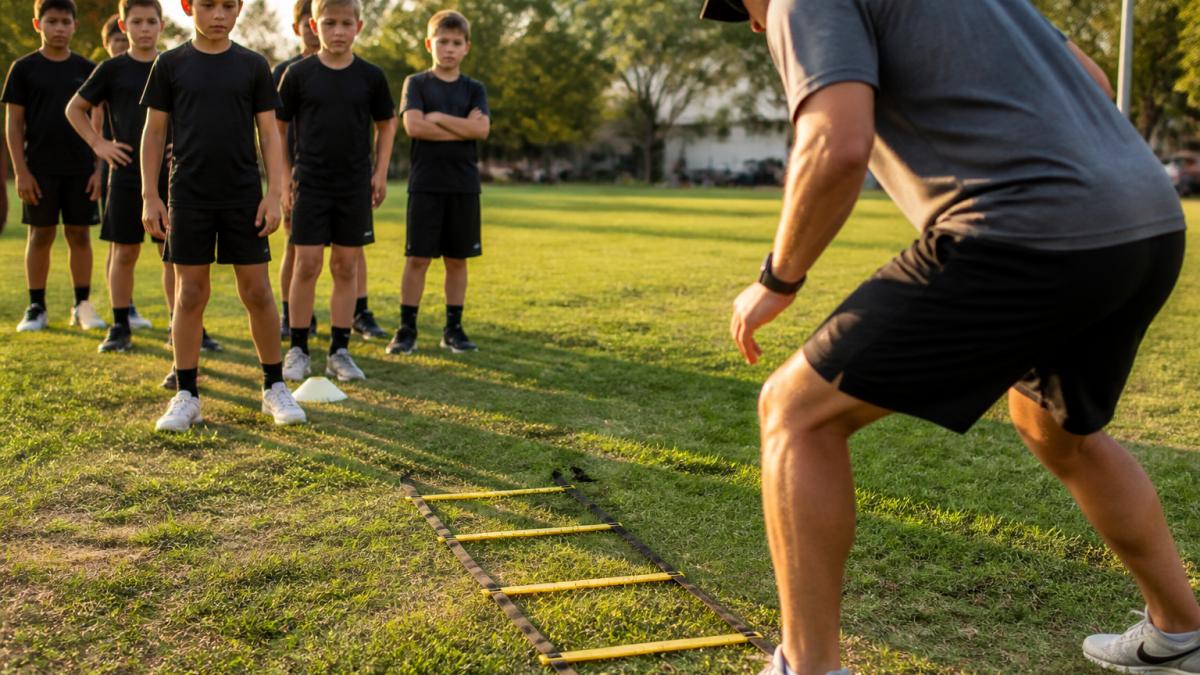
The Ladder Footwork Drill:
Lay an agility ladder on the ground.
Perform 2 sets of 4 passes through the ladder. This builds foot speed and coordination.
The Balance Beam Walk:
Use cones or tape to create a straight path.
Perform 2 sets of 10 yards forward and backward.
Youth Football Agility Drills: Change of Direction and Speed
Agility separates average players from good ones. Young athletes need to change direction quickly without losing balance. These drills include setup, cues, common mistakes, and beginner variations.
Quarterback Registration (Required) →
The T-Drill:
- Setup: Mark a T shape with cones. The stem is 10 yards long. The crossbar is 5 yards on each side of center.
- Execution: Players sprint forward to the top of the T, shuffle left to the end, shuffle right past center to the other end, then shuffle back to center and sprint backward to the start.
- Sets/Reps: 3 sets of 2 repetitions. Rest 45 seconds between sets.
- Coaching cues: “Stay low, pump your arms, don’t cross your feet during the shuffle.”
- Common mistake: Leaning too far forward during the shuffle, which reduces balance. Cue players to keep their chest up.
- Variation for beginners: Reduce the stem to 7 yards and crossbar to 3 yards each side. Walk through the pattern first, then increase speed.
The 5-10-5 Shuttle:
- Setup: Mark three lines: a center line and two lines 5 yards on each side.
- Execution: Players start at center, sprint 5 yards to one line and back to center, then sprint 10 yards to the other line and back. This mimics sideline pursuit and gap pursuit movements in actual games.
- Sets/Reps: 3 sets of 2 repetitions. Rest 45 seconds between sets.
- Coaching cues: “Plant your outside foot, drop your hips, explode out of the turn.”
- Common mistake: Rounding the turn instead of planting and cutting. Use a cone to mark the turn point and have players touch it with their hand.
- Variation for beginners: Start with 3-yard and 6-yard distances. Focus on proper footwork before adding speed.
The Lateral Cone Drill:
- Setup: Place three cones in a line, 3 yards apart.
- Execution: Players face one direction and move laterally, touching each cone in sequence. This teaches lateral agility without forward momentum.
- Sets/Reps: 3 sets of 4 passes. Rest 30 seconds between sets.
- Coaching cues: “Stay upright, quick feet, touch each cone with your outside hand.”
- Common mistake: Crossing feet or hopping. Cue players to use a shuffle step.
- Variation for beginners: Reduce distance to 2 yards between cones and allow walking speed first.
For neurodiverse learners or players who need extra processing time, demonstrate each drill slowly, use colored cones to mark direction changes, and pair players up so they can watch a partner first.
These youth football agility drills for beginners teach that speed comes from proper footwork and body position, not just effort. Start with the beginner variations and progress only when players hold form through all sets.
Beginner Football Passing Drills: From Grip to Accuracy
Passing starts with grip, which gives young athletes control and consistency.
Grip fundamentals:
- Fingers on laces, not the palm
- Thumb underneath, supporting the ball
- Pinky and ring finger closer to the back
- Index and middle finger spread on the laces
The Stationary Grip Drill:
Players stand in place and practice grip only, no throwing.
The Short Toss Drill:
Partners stand 10 feet apart and throw back and forth, focusing on grip and release. Start with underhand tosses, progress to sidearm, then add overhand throws.
Perform 10 throws each way. Rest 1 minute. Repeat 3 sets.
The Target Drill:
Set up a target (cone, hula hoop, or marked zone) at 15 yards.
Perform 3 sets of 5 throws at each distance.
Beginner football passing drills should emphasize accuracy over distance. A young player who consistently hits a target from 15 yards will develop arm strength naturally over time.
Common Mistakes Young Players Make and How to Correct Them
Most young players make the same mistakes. Catching them early prevents bad habits.
Fix: Teach a ready position. Feet shoulder-width apart. Knees slightly bent.
Fix: Use verbal cues.
Fix: Slow down the drill. Have players move at 50% speed first.
Mistake 4: Inconsistent effort
Some players coast through drills without pushing themselves.
Fix: Set clear standards. Every rep counts. Use team competitions.
Fix: Check grip before every passing drill. Have players practice grip without throwing.
These mistakes are correctable.
Start Your Youth Football Training Today
Young football players who master fundamentals early learn new skills faster, stay healthier, and play with more confidence.
The youth football drills for beginners covered here build the foundation every young athlete needs.
Consistency matters more than intensity. Three focused 45-minute sessions per week beats one long, unfocused session. Young players improve when they repeat proper technique in a structured environment.
QB Factory has spent years refining these drills with young athletes of all abilities. If you’re ready to take your young athlete’s training to the next level, Apply today! to learn how our programs can help your player master these fundamentals and progress faster.
football training for 10 year olds 2026 guide(page:2) offers age-specific training guidance for your young athlete. And youth football receiver drill progression 2026(page:3) shows how to progress these fundamentals into position-specific work.
The foundation you build now shapes everything that comes later.
Building a strong foundation in youth football takes time, structure, and expert guidance.
Frequently Asked Questions
What are some good drills for 9-year-old football players?
At age 9, focus on drills that build coordination and ball familiarity without intense contact. Cone drills, ladder footwork exercises, and catch-and-carry progressions work best. Start with basic agility work, weaving through cones and shuttle runs, then add ball handling once footwork feels natural. Keep repetitions short (5-10 reps per drill) and rotate between individual and partner drills to maintain engagement and prevent fatigue.
How do you teach a beginner to throw a football?
Start with grip fundamentals: fingers on the laces near the middle, thumb underneath, and wrist relaxed. Have beginners practice the throwing motion without the ball first, arm slot, elbow position, and follow-through. Then use a lighter ball or foam football to reduce hand strain. Progress from short distances (5-10 feet) with stationary targets before adding movement or live receivers. Emphasize proper footwork and release consistency over distance.
How long should a youth football practice last?
Beginner youth football practice should run 60-90 minutes total. Allocate 10-15 minutes for warm-up and dynamic stretching, 35-50 minutes for skill drills (footwork, agility, passing, catching), 10-15 minutes for team concepts or scrimmage, and 5-10 minutes for cool-down. Younger players (ages 7-10) benefit from shorter, more frequent sessions, while older beginners (11-14) can handle the full 90-minute structure.
What equipment do kids need for beginner football drills?
Essential equipment includes cones (for agility drills), a football, and a flat practice space. Additional items that help: agility ladder, foam balls for catching drills, blocking dummies, and a whistle for the coach. Proper footwear (cleats or turf shoes) prevents slipping. Optional but useful: resistance bands for warm-ups, a video camera to review footwork, and a hydration station. Most drills can start with just cones and a ball.