
Last Updated: October 24, 2026
Quick Summary
Specialized quarterback training camps accelerate skill development by combining intensive mechanics coaching, tactical football intelligence, and mental preparation in ways that traditional team practice cannot match. Unlike high school practice that manages multiple positions, quarterback training camps focus entirely on quarterback mastery with individualized instruction and frame-by-frame video analysis.
- Coach-to-player ratio of 1:8-10 allows meaningful feedback on every rep and is the biggest predictor of improvement.
- Throwing mechanics break into five core components: grip, stance, arm path, release, and follow-through.
- Decision-making drills teach quarterbacks to recognize defensive formations and execute pre-snap and post-snap reads under pressure.
- High school freshmen and sophomores represent the ideal window to build a strong mechanical foundation before college evaluation.
- Responsible camps monitor throwing volume, rest breaks, and fatigue to prevent overuse injury and prioritize long-term health.
Table of Contents
- What Specialized Quarterback Training Camps Deliver
- Mastering Quarterback Throwing Mechanics
- Developing Footwork Through Quarterback Footwork Drills
- Building Football IQ With Quarterback Decision-Making Drills
- Mental Preparation and Leadership Development
- How to Choose a Quarterback Camp That Fits Your Goals
- Starting Your Quarterback Development Journey
- Frequently Asked Questions
What Specialized Quarterback Training Camps Deliver
Specialized quarterback training camps are designed to accelerate skill development in ways that traditional high school practice cannot match. These programs combine intensive mechanics coaching, tactical football intelligence, and mental preparation to build complete quarterbacks ready for college-level competition.
The difference between a quarterback training camp and standard team practice comes down to focus and expertise. At a training camp, every drill targets a specific weakness. Every rep builds toward measurable improvement. Coaches analyze footwork frame-by-frame, correct throwing mechanics in real time, and teach decision-making through game-film study and scenario-based drills.
Most quarterbacks plateau because they repeat the same mistakes week after week. A high school coach manages 40 players across multiple positions. A specialized quarterback training program has one job: develop elite quarterbacks. That singular focus changes everything.
Mastering Quarterback Throwing Mechanics
Proper throwing mechanics are the foundation of consistent accuracy and arm strength. Without sound mechanics, a quarterback limits their ceiling, no amount of practice will overcome a flawed release or improper footwork in the pocket.
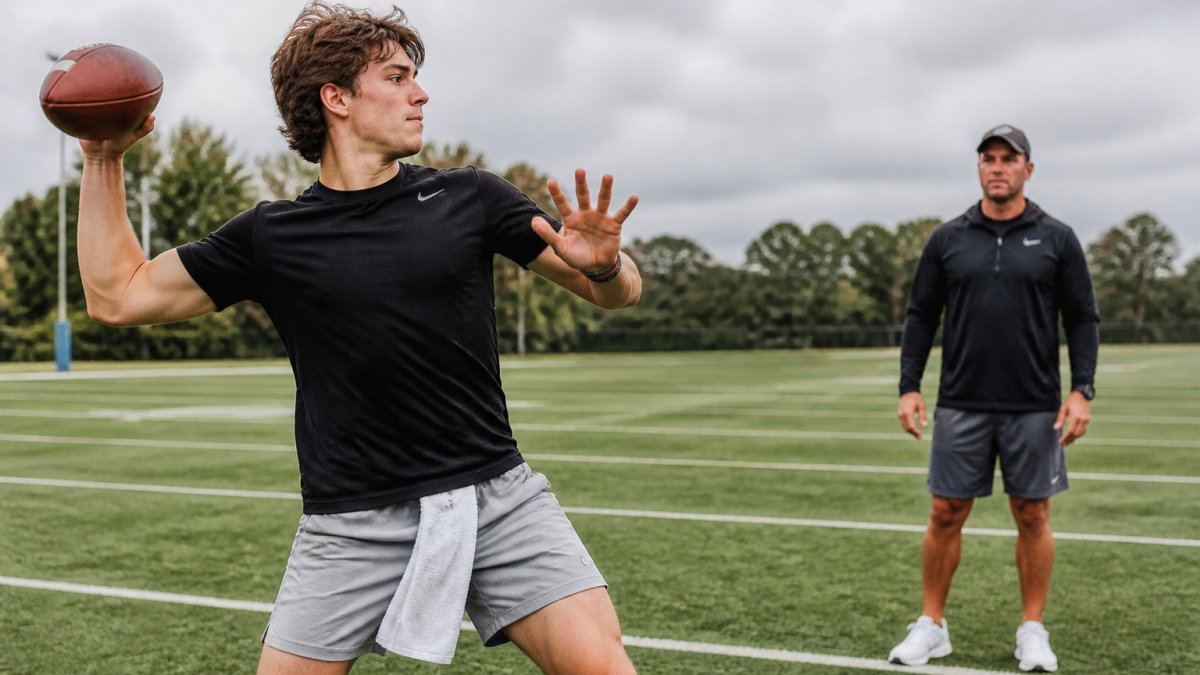
Throwing mechanics break into five core components: grip, stance, arm path, release, and follow-through. For a comprehensive deep dive into these techniques and how to master them, explore our detailed QB mechanics training guide.
At QB Factory, we teach quarterbacks to understand why mechanics matter, not just how to execute them. A quarterback who understands that a high elbow prevents ball placement will self-correct.
The release point is where most quarterbacks develop inconsistency. Small variations in when the ball leaves the hand create large variations in accuracy downfield.
Arm strength develops through proper mechanics and intentional progression. Throwing harder does not mean throwing with more effort, it means throwing with better efficiency.
Developing Footwork Through Quarterback Footwork Drills
Footwork is the engine of quarterback mechanics. Poor footwork creates timing problems with receivers, forces off-platform throws, and limits accuracy. Elite footwork allows a quarterback to create time, extend plays, and maintain accuracy under pressure.
Quarterback footwork drills isolate the lower body and build muscle memory for specific situations. A three-step drop should look identical every time. A five-step drop should feel automatic.
The most effective footwork drills use repetition with immediate feedback. A quarterback takes 50 three-step drops in a single session, with a coach correcting each one. Over time, the footwork becomes automatic, the quarterback no longer thinks about it, just executes it.
Specialized quarterback training programs structure footwork drills to match game situations. Drills progress from stationary (feet set, no movement) to movement-based (rolling out, scrambling) to pressure situations (defensive end closing, pocket collapsing). This progression builds confidence and transfers directly to game performance.
Our detailed footwork training guide covers specific drill progressions that quarterbacks can use to develop footwork consistency and game awareness. The guide connects footwork development to decision-making, showing how proper footwork creates time for reads to develop.
Building Football IQ With Quarterback Decision-Making Drills
Football IQ separates average quarterbacks from elite ones. A quarterback with average arm strength but exceptional decision-making will outperform a quarterback with elite arm strength but poor reads.
Decision-making drills teach quarterbacks to recognize defensive formations, understand coverage concepts, and make pre-snap and post-snap reads. These drills happen in the classroom as much as on the field. Film study, whiteboard sessions, and scenario-based walkthroughs build the mental framework that translates to game performance.
Pre-snap reads start before the ball is snapped. A quarterback should identify the safeties, count the box, and recognize coverage tendencies. This information determines which receivers to target and which option to take.
Post-snap reads follow a progression. The quarterback throws to their first read. If that receiver is covered, they move to the second read. If the second read is covered, they find the third read or take off.
Specialized quarterback training camps teach decision-making through specific mental preparation drills that simulate game pressure. Quarterbacks study film, learn coverage recognition, and practice reads against live or simulated defenses. This classroom-style instruction combined with on-field execution builds the football intelligence that college coaches recruit.
Mental Preparation and Leadership Development
The mental game separates quarterbacks who perform in high-pressure situations from those who fold. A quarterback with average mechanics but unshakeable confidence will outperform a mechanically superior quarterback who doubts themselves.
Mental preparation includes confidence-building, pressure simulation, and leadership development. Confidence comes from mastery, a quarterback who has thrown a thousand passes in practice walks into a Friday night game knowing they’ve prepared more than their opponent. Pressure simulation means practicing in conditions that mimic games: loud environments, time pressure, consequences for mistakes.
Leadership development teaches quarterbacks to communicate with receivers, manage the offense, and command respect in the huddle. A quarterback is the offense’s field general. Their communication style, body language, and decision-making set the tone for the entire unit.
Most quarterbacks never receive formal leadership coaching. They’re expected to “figure it out.” Specialized quarterback training camps teach leadership as a skill, not an afterthought. Quarterbacks learn how to give feedback, handle adversity, and motivate teammates.
How to Choose a Quarterback Camp That Fits Your Goals
Not all quarterback training camps deliver the same results.
1. Coaching experience and credentials. Ask about the staff’s playing and coaching background. Former college quarterbacks and championship-level coaches bring a different level of insight than high school assistants.
Quarterback Registration (Required) →
2. Coach-to-player ratio. Individual attention is the single biggest predictor of improvement. A ratio of 1 coach to 8-10 players allows for meaningful feedback on every rep.
3. Curriculum and measurable outcomes. A strong camp has a written curriculum that progresses from fundamentals to advanced concepts.
4. Feedback and video analysis. Does the camp provide video review? Do coaches give written evaluations?
5. Safety and workload management. Quarterback training involves repetitive throwing, which carries overuse risk.
6. Fit for age and skill level. A camp designed for middle schoolers will not challenge a varsity starter.
7. Alumni outcomes and references. Ask specific questions: How many players has the camp sent to college programs? Can they provide references from parents or athletes?
8. Try before you commit. Many camps offer a single-day clinic or evaluation session.
QB Factory meets these criteria: our coaching staff includes former D1 players and championship-level coaches, and we provide video analysis and written feedback. Sign up for quarterback training to get started with a program tailored to your goals. We also prioritize workload management and age-appropriate training. Apply today! to experience the difference.
Use this checklist to evaluate quarterback camps across the key factors that predict success.
| Evaluation Factor | What to Look For | Why It Matters |
|---|---|---|
| Coaching credentials | Former D1 players and championship-level coaches | Experience developing quarterbacks at your athlete’s level |
| Coach-to-player ratio | 1 coach per 8-10 players | Individual attention is the biggest predictor of improvement |
| Curriculum | Written progression with measurable metrics | Tracks release time, accuracy under pressure, decision-making |
| Video analysis | Frame-by-frame review and written feedback | Identifies and corrects micro-variations in mechanics |
| Workload management | Clear throwing volume limits and rest protocols | Prevents overuse injury and prioritizes long-term health |
| Age-appropriate training | Separate tracks by skill level and age | Ensures proper challenge for your athlete’s development stage |
| Alumni outcomes | Verifiable college placements and references | Demonstrates track record beyond cherry-picked success stories |
| Trial session | Single-day clinic to assess coaching style | Confirms fit before full commitment |
Starting Your Quarterback Development Journey
The best time to begin specialized quarterback training depends on age, current skill level, and recruitment timeline.
Youth quarterbacks (ages 7-10): At this stage, the focus should be on broad athletic development and fundamental movement skills.
Middle school (ages 11-13): This is when athletes begin to show genuine interest and aptitude for the position.
High school freshmen and sophomores: This is the ideal window to build a strong mechanical foundation.
High school juniors and seniors: The focus shifts to refinement and recruitment preparation. Training should target specific weaknesses, improve consistency under pressure, and prepare for the mental demands of college football.
Signs your athlete is ready for specialized training:
- They consistently ask for extra practice and show intrinsic motivation.
- They have mastered basic throwing mechanics and footwork.
- They are physically mature enough to handle repetitive throwing without undue strain.
- They understand the commitment required and are willing to prioritize training.
Avoiding excessive specialization: Early specialization in a single sport is linked to higher injury rates and burnout.
Safety and workload: Throwing volume should be gradually increased, with at least one full rest day per week. Warm-up and cool-down routines are non-negotiable.
Learn more about when to begin specialized training and how to determine if your quarterback is ready for intensive development.
Specialized quarterback training camps accelerate development because they focus entirely on quarterback mastery.
Frequently Asked Questions
What age should you start quarterback training?
Quarterback training fundamentals can begin as early as age 7-8, focusing on basic footwork, grip, and throwing motion. Specialized quarterback training camps typically serve athletes from middle school through high school, with programs designed for different developmental stages. Younger athletes benefit from foundational mechanics, while high school players focus on advanced decision-making and game preparation. The key is matching training intensity to the athlete’s physical maturity and competitive level.
How do quarterback camps improve footwork and throwing mechanics?
Specialized camps use repetitive quarterback footwork drills and individualized instruction to ingrain proper technique. Coaches break down the throwing motion into components: stance, footwork, arm angle, and release. Athletes practice these mechanics thousands of times under expert feedback, correcting bad habits before they become automatic. Video analysis and one-on-one coaching ensure each athlete understands why technique matters and how it translates to accuracy and arm strength on game day.
How can quarterbacks practice reading pass defenses?
Quarterbacks learn pre-snap and post-snap reads through classroom instruction combined with on-field drills. Coaches teach athletes to identify defensive formations, recognize coverage types, and anticipate where defenders will be. Specialized quarterback decision-making drills simulate game scenarios where athletes must make quick reads under pressure. Film study and mental preparation exercises help quarterbacks develop game awareness and confidence in their decision-making during live play.
Will specialized quarterback training actually improve my son’s game if he’s already doing well at his high school?
High school coaching focuses on team strategy and game management. Specialized camps provide individualized skill development that high school programs cannot match due to time and roster constraints. Athletes who are already performing well often reach a plateau without specialized feedback on mechanics and decision-making. Elite quarterbacks use camps to refine technique, develop leadership skills, and gain the competitive edge needed for college recruitment and athletic scholarships.
What skills do quarterbacks learn at training camps?
Quarterbacks develop throwing mechanics, footwork precision, arm strength, and accuracy. Beyond physical skills, they learn to read defenses, make quick decisions under pressure, and develop the confidence and leadership qualities necessary for the position. Camps also teach mental preparation techniques for high-pressure game situations, helping athletes manage performance anxiety and maintain focus during Friday night games and critical moments.
How do I know if a quarterback camp’s mental preparation actually translates to game day?
Look for camps that combine classroom-style teaching with on-field application. Effective programs teach athletes specific mental techniques (visualization, pre-snap routines, pressure management) and then practice those techniques in simulated game scenarios. Coaches who have played at high levels (D1, professional) can share real experience about managing pressure. Ask about progress tracking and feedback mechanisms that measure improvement in decision-making and composure during games, not just drills.
What should I look for when choosing a quarterback camp for my athlete?
Evaluate the coaching staff’s background (former D1 players, championship-level coaches), the camp’s track record with athletes at your child’s level, and whether the program offers individualized instruction. Consider whether the camp teaches both mechanics and mental preparation, and whether it provides specific feedback on areas for improvement. Ask about program structure, duration, and whether training focuses on your athlete’s specific goals (college recruitment, fundamentals, or off-season development).