

Last Updated: October 22, 2026
Quick Summary
A youth football receiver drill progression builds elite receivers by starting with stance and footwork, progressing through route breaks and catching fundamentals, then advancing to game-speed drills. This structured approach works for ages 7 through high school and prevents bad habits while building muscle memory and confidence.
- Foundation phase focuses on receiver stance, release drills, and first-step explosiveness before any route work
- Receivers should catch 50-75 balls per practice, totaling 250-375 reps weekly for younger athletes
- Practice structure runs 60-75 minutes with warm-up, foundation work, footwork drills, route work, and cool-down
- Age-appropriate modifications matter: ages 7-10 focus on fundamentals, 11-13 add intermediate skills, high school emphasizes game simulation
- Track measurable progress through cone drill times, catching accuracy, and route sharpness ratings
Table of Contents
- Why Progressive Receiver Drill Progression Matters
- Foundation Phase: Stance, Start, and First-Step Quickness
- Wide Receiver Footwork Drills for Balance and Body Control
- Youth Receiver Route Running Drills and Route Technique
- Football Catching Drills for Kids: Hand Placement and Tracking
- Youth Football Practice Plan for Receivers: Structure and Progression
- Advanced Drills: Cone Patterns, Agility Squares, and Game Simulation
- Age-Appropriate Modifications and Measuring Progress
- Frequently Asked Questions
Why Progressive Receiver Drill Progression Matters
A receiver’s success on game day depends on mastering fundamentals in the right order. You can’t perfect route breaks without solid footwork. You can’t nail footwork without nailing your stance.
At QB Factory, we’ve developed over 300 full scholarship players. The difference between players who plateau and those who excel almost always comes down to how they trained early.
This guide walks you through a complete youth football receiver drill progression for 2026 that works for ages 7 through high school. We’ll show you the exact sequence, the coaching cues that matter, and how to structure your practice so athletes improve week to week.
Foundation Phase: Stance, Start, and First-Step Quickness
The foundation phase is non-negotiable. Everything else builds on it. A receiver with poor stance will never have true first-step quickness. A receiver without first-step quickness will never separate from defenders.
Receiver Stance and Starting Position
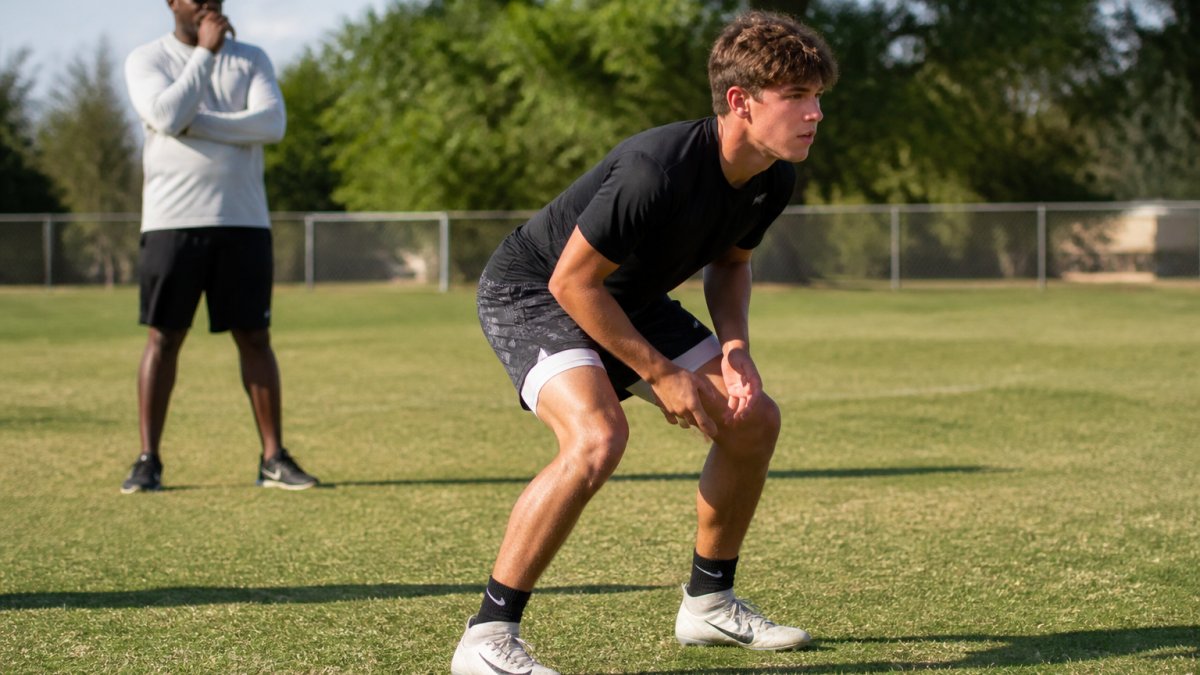
Your receiver stance determines everything that comes next. The feet should be shoulder-width apart. Knees bend slightly.
This isn’t casual standing. This is an athletic position. Think of a linebacker ready to move in any direction instantly.
Common mistake: players stand too upright. They look comfortable. That comfort is the problem. Comfort means they’re not ready to explode.
Coaching cue: “Stay on your toes. Ready to go.”
Release Drills and First-Step Explosiveness
Release drills teach receivers to fight through contact at the line and explode into their routes. Start with stationary releases before adding any movement.
Stationary Release Drill:
- Receiver stands in proper stance facing a coach or another player
- Coach places hands on receiver’s shoulders or chest
- Receiver drives feet hard and pushes through the contact
First-Step Explosion Drill:
- Receiver starts in stance
- Coach points in a direction (left, right, or straight)
- Receiver takes one explosive step in that direction
The first step separates elite receivers from average ones. Train it hard.
Wide Receiver Footwork Drills for Balance and Body Control
Footwork is where receivers truly learn to move like athletes. Sloppy footwork means sloppy routes. Sloppy routes mean incomplete passes.
Footwork and Balance Fundamentals
Balance drills teach receivers to stay controlled while moving at speed. Start slow. Perfect the movement. Then add speed.
Line Drill:
- Mark a straight line on the ground (tape, chalk, or grass)
- Receiver walks the line heel-to-toe, arms out for balance
- Progress to jogging the line
Ladder Drill:
- Use an agility ladder (or mark boxes with tape)
- Receiver moves through the ladder with quick feet
- Focus on staying low and balanced
Single-Leg Balance Drill:
- Receiver stands on one leg, other knee up
- Hold position for 10-15 seconds
- Switch legs
These drills build the ankle and leg strength that prevents injuries and improves cutting ability.
Agility and Change of Direction
Change of direction separates receivers from defenders. A defender can run straight.
45-Degree Cut Drill:
- Mark two lines on the ground at a 45-degree angle
- Receiver sprints along the first line
- Plants outside foot and cuts sharply at the angle
L-Drill:
- Receiver sprints 10 yards straight
- Plants and cuts 90 degrees
- Sprints 10 yards in the new direction
Plant foot technique matters. The plant foot should be firm and outside the body. Weight transfers to the outside leg.
Common mistake: receivers lean instead of plant. Leaning means they lose speed. Planting means they maintain momentum through the cut.
Youth Receiver Route Running Drills and Route Technique
Routes are patterns. Patterns are learned. The youth football receiver drill progression teaches routes in stages: stems first, then breaks, then full routes.
Route Break and Cutting Control
The route break is where receivers separate. A break is the moment the receiver plants and changes direction. A sharp break looks clean. A sloppy break looks like the receiver is jogging.
Stem and Break Drill:
- Receiver runs a stem (the straight part of a route) for 5-10 yards
- Coach points or calls a direction
- Receiver plants and breaks in that direction
5-Step Slant Drill:
- Receiver lines up at the numbers
- Takes 5 steps downfield
- Plants and breaks toward the center of the field
7-Step Comeback Drill:
- Receiver runs 7 steps downfield
- Plants and breaks back toward the line of scrimmage
- Simulates a comeback route
Route breaks separate receivers who get open from receivers who run open. Train the break until it’s automatic.
Football Catching Drills for Kids: Hand Placement and Tracking
A receiver who drops passes doesn’t get recruited. Catching is a skill. Skills are trained.
Catching Sequence and Hand-Eye Coordination
Hand placement matters. Receivers catch with their hands, not their body. Eyes track the ball from release to hands.
Catch Progression Drill:
- Start with receiver and coach 5 yards apart
- Coach tosses the ball softly underhand
- Receiver catches with hands only (not trapping against body)
Two-Hand Catch Drill:
- Receiver and coach 10 yards apart
- Coach throws at chest height
- Receiver catches with both hands, thumbs together for balls above the waist
One-Hand Catch Drill (advanced):
- Coach throws slightly away from the receiver’s body
- Receiver extends one arm and catches with one hand
- Focus on tracking the ball with eyes
Hand-eye coordination improves through repetition. Catch 50 balls a day and you’ll see improvement in a week.
Ball Tracking and Drop Prevention
Drops happen when receivers stop tracking the ball. The ball is in flight. The receiver’s job is to watch it all the way to the hands.
No-Look Catch Drill:
- Receiver starts looking away from the coach
- Coach calls the receiver’s name
- Receiver turns and finds the ball already in flight
Concentration Catch Drill:
- Coach throws passes slightly off-target (makeable but difficult)
- Receiver must focus hard to track and adjust
- Emphasis on hands, not body
Game-Speed Catch Drill:
Quarterback Registration (Required) →
- Coach throws passes while receiver is moving (running routes)
- Receiver catches while in motion
- Ball is thrown at different heights and distances
Drops usually mean the receiver stopped concentrating. Drills that demand concentration build the habit of tracking every ball.
Youth Football Practice Plan for Receivers: Structure and Progression
A practice plan without structure is just random drills. Structure builds progression. Progression builds improvement.
Weekly Practice Organization and Drill Repetition
A solid receiver practice runs 60-75 minutes. Here’s how to structure it:
Warm-Up (10 minutes):
- Light jog, 2 minutes
- Dynamic stretching, 3 minutes
- Footwork ladder drill, 5 minutes
Foundation Work (15-20 minutes):
- Stance and release drills, 10 minutes
- First-step explosion, 5-10 minutes
Footwork and Agility (15-20 minutes):
- Balance drills (line, ladder), 8-10 minutes
- Change of direction drills, 7-10 minutes
Route and Catching Work (20-25 minutes):
- Route breaks and stems, 10 minutes
- Catching drills, 10-15 minutes
Cool-Down (5 minutes):
- Light stretching
- Breathing and mental focus work
Repetition drives improvement. A receiver should catch 50-75 balls per practice. That’s 250-375 per week.
Warm-Up, Safety, and Workload Management
Young athletes get injured when they’re fatigued or unprepared. A proper warm-up prevents injuries. Smart workload management prevents burnout.
Warm-Up Essentials:
- Light cardiovascular work to increase heart rate
- Dynamic stretching (leg swings, arm circles, walking lunges)
- Sport-specific movements (footwork drills, light acceleration)
Workload Management:
- Monitor total reps per week (catching, footwork, route work)
- Young athletes (7-10 years) should cap at 150-200 total reps per week
- Older athletes (11-13 years) can handle 250-350 reps per week
Signs of Overtraining:
- Persistent fatigue
- Declining performance
- Increased errors or drops
Rest is part of training. Athletes improve during recovery, not during the work.
Advanced Drills: Cone Patterns, Agility Squares, and Game Simulation
Once receivers master foundations, advanced drills prepare them for game speed and decision-making.
Cone Drill Patterns and Three-Cone Progression
Cone drills combine footwork, agility, and route simulation in one rep.
Three-Cone Drill (Classic):
- Set three cones in an L-shape: 5 yards apart
- Receiver sprints to first cone, plants, cuts to second cone
- Plants again, cuts to third cone
M-Drill:
- Set five cones in an M pattern
- Receiver weaves through the cones with quick feet
- Emphasizes footwork and balance at speed
Figure-Eight Drill:
- Set two cones 10 yards apart
- Receiver runs a figure-eight pattern around both cones
- Focus on smooth cuts and balance
Cone drills teach receivers to move efficiently. They also provide measurable times that show improvement over weeks and months.
Agility Square, Figure-Eight, and Triangle Drills
These drills build multi-directional agility.
Agility Square Drill:
- Mark a square, 10 yards per side
- Receiver sprints forward, plants and cuts right, sprints forward, plants and cuts left, continues around the square
- One complete square = one rep
Triangle Drill:
- Mark a triangle with 10-yard sides
- Receiver sprints to each corner, plants, and cuts to the next corner
- 2-3 reps per direction
Figure-Eight Drill (Advanced):
- Set two cones 15 yards apart
- Receiver runs a tight figure-eight at speed
- Emphasizes quick feet and balance
These drills prepare receivers for the constant directional changes they face in games.
Age-Appropriate Modifications and Measuring Progress
Not every drill works for every age. Progression means matching difficulty to development level.
Drills for Ages 7-10, 11-13, and High School Athletes
Ages 7-10 (Fundamentals Focus):
- Stance and balance drills dominate
- Keep catching distances short (5-10 yards)
- Use lighter footballs if available
Ages 11-13 (Intermediate Development):
- Add route breaks and change of direction
- Increase catching distances to 15-20 yards
- Introduce cone drills at slower speeds
High School (Advanced Training):
- Full-speed route running and game simulation
- Catching at all distances and angles
- Competitive cone drills with timed benchmarks
Age matters. A 9-year-old isn’t ready for high school intensity. That doesn’t mean they don’t work hard. It means the work matches their development level.
Tracking Improvement and Coaching Cues
Progress is measurable. Track it.
Metrics to Track:
- Cone drill times (three-cone, M-drill)
- Catching accuracy (drops per 10 reps)
- Route sharpness (rated 1-5 by coach)
Coaching Cues That Work:
- “Stay on your toes” (stance)
- “Plant and explode” (route breaks)
- “Watch it in” (catching)
Record times and performance. Show athletes their progress. A receiver who sees themselves improving stays motivated.
The youth football receiver drill progression we’ve outlined builds elite receivers. It starts with stance. It progresses through footwork, routes, and catching.
At QB Factory, we’ve used a proven formula to develop over 300 full scholarship players.
Your receivers will improve fastest when they follow a structured progression with clear coaching cues, measurable benchmarks, and age-appropriate intensity. That’s how elite athletes are built. Apply today! to get started with a program designed for serious young athletes ready to dominate their position.
Frequently Asked Questions
What is a good progression for teaching young receivers to run routes?
Start with straight-line sprints and plant-and-cut basics, then progress to 90-degree cuts, 45-degree angles, and finally breaking out of cuts at full speed. Introduce route trees gradually: slants and quick outs first, then intermediate routes like digs and corners, and finally advanced routes with multiple breaks. Each phase should emphasize footwork precision and body control before adding speed and game-like pressure.
How can young receivers improve their footwork and releases?
Use repetitive stance drills to build muscle memory, focusing on alignment and athletic position. Practice release drills where receivers work against imaginary or light resistance to develop explosive first steps. Incorporate balance and footwork drills like the agility square and figure-eight to improve lateral movement and weight transfer. Combine these with route-running drills that demand controlled footwork at varying speeds to develop consistency.
How long should a youth football receiver practice each drill?
Most drills work best in 5-10 minute blocks with adequate rest between repetitions. For younger athletes (7-10), keep sessions under 30 minutes total; for ages 11-13, 45-60 minutes is appropriate; high school athletes can handle 60-90 minute focused sessions. Prioritize quality repetitions over volume, five perfect reps of a route break beat twenty sloppy ones. Rotate drills every 10 minutes to maintain focus and reduce injury risk from repetitive motion.
How can coaches make receiver drills age-appropriate and safe?
Younger athletes should focus on fundamental stance, footwork, and catching without heavy contact or advanced cutting. Use proper warm-ups emphasizing dynamic stretching and movement prep before every session. Limit high-intensity cutting drills to 2-3 times per week for youth athletes and allow recovery days between intense workouts. Teach proper landing mechanics and body control to prevent knee and ankle injuries, and scale drill complexity to match the athlete’s cognitive and physical development stage.