


Table of Contents
- Route Tree Mastery: The Foundation of Advanced Route Running
- Wide Receiver Release Techniques: Beating Press Coverage
- Eye Manipulation and Head Fakes: Creating Use
- Stem and Break Point Mechanics for Route Precision
- Drills for Wide Receiver Separation and Explosive Acceleration
- Reading Defensive Coverage as a Receiver
- Biomechanical Efficiency and Body Control at Game Speed
- Defensive Back Counter-Moves and Route Adjustments
- Frequently Asked Questions
Last Updated: September 27, 2026
Route Tree Mastery: The Foundation of Advanced Route Running
Advanced route running starts with one truth: every route grows from the same tree. The route tree is the numbered system mapping every pattern a receiver can run. Master the tree, and you master the language of the position.
The standard tree runs from 0 to 9:
- 0: Screen
- 1: Quick out
- 2: Slant
- 3: Deep out
- 4: Curl
- 5: Comeback
- 6: Dig
- 7: Corner
- 8: Post
- 9: Go
Route Continuation and Stem Depth
Route continuation means selling one route to set up another. The stem, the part before the break, controls everything that follows.
Wide Receiver Release Techniques: Beating Press Coverage
Wide receiver release techniques decide whether you enter your route clean or fighting from behind. Against press coverage, the first two steps matter most.
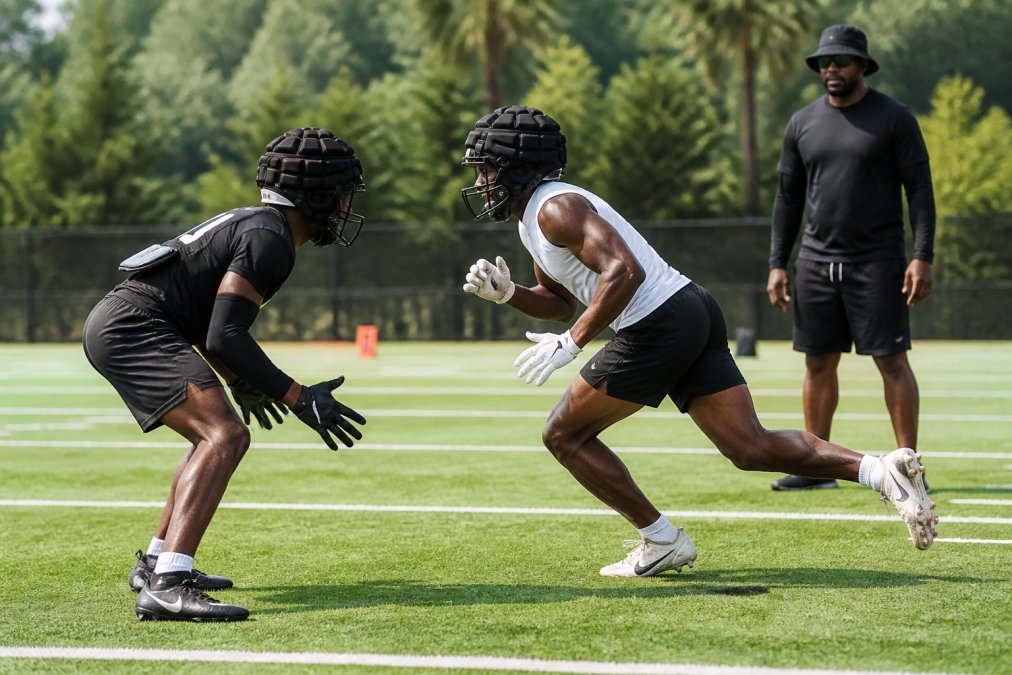
Release Moves vs. Press Coverage
Build a release toolbox, not a single move. The best receivers carry three or four and pick based on the defender’s use.
- Quick swim: Beat the jam with a fast arm-over.
- Foot fire: Attack the defender’s toes to force a false step.
- Stutter release: Break rhythm, then explode past.
- Inside jab: Threaten inside to open the outside.
Watch the defender’s hands, not their eyes. Hands commit first. If the outside hand drops, the inside release is open.
Eye Manipulation and Head Fakes: Creating Use
Eye manipulation means using your eyes and head to move a defender where you want them. It’s the difference between running a route and controlling one.
Stem and Break Point Mechanics for Route Precision
The break point is where your route changes direction, and route precision lives or dies in the roughly two steps on either side of it. Most guides tell you to “drop your hips and plant”, that’s the what. This section is the why: the biomechanics that make the cut fast or slow.
The Biomechanics of a Clean Cut
A change of direction is a controlled deceleration followed by a re-acceleration. Three variables decide how much speed you keep through the break:
- Center of gravity (COG). Your COG sits near your navel. To cut hard, lower it before the break, not during it. Lowering your COG widens your base and lets you redirect force into the ground instead of into a stumble. If your COG is still high when your plant foot lands, the cut leaks and the defender recovers.
- Shin angle. At the plant, your shin should angle in the direction you are pushing off, roughly 45 degrees or steeper into the cut. A vertical shin means you are braking, not redirecting. Coaches cue this as “get your shin over your toe.”
- Foot strike and hip stack. Plant the outside foot with the ball of the foot, not the heel. Heel-first plants kill the cut because the ankle cannot load. Stack your hips over the plant leg so your torso does not drift past your base, drift is the most common cause of a rounded break.
Deceleration Is the Skill Nobody Trains
You cannot cut at full speed without first slowing down. The best route runners treat deceleration as a skill, not a penalty, using a two-step deceleration into the break:
- Step 1 (prep step): Shorten your stride and lower your COG. You are loading the spring.
- Step 2 (plant step): Strike the ground with the outside foot, shin angled into the cut, hips stacked.
- Step 3 (drive step): Push out of the break with the inside foot and re-accelerate.
Film your breaks from the side, not from behind. Side angle is the only view that shows shin angle, COG height, and whether your hips drift past your plant foot.
Depth Control and the Drift Problem
Every route has a target depth, the yard line where the break should happen. Drifting past it is the most common precision error at the high school and college level, and it compounds: one extra step gives a trailing defender a full step of recovery.
A concrete way to fix drift:
- Pick a landmark. Before the snap, identify a yard line, a hash mark, or a painted number as your break depth.
- Count your steps. Most receivers can calibrate their stem so the break lands on the landmark within a step.
- Break on the landmark, not on the defender. Reading the defender is for adjusting the break point, not for deciding when to break.
Break-Point Variations by Route Type
Not every break is the same. The mechanics change with the route:
- Sharp breaks (out, dig, comeback): Lowest COG, hardest plant, shortest deceleration. These demand the most biomechanical discipline.
- Soft breaks (curl, slant): Less deceleration, more of a lean-and-go. The plant is lighter and the re-acceleration is quicker.
- Double moves (post-corner, out-and-up): The first break is intentionally softer to sell the route; the second break is the sharp one. Save your hardest plant for the break that matters.
The Trade-Off You Have to Accept
There is no free lunch at the break: a harder plant means a sharper cut but slower exit; a softer plant means a faster exit but a rounded cut. The advanced skill is matching the plant to the route and coverage, sharp plant when you need separation now, soft plant when you need to threaten vertical and break late.
Planting hard without eccentric strength in the hamstrings and glutes is how knees and ankles get hurt. Build deceleration strength in the weight room before you demand it on the field.
Drills for Wide Receiver Separation and Explosive Acceleration
Drills for wide receiver separation build the physical tools that make everything else work. Speed without control is useless. Control without speed gets you covered.
Try these:
- Cone weaves: Build change of direction.
- Resisted sprints: Improve explosive acceleration.
- Ladder footwork: Sharpen quick feet.
- Break-point reps: Practice planting and cutting at full speed.
- Route tree circuits: Run the full tree for timing.
Skipping deceleration work is the fastest way to blow a knee. Plant hard without control, and the joint pays for it.
Reading Defensive Coverage as a Receiver
Reading defensive coverage turns you from a route runner into a problem solver. The route called in the huddle is a starting point, not a script.
Coverage recognition comes down to a few cues:
- Safety depth: One high or two high changes everything.
- Corner use: Inside or outside tells you the technique.
- Linebacker drops: They reveal zone or man.
Film Study Methodology for Coverage Recognition
Film study is where coverage recognition gets built. Watch the defense, not the ball.
A simple method:
- Watch the safety first on every rep.
- Note corner use before the snap.
- Track how the defense adjusts to motion.
- Log the coverage on every play for one game.
Biomechanical Efficiency and Body Control at Game Speed
Biomechanical efficiency means moving without wasting energy. Body control at game speed separates good receivers from great ones.
Great route running is efficient route running. The receiver who wastes the least motion is open the most.
Defensive Back Counter-Moves and Route Adjustments
Defensive backs adjust, so should you. The DB counter-move is the adjustment a defender makes to take away your route, and reading it early is a skill in itself. Most route-running content stops at “beat press” or “find the soft spot.” This section goes deeper: how to identify the technique a defender uses, what it takes away, and the route adjustment that punishes it.
Read the Technique, Not the Player
Defenders are taught in techniques, and each has a tell. Learn the tells and you can predict the counter before the snap.
- Press (jam) technique: The corner lines up within a yard of the line, square, with hands ready. Tell: weight forward, eyes on your chest. Designed to disrupt your release and reroute you inside.
- Off technique: The corner lines up 5-7 yards off, often with outside leverage. Tell: backpedal on the snap, eyes on the quarterback. Designed to keep everything in front and break on the throw.
- Bail technique: The corner turns and runs at the snap, opening his hips to the sideline. Tell: he is already retreating before you release. Designed to take away the deep ball and force the underneath throw.
- Trail technique: The corner plays your back hip after you release, mirroring your stem. Tell: he is behind you but attached. Designed to stay in phase and break on the ball at your break point.
- Inside use (leverage): The corner aligns with inside leverage, taking away the inside release. Tell: his inside shoulder is closer to you than his outside shoulder. Designed to funnel you to the sideline.
Counter-Moves by Technique
Once you identify the technique, the counter is the route that attacks its weakness:
- vs. Press: Win the release first. Use a quick swim, foot fire, or stutter release to get clean hands and a free step. Then run your route. If the press is soft, attack the toes; if it is hard, use the arm-over.
- vs. Off: Attack the cushion. Push vertical to close the 5-7 yards, then break at the top of the route. The comeback and out are your friends here because the defender is already backpedaling.
- vs. Bail: Take the free yards underneath. The quick out, slant, and hitch are open immediately because the defender has turned and run. Do not chase the deep ball against bail, throw the ball to the void.
- vs. Trail: Attack the back hip. The comeback is the classic trail-beater because the defender is running to your break point and cannot stop as fast as you can. The out-and-up also works if the trail is tight.
- vs. Inside use: Take the outside release and stack. The slant is available if the defender overplays outside, but the primary counter is to win outside and force him to open his hips.
Adjusting Mid-Route
Defenders change technique mid-route: a corner in press may bail at the snap, a corner in off may jump the short route. The advanced skill is recognizing the change and adjusting your break point without abandoning the route.
Before the snap, identify the defender’s technique and pick your counter. After the snap, confirm or adjust. This turns the counter-move into a reaction instead of a guess.
Film Study for DB Tendencies
Counter-moves are only as good as your scouting. Watch the defense, not the ball. Log the technique each corner uses on every rep for one game. Patterns jump out fast: most corners have a favorite technique in certain downs and distances, and most defenses repeat their leverage rules.
A simple method:
- Watch the safety first on every rep to identify the coverage shell.
- Note the corner’s alignment and leverage before the snap.
- Track the technique at the snap (press, off, bail, trail).
- Log the coverage and technique on every play for one game.
The best route runners are not just technicians, they are problem solvers. Read the technique, pick the counter, and let the route do the rest.
Frequently Asked Questions
How do you create separation against press coverage?
Creating separation against press coverage starts with a decisive release. Use a quick jab step or swipe to knock the defensive back’s hands down, then accelerate through the contact point. The key is to attack the DB’s leverage rather than avoiding it. If he’s playing inside leverage, release outside. If he’s outside, release inside. Combine that with a head fake or shoulder dip and you’ll force him to open his hips early, giving you a step of separation that route precision and timing can exploit.
What are the most effective footwork drills for wide receivers?
The most effective footwork drills for wide receivers include the ladder drill for rapid foot fire, the cone drill for change of direction, and the whip route drill for sharp deceleration at the break point. These drills for wide receiver separation train your feet to fire quickly and your body to stay under control at game speed. Do them at full speed with a defender in mind, not just as a warmup. Pair them with film study to see where your footwork breaks down on routes like comebacks, slants, and out routes.
What is the hardest route to run in football?
The comeback route is often considered the hardest to run because it requires full-speed acceleration, a sharp deceleration, and a precise break back to the quarterback, all while the defensive back is trailing you. Any wasted step or drift at the top of the route gives the DB time to close. The dig and deep post also demand elite route precision and body control. Mastering these routes requires repeated drills for wide receiver separation and a strong understanding of reading defensive coverage as a receiver.
How does film study help with reading defensive coverage as a receiver?
Film study lets you recognize coverage shells before the snap. By watching how safeties rotate and how corners align, you can predict whether you’ll face Cover 1, Cover 2, or Cover 3. That tells you which route adjustments to make. For example, against Cover 2, the deep post opens up the middle. Against Cover 3, the comeback and out route are available. Spending 15 minutes a day on film study methodology builds the pattern recognition that separates elite route runners from average ones.
Defensive backs get faster every year, and the margin for error keeps shrinking. Route running is the skill that closes that gap, and it’s coachable. QB Factory builds it with a progressive formula that combines physical mechanics and tactical footwork with classroom-style mental preparation, taught by former D1 players and championship-level coaches who’ve developed over 300 full scholarship players. Get started with QB Factory and turn raw talent into separation.