
Table of Contents
- Why Mental Preparation Separates Elite Quarterbacks from the Rest
- Quarterback Visualization Techniques for Game Scenarios
- QB Decision-Making Drills Under Game Pressure
- Improving QB Processing Speed Through Solo Mental Drills
- Building Mental Toughness and Resilience Under Pressure
- Integrating Footwork Mechanics with Mental Preparation
- Developing Leadership and Communication Skills on the Field
- Creating Your Weekly Mental Preparation Routine
- Frequently Asked Questions
Last Updated: October 1, 2026
Why Mental Preparation Separates Elite Quarterbacks from the Rest
The difference between a quarterback who wilts under pressure and one who thrives isn’t arm strength or footwork alone. It’s what happens between the ears.
Elite quarterbacks train their minds as rigorously as their bodies, visualizing scenarios, practicing decisions under stress, and building resilience so one bad play doesn’t derail the next drive.
At QB Factory, we’ve worked with hundreds of quarterbacks pursuing college scholarships and professional opportunities. The ones who succeed fastest aren’t always the most talented physically. They’re the ones who’ve mastered quarterback mental preparation drills that sharpen cognitive processing, decision speed, and composure.
This guide covers specific, measurable drills that separate good quarterbacks from great ones, not motivational speeches, but exercises you can implement today.
Quarterback Visualization Techniques for Game Scenarios
Visualization is deliberate mental rehearsal that primes your brain to recognize and react to situations before they occur in live games.
Pre-snap Read Visualization
Before every practice, spend 5-10 minutes visualizing specific defensive formations (Cover 2, Cover 3, blitz packages). See safeties rotating, linebackers shifting, progressions unfolding. This mental repetition builds neural pathways and speeds pattern recognition. The more detail you visualize, exact alignment, cornerback depth, free safety position, the stronger the neural imprint.
Pressure Pocket Drills
Visualize pressure scenarios: offensive line breaking down, defenders closing, then executing your escape plan, stepping up, moving laterally, finding secondary options. Practice 3-4 times weekly for 3-5 minutes per session. The goal is making pressure familiar, not frightening.
QB Decision-Making Drills Under Game Pressure
Decision-making speed separates college-recruited quarterbacks from the rest. Your brain must process information faster than the defense can react.
Film Study Progression Reads
Watch game film and identify progressions before each play starts. Do this for 20-30 plays per session, twice weekly. After each play, write down your pre-snap read and actual progression, then compare. This feedback loop trains your brain to recognize patterns instantly and accelerates learning.
Audible Recognition in Real Time
Watch game film on mute, pause at the snap, and call the audible you’d make based on defensive alignment. Then unmute to see the actual call. Do this 10-15 times per session, once weekly. This trains your brain to recognize defensive adjustments instantly, quarterback mental preparation at its core.
Improving QB Processing Speed Through Solo Mental Drills
Solo drills build the cognitive foundation that game-speed drills amplify. The key is measurable progression and data tracking.
The Pattern Recognition Drill (At-Home, Measurable)
This drill trains your brain to recognize defensive formations instantly and retrieve your pre-programmed reads without conscious thought.
Setup:
- Use game film from your own team or opponents. Pause at the snap, before the quarterback reads the defense.
- Create a list of 10-15 specific defensive formations you face regularly (Cover 2, Cover 3, Nickel, Dime, specific blitz packages).
- Have a partner, coach, or use a timer app to call out formations randomly.
Execution:
- Hear the formation name. Respond with your first read, second read, and hot route within 2 seconds.
- Record your response time and accuracy (did you call the right progression for that coverage?).
- Do 20 reps per session, 3 times per week.
Progression Metric:
Track your average response time and accuracy percentage. Week 1, you might average 3.2 seconds with 75% accuracy. This is measurable cognitive improvement.
Film Breakdown with Predictive Reads (Solo, Data-Driven)
Watch game film and predict the quarterback’s decision before it happens. Pause before the release, write down the coverage, your predicted read, and throw location. Unmute and score yourself. Track accuracy weekly in a spreadsheet.
Reaction-Time Acceleration with Timed Responses
Use a reaction-time app or partner to call out 8-10 formations randomly. Respond with your first read within 1.5 seconds and record response time. Do 15 reps per session, 3 times weekly. Repetition moves decisions from working memory (slow) to long-term memory (fast).
Wearable Data Integration for Mental State Monitoring
Wearable devices (smartwatches, fitness trackers, dedicated HRV monitors) provide real-time feedback on how your nervous system responds to mental stress. This transforms vague “mental training” into quantifiable progress.
Metrics to track:
-
Resting Heart Rate Variability (HRV): Measure first thing in the morning, before getting out of bed. Declining HRV signals accumulated stress or inadequate recovery.
-
Resting Heart Rate: Measure for 60 seconds. Declining RHR signals improved cardiovascular adaptation to stress.
-
Sleep Quality and Duration: Track nightly. Most wearables estimate REM and deep sleep.
How to use this data:
- Establish your baseline (week 1): Record HRV, RHR, and sleep every day.
- Implement mental drills (weeks 2-4): Continue recording daily.
- Compare: If HRV rises or stays stable while you’re doing more mental work, your nervous system is adapting well. If HRV drops and doesn’t recover, you need more rest.
- Adjust: If HRV drops below your baseline, reduce film study volume or increase sleep by 1 hour. If HRV climbs, you can handle more mental load.
This data-driven approach removes guesswork, you’re measuring improvement, not hoping for it.
Solo Drill Weekly Schedule
Monday: Pattern Recognition Drill (20 reps)
Wednesday: Film Breakdown with Predictive Reads (20 plays)
Friday: Reaction-Time Acceleration (15 reps)
Daily: Track HRV, RHR, and sleep
Total: 45 minutes weekly of active drilling. Over 4 weeks, you’ll have measurable evidence of improved pattern recognition, faster decision speed, and better nervous system adaptation.
Building Mental Toughness and Resilience Under Pressure
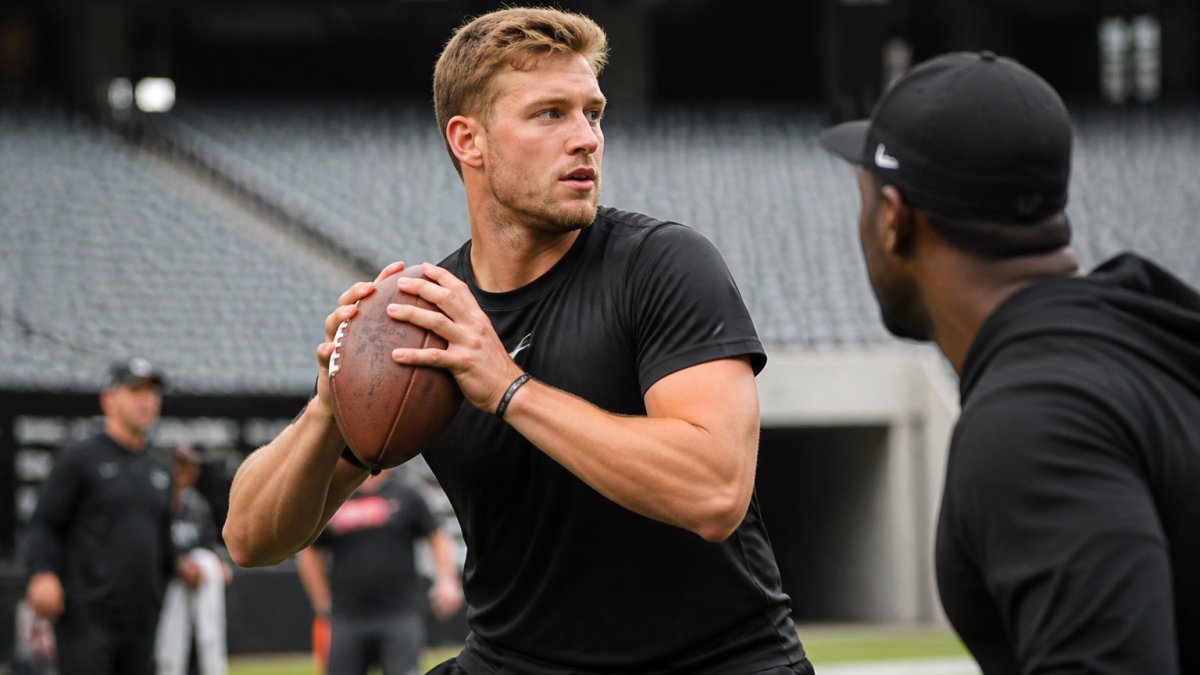
Mental toughness isn’t willpower alone. It’s your nervous system’s ability to recover from stress and maintain cognitive function under load. Understanding the neuroscience behind resilience transforms vague “toughness” into a trainable skill.
The Neuroscience of Stress Recovery and Cognitive Fatigue
Under pressure, your sympathetic nervous system activates, heart rate climbs, adrenaline rises, blood flow shifts away from your prefrontal cortex (decision-making center). This is why quarterbacks make poor reads when panicked. Elite quarterbacks train their parasympathetic nervous system to activate faster, shortening recovery between high-stress moments.
Heart Rate Variability (HRV) measures millisecond variation between heartbeats. High HRV indicates strong parasympathetic recovery; low HRV signals fatigue. Track resting HRV daily using a wearable device. Declining HRV correlates with slower reads and longer hold times; stable HRV keeps you sharp under pressure.
Cognitive Fatigue and Decision-Making Degradation
Decision-making burns glucose rapidly. After 2-3 hours of intense mental work, glucose availability drops and decision quality declines, decision fatigue. This is why quarterbacks who film-study for 4 hours straight make worse decisions in the final hour.
Manage cognitive fatigue by: breaking film study into 45-minute blocks with 10-minute recovery periods; prioritizing 8-9 hours of sleep nightly (quarterbacks sleeping 6 hours or less show slower decision speed); eating balanced meals 2-3 hours before mental work; and rotating mental tasks to prevent specific neural pathways from fatiguing.
Self-Talk and the Reappraisal Framework
Generic motivation (“You’ve got this!”) activates your sympathetic system briefly. Reappraisal self-talk reframes the situation, keeping your prefrontal cortex engaged. Instead of “I’m nervous,” say “My body is energized.” Instead of “This pressure is crushing,” say “Pressure means the play matters; I’ve trained for this.”
Develop three reappraisal phrases for different moments:
- Pre-snap (calm focus): “I’ve seen this coverage. My reads are clear. Execute.”
- After a mistake (recovery): “One play doesn’t define the drive. Next snap, I’m sharper.”
- Under immediate pressure (action): “Pressure is information. I move and find the open man.”
Practice these phrases daily, especially after stressful situations. Your brain will default to them automatically under game pressure.
Breathing Protocols for Nervous System Regulation
Specific breathing patterns activate your parasympathetic system within seconds. Box breathing (4-4-4-4): Inhale 4, hold 4, exhale 4, hold 4. Repeat 5 times before film study or games. Extended exhale breathing (4-6): Inhale 4, exhale 6. Repeat 10 times after high-stress moments. Practice 2-3 times daily for 2 weeks until automatic.
Integrating Footwork Mechanics with Mental Preparation
Footwork and mental preparation are connected. Spend 10 minutes daily on footwork drills (3-step, 5-step, 7-step drops) until automatic. When footwork is automatic, your mental energy focuses on reading the defense. Quarterbacks who struggle under pressure often think about their feet; elite quarterbacks have drilled mechanics so thoroughly their mind is free to process the defense.
Developing Leadership and Communication Skills on the Field
A quarterback is a leader. Mental preparation includes developing the communication skills that make teammates execute at a high level.
Creating Your Weekly Mental Preparation Routine
Consistency matters more than intensity. A 10-minute daily drill beats a 2-hour weekly session.
Monday Through Wednesday: Film Study and Cognitive Processing
Monday: Watch full-game film. Identify your reads before each play. Write them down. This builds pattern recognition.
Thursday and Friday: Game-Speed Simulation
Thursday: Practice visualization and reaction-time drills. Simulate pressure situations. Practice your self-talk. This is mental rehearsal at game speed.
Frequently Asked Questions
What are the best mental visualization techniques for quarterbacks?
The most effective quarterback visualization techniques involve mentally rehearsing pre-snap reads, defensive coverages, and throwing progressions at game speed. Close your eyes and visualize the entire play: your footwork, the receivers’ routes, the defensive alignment, and your decision point. Practice this daily for 10-15 minutes.
How can quarterbacks improve their processing speed during a play?
Improving QB processing speed requires repetition at game-speed simulation. Use film study to identify common defensive looks, then practice recognition drills where you call out coverages in 2-3 seconds. Solo mental drills at home, such as watching game film and pausing to make decisions, accelerate your recognition pattern. Wearable tech can track your cognitive response times. The key is deliberate practice: each rep should challenge your reaction time slightly beyond your current comfort level.
How does mental preparation impact a quarterback’s accuracy?
Mental preparation directly affects accuracy by reducing performance anxiety and improving concentration. When you manage pressure through self-talk and mindfulness techniques, your nervous system stays calm, allowing your neuromuscular system to execute throwing mechanics consistently. Mental fatigue is real, proper recovery and focus techniques keep your decision-making sharp throughout a game.
What drills help a quarterback stay calm under pressure?
Pressure management drills include visualization of worst-case scenarios, controlled breathing exercises, and game-speed pressure pocket drills. Practice making decisions with defenders closing in during team drills, which trains your brain to stay calm in actual game situations. Mindfulness and self-talk routines also build resilience. The goal is to normalize pressure in practice so game day feels familiar.