

Last Updated: October 27, 2026
Quick Summary
The best youth football training program depends on your child’s age, skill level and goals, so start by matching the program’s age range and focus to what your child needs. Youth football training should build fundamentals first, then add position-specific work as players get older. Confirm coaching experience, contact progression and safety policies before you register.
- Check the age range, skill focus and coaching background before comparing anything else.
- Camps come in full-day, shorter clinic, position-specific and showcase formats, each suited to different goals.
- Quarterback training helps once a young player already throws regularly and shows interest in the position.
- Drills should match both position and age, with fundamentals taught before advanced position complexity.
- Ask how tackling is introduced, what the coach-to-player ratio is, and whether a trainer is on site.
Table of Contents
- What Makes a Youth Football Training Program Worth Your Time
- Youth Football Camps 2026: Formats, Dates and Who Each Suits
- Quarterback Training for Youth Players: When It Helps and When It Can Wait
- Youth Football Drills by Position: What Should Be Taught at Each Age
- How to Choose a Youth Football Camp for Your Child’s Age and Goals
- Safety, Contact Progression and Coaching Experience to Check
- Booking Your Child’s Next Training Step
- Frequently Asked Questions
What Makes a Youth Football Training Program Worth Your Time
Parents comparing youth football training programs for 2026 face a crowded field. Camps, clinics, local coaches and regional roundups all promise to develop young players, and the marketing often sounds identical. The better question is what actually moves a child’s game forward. At QB Factory, we coach quarterbacks, receivers and linemen.
Start with fit. A program built for a 14-year-old preparing for high school tryouts is a different product from one designed for a 7-year-old learning how to stance and catch. Check the age range, the skill focus and the coaching background before looking at anything else.
Look for three things in any program you consider:
- A clear age range and grade eligibility
- A defined focus, such as position skills, individual mechanics or team play
- Coaches whose experience matches the level your child is playing
Our approach at QB Factory combines physical mechanics with classroom-style preparation for game situations.
Youth Football Camps 2026: Formats, Dates and Who Each Suits
Youth football camps come in several formats, and each suits a different goal. Full-day camps give kids extended repetition. Shorter clinics focus on one or two skills. Position-specific camps go deeper on the mechanics of a single role, and showcase or ID camps are built around evaluation and exposure for older players.
Before you register, confirm the camp dates and the session length. Summer schedules fill quickly, and some camps run only a few weekends each year. You can see upcoming dates and register for an advanced football camp directly. Check whether the camp is open to boys and girls, and whether it accepts flag football players, tackle players or both. A camp designed for non-contact instruction will teach different things than one that includes full tackle drills.
Ask a few practical questions about format:
- How many days and hours per day does the camp run?
- Is instruction grouped by age or by experience level?
- Does the camp end with an evaluation or a skills report you can keep?
Ask the same questions of every program you compare, and write the answers down. Side-by-side notes make the differences obvious within a few minutes.
The article points to a few practical things to compare across camp formats before you register.
| Camp format | Best for | Key difference |
|---|---|---|
| Full-day camp | Extended repetition | Longest session time |
| Shorter clinic | One or two skills | Focused on specific skills |
| Position-specific camp | Mechanics of one role | Deeper work on a single position |
| Showcase or ID camp | Older players seeking exposure | Built around evaluation |
Quarterback Training for Youth Players: When It Helps and When It Can Wait
Quarterback training is worth considering when a young player already throws regularly and is showing interest in the position. Dedicated work on footwork, release and reading coverage. For a player who is still learning basic athletic movement, general skill development usually comes first.
A common mistake is starting specialized quarterback work before a child has the fundamentals of balance and coordination. Another is waiting too long, after habits such as throwing off the back foot or dropping the elbow have already formed. The right timing depends on the child, not on a fixed age.
Parents often ask whether specialized training is necessary if their child is already doing well at school. The honest answer is that a strong high school coach may cover much of what a quarterback needs, but supplemental work from a program such as Apply today!.
Youth Football Drills by Position: What Should Be Taught at Each Age
Drills should match the position and the age of the player. Younger players benefit from broad coverage of the basics: running, catching, tackling technique and getting up after contact. As players get older, position work becomes more useful.
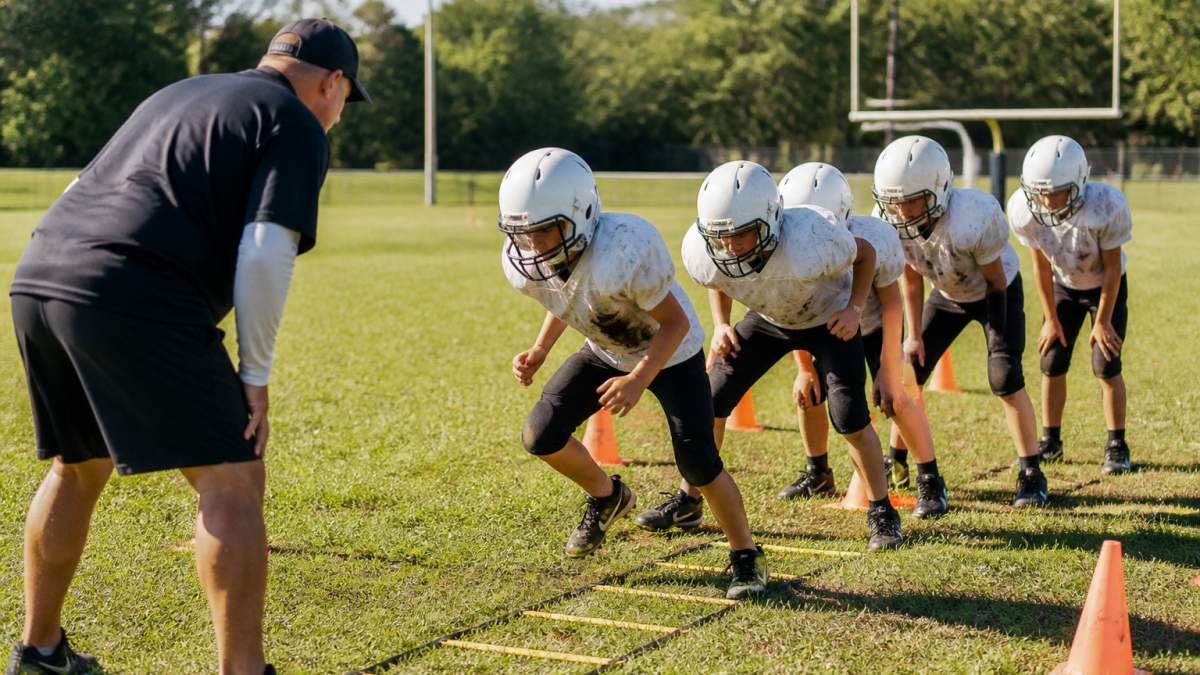
For quarterbacks, footwork drills such as drop-backs, pocket movement and throwing on the move build the foundation. Receivers benefit from route running, releases off the line and hands work. Linemen need stance, hand placement and movement drills.
Look for a program that teaches the fundamentals first and adds position complexity gradually. A camp that puts a 9-year-old through advanced route trees or pro-style protection schemes is likely skipping the steps that matter most at that age.
How to Choose a Youth Football Camp for Your Child’s Age and Goals
Most camp listings describe what they offer but not who should attend. A decision framework by age and goal closes that gap. Use the following tiers as a starting point, then confirm specifics with each program.
Ages 5-8: Foundation and fun. At this stage, the priority is athletic movement, listening skills, and a positive first experience. Look for flag or non-contact clinics that teach stance, catching, and basic running. Avoid programs that emphasize tackling or position specialization.
Ages 9-11: Skill introduction and contact progression. Players can begin learning position basics and controlled contact. Choose a camp that separates flag and tackle instruction and explains its tackling progression. Ask whether tackling is taught in a step-by-step manner (fit, form, finish) and whether players are matched by size. Position-specific work can start here but should remain secondary to overall athletic development.
Ages 12-14: Position focus and competitive reps. This is when specialized training pays off. Quarterbacks, receivers, and linemen benefit from position-specific camps that teach mechanics and decision-making. Look for camps that group by experience level, not just age, and that provide reps against live defenders in controlled drills. Ask about the coach-to-player ratio; smaller groups mean more individual correction.
Quarterback Registration (Required) →
Ages 15-18: Exposure and recruiting preparation. Older players need camps that simulate college practice tempo and provide evaluation. Showcase or ID camps can be useful, but verify who attends as evaluators and whether the camp provides a written assessment. For players targeting college programs, ask whether the camp staff has experience coaching at that level.
Match the format to the goal. A beginner who wants to build confidence needs a clinic with a low-pressure environment. A player preparing for high school tryouts needs a camp with competitive reps and position coaching. A player seeking recruiting exposure needs a camp with college coaches present.
Consider the calendar and travel. A camp that is excellent but requires a two-hour drive each way may lead to missed sessions. Consistency matters more than prestige at younger ages. For older players, a short residential camp may be worth the travel if it provides exposure you cannot get locally.
Before registering, ask the camp director: “Which age and experience level is this session designed for, and how do you group players during drills?” A clear answer signals a well-organized program.
Questions to Ask Before You Register
Before you pay a deposit or submit a registration form, ask the organizers:
- Who will coach my child, and what is their playing or coaching background?
- What is the instructor-to-player ratio?
- What does the camp cover, and what should my child bring?
- Is there a refund or transfer policy if we cannot attend?
- Can I speak with past families about their experience?
Clear, direct answers are a good sign. Vague responses are worth noting.
Safety, Contact Progression and Coaching Experience to Check
Safety is not a checkbox; it is a set of practices you can verify. Responsible programs have written policies on contact, heat, and injury response. Ask for them.
Contact progression. Programs should distinguish flag, non-contact, and tackle instruction. For tackle, ask how tackling is introduced. A common progression is: fit and form (no take-down), then controlled take-down with a partner, then full-speed drills in small groups. Players should be matched by size and experience.
Supervision and ratios. Ask how many coaches supervise each group and whether there is a certified athletic trainer on site. For contact drills, a lower ratio (e.g., one coach per 8-10 players) allows for individual correction and safer progression. Confirm that background checks are required for all staff and volunteers.
Heat and hydration. Summer camps should have a heat policy. Ask about scheduled water breaks (e.g., every 20-30 minutes), access to shade, and whether practices are modified or moved based on heat index. A written lightning policy is also a good sign.
Concussion protocol. Coaches should be trained to recognize concussion signs and remove players from activity immediately. Ask whether the program follows a return-to-play protocol that requires medical clearance. USA Football and the CDC offer free concussion training; ask if coaches have completed it.
Equipment. For tackle programs, ask whether helmets and pads are provided or required, and whether equipment is reconditioned and certified. For flag programs, confirm that belts and flags are in good condition and that contact is limited to blocking and flag pulling.
Coaching experience. Look for instructors who can explain why a technique works, not only how to perform it. Ask about their playing history, their coaching record, and how long they have worked with youth players. Experience with the age group you are considering is especially important. A coach who has worked with high school players may not be effective with 8-year-olds.
Measurable outcomes. Ask whether the program tracks progress. A skills report at the end of camp, a pre- and post-assessment, or a written evaluation gives you something to compare. Programs that provide specific feedback (e.g., “your child improved release time from 0.5 to 0.4 seconds”) are more useful than generic praise.
If a program cannot provide written safety policies or refuses to discuss contact progression, treat that as a red flag. No camp is worth an unnecessary injury risk.
The mental side of the game also deserves attention. A camp that teaches reading defenses and decision-making in game-like situations gives players skills that carry over into real competition, rather than only drilling repetitions.
Booking Your Child’s Next Training Step
The right program is the one that matches your child’s age, goals and current level, and that you can attend consistently. Use the comparison points above, ask direct questions, and check safety and coaching before committing.
Parents weighing quarterback coaching may also want to review the best private quarterback coaching programs for scholarship-focused players, and those comparing formats can read the complete guide to specialized quarterback training camps.
For age-appropriate practice ideas you can use at home between sessions, see 8 Youth Football Drills for Beginners That Build Fundamentals Fast.
Frequently Asked Questions
What age should a child start football training?
Many programs accept children around ages 7 to 8, and flag or non-contact formats are common at the youngest levels. Before enrolling, check whether a program is built for your child’s age group and experience. A child who is still learning basic footwork, catching and throwing benefits most from fundamentals-focused instruction, while an older player preparing for competitive play may need more position-specific work. Match the program’s structure to where your child is now, not where you expect them to be later.
Are youth football camps useful for young players?
Camps can give young players concentrated instruction, new drills and exposure to different coaching styles in a short window. Ask what the daily schedule looks like, how many players share each coach and whether the instruction includes both physical technique and game awareness.
How can quarterbacks improve their skills during the offseason?
Offseason quarterback development usually centers on footwork, throwing mechanics and reading defenses. Parents should look for programs that pair physical drills with classroom-style work on reads and reactions.
What should parents look for in a youth football coach?
Look for coaches with verifiable playing or coaching experience, a clear teaching method. Ask how the coach gives feedback and how they handle different skill levels. A good coach explains why a technique matters, not only how to perform it.
Ready to take the next step? QB Factory can help your player build the technique and game-day decision-making that matter most. Start by registering for quarterback training at QB Factory.