
Last Updated: October 31, 2026
Quick Summary
Mastering pass protection footwork means drilling a low, balanced stance and a short, controlled kick step followed by a power step, so you are set and square before contact. Train it with a four-week progression that moves from isolated steps to reactive pass sets against a live rusher.
- Keep feet wider than your shoulders with weight on the balls of your feet.
- Fire on the ball, not on the defender’s first move, to avoid tipping your set.
- Drill the kick, power, set sequence until the feet lead and hands follow.
- Punch as your feet set, keeping hands inside your frame and elbows tight.
- Recovery footwork changes with the counter move, so diagnose the error first.
Table of Contents
- Stance and Alignment: Where Pass Protection Footwork Begins
- Offensive Line Pass Set Technique: Timing the First Step
- Kick Step and Power Step Fundamentals
- Offensive Line Kick Step Drills That Build Real Foot Speed
- Hand Placement and Punch Timing
- Offensive Line Mirror Drill: Staying Square and Balanced
- Offensive Line Pass Protection Recovery Technique for Counter Moves
- Apply for QB Factory Lineman Training
- Frequently Asked Questions
Stance and Alignment: Where Pass Protection Footwork Begins
Pass protection footwork starts before the snap.
A few alignment rules we drill into every lineman:
- Feet wider than your shoulders for a stable base
- Weight on the balls of your feet, never flat-footed
- Knees bent, hips down, chest over your toes
- Eyes on the defender’s near hip, not his head or hands
- Hands ready inside your frame, elbows tight
Your alignment matters just as much as your stance. Know where the rusher lines up and which way he’s tilted. A wide alignment opens the door to an inside move.
The mistake we see most: young linemen stand tall because it feels comfortable. It isn’t. A tall stance kills your first step and gives the rusher a free target.
Offensive Line Pass Set Technique: Timing the First Step
Your first step decides the rep.
On the snap, drive your inside foot back at a sharp angle. That’s your kick step.
Timing is everything here. Move too early and you tip your set. Move too late and the rusher is already on your edge.
A common mistake is overstriding on the first step. A huge first step feels aggressive but leaves you off-balance and slow to recover.
The set point is where you want to meet the rusher.
Kick Step and Power Step Fundamentals
Two steps carry every pass protection rep: the kick step and the power step. Master both and you can handle any rush angle.
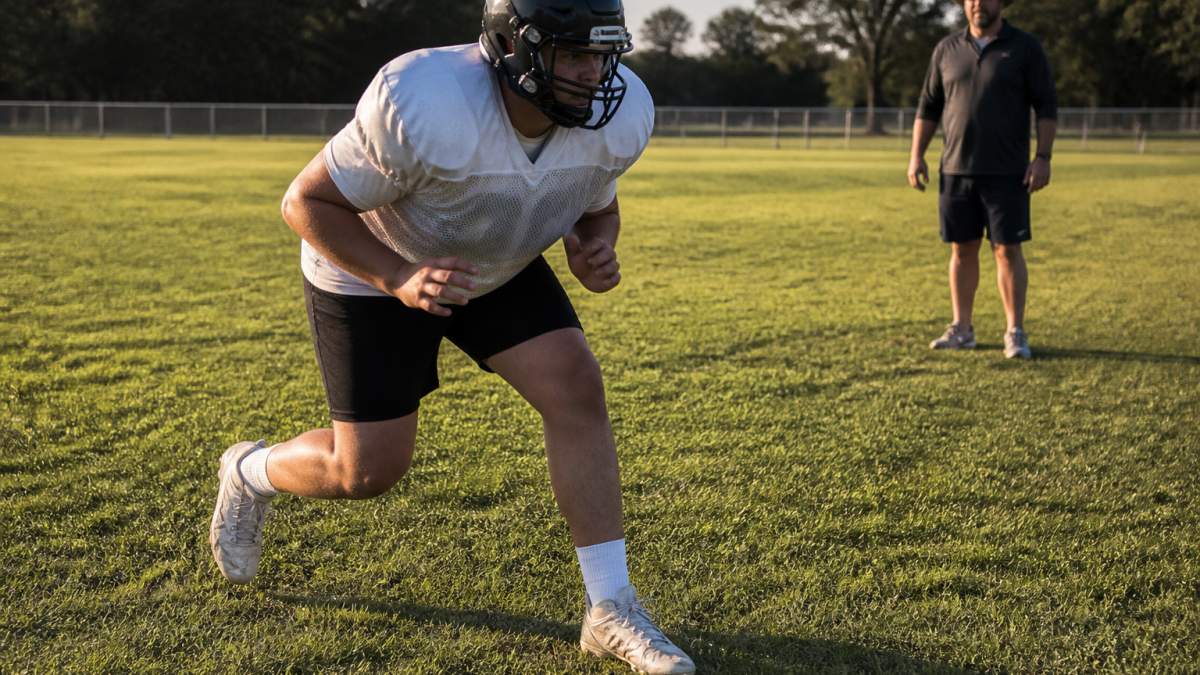
The kick step is your retreat.
The power step is your anchor. It’s a short, forceful step with your outside foot that stops your momentum and re-establishes your base.
Here’s what most guides miss: these two steps have to work together. The kick step creates space, the power step holds it. If your power step is weak, a strong rusher will collapse the pocket.
Drill the sequence until it’s automatic. Kick, power, set. Kick, power, set. The feet lead, the hands follow.
Offensive Line Kick Step Drills That Build Real Foot Speed
Foot speed is a skill you can train, but random drill lists don’t build it.
Week 1, Isolate the step (no defender).
- One-step kick set: On the snap, take one sharp kick step and freeze for a two-count. Check three things: feet wider than shoulders, weight on the balls of your feet, and shoulders square to the line. Reset and repeat. Do 3 sets of 8 reps per side.
- Wall kick-step: Stand arm’s length from a wall in your pass set. Kick step back and touch the wall with your inside hand without leaning. Do 3 sets of 10. If you have to lean, your step is too long.
Week 2, Add the power step and set point.
- Kick-power-set sequence: Kick step, power step, then freeze at your set point. Do 4 sets of 6. The cue is “kick, power, set” spoken aloud so the feet and the count stay linked.
- Set-and-recover: Kick step, then power step back to your original spot. Do 3 sets of 8. This trains the recovery footwork that shows up when a rusher counters.
Week 3, Add a moving target.
- Mirror drill with a partner: Shadow a partner’s lateral movement for 30 seconds without crossing your feet. Do 3 sets with 45 seconds rest. Watch the hips, if they turn, the rep is dead.
- Angle kick reps: Place a cone at a 45-degree rush angle and kick step to it. Vary the angle each rep (45, 30, 60 degrees) to train change of direction. Do 3 sets of 6 per angle.
Week 4, Reactive pass sets.
- One-step kick set vs. a live rusher: A partner starts from a two-point stance and rushes at half speed. You take one kick step and set. Do 3 sets of 5, then progress to full speed. This is the bridge from drill to rep.
- Lateral line hops: Stay low and hop side to side over a line for 20 seconds. Do 3 sets. This builds the fast-twitch response that shows up in the fourth quarter.
Coaching cues that fix the most common errors:
- Crossed feet: Slow the drill to half speed and say “inside foot first” on every rep. Crossed feet usually mean the first step is too long.
- Narrow base: Put a cone outside each foot and require the kick step to land outside the cone.
- False step: Film the first step from the side. A false step is any movement before the ball is snapped, count it out loud in practice.
- Overstriding: Mark the target landing spot with tape. If the foot lands past the tape, the step is too long.
Quality beats quantity here. Ten focused reps with a freeze and a cue beat fifty lazy ones. If you want a broader look at building foot speed from the ground up, our footwork training guide breaks down the full progression.
Here is the four-week drill progression laid out week by week.
Quarterback Registration (Required) →
| Week | Drill | Sets and reps |
|---|---|---|
| Week 1 | One-step kick set | 3 sets of 8 reps per side |
| Week 1 | Wall kick-step | 3 sets of 10 |
| Week 2 | Kick-power-set sequence | 4 sets of 6 |
| Week 2 | Set-and-recover | 3 sets of 8 |
| Week 3 | Mirror drill with a partner | 3 sets of 30 seconds, 45 seconds rest |
| Week 3 | Angle kick reps | 3 sets of 6 per angle |
| Week 4 | One-step kick set vs. live rusher | 3 sets of 5 |
| Week 4 | Lateral line hops | 3 sets of 20 seconds |
Hand Placement and Punch Timing
Your feet get you in position. Your hands finish the job.
Keep your hands inside your frame, thumbs up, elbows tight to your body. The inside hand controls the rusher’s chest.
Punch timing is where linemen separate themselves. Punch too early and the rusher swats your hands away.
A common mistake is reaching for the rusher instead of letting him come to you.
Avoid grabbing. Once you grab, you’re beaten. A grab means your feet stopped moving. Keep the feet alive and the hands will follow.
Offensive Line Mirror Drill: Staying Square and Balanced
The offensive line mirror drill is the best tool we know for staying square and balanced against a moving rusher.
Set up across from a partner. He moves left, right, forward, and back at random.
What most guides miss: the mirror drill isn’t about speed. It’s about control.
Watch your hips. If your hips turn, your shoulders follow, and the rusher has a free lane to the quarterback.
Do this drill for time, not reps. Two or three focused sets of thirty seconds will sharpen your reaction time fast.
Offensive Line Pass Protection Recovery Technique for Counter Moves
You will get beaten on the first move sometimes.
First, diagnose the loss. Before you drill recovery, identify which of these four errors caused the rep to break down:
- Crossed feet: The inside foot landed past the outside foot, so the hips opened and the rusher had a free lane. Cue: “inside foot first, short step.”
- Narrow base: The feet came together at the set point, so a bull rush walked you back. Cue: “wide base at contact.”
- False step: A movement before the snap tipped the set and gave the rusher a head start. Cue: “fire on the ball.”
- Overstriding: The first step was too long, leaving you off-balance and slow to recover. Cue: “short, quick, controlled.”
Then train the recovery that matches the counter.
- Inside counter (the rusher crosses your face): Drop your inside foot to cut off the inside lane, re-square your shoulders, and re-punch. Do 3 sets of 6 reps against a half-speed partner. The cue is “drop, square, punch.” If you lunge with one big step, you open the outside lane, short steps get you back faster.
- Speed rush (the rusher tries to run the edge): Don’t overset. Keep your kick step shallow and let the rusher run himself past you. Do 3 sets of 5 reps where the partner rushes at full speed and you only mirror, no punch. The cue is “patience, shallow kick.”
- Bull rush (the rusher drives straight into your chest): Drop your hips, widen your base, and anchor with the power step. Do 3 sets of 5 reps with a partner pushing a sled or a pad. The cue is “hips down, base wide.”
- Changing rush angle (the rusher starts wide and cuts inside): Re-establish your set point with two short steps, not one big one. Do 3 sets of 6 reps with a cone marking the new angle. The cue is “two short, re-square.”
Measurable benchmarks for recovery. Track how often you stay square at contact, how many steps it takes to get back to your set point, and whether your feet cross during the rep.
Safety and fatigue note. Recovery reps are high-effort and high-fall-risk. Warm up with hip and ankle mobility work before every session, and stop the drill when form breaks, sloppy recovery reps build sloppy habits.
Recovery is a footwork skill, not a strength contest. Long-term, these reps are exactly what off-season training is built to lock in, and our guide to building skills year-round shows how to keep them sharp.
Apply for QB Factory Lineman Training
Pass protection footwork is a skill, and like any skill it improves with the right coaching and the right reps. That’s what we build at QB Factory.
Our coaching staff includes former D1 players and championship-level coaches who teach a progressive training formula. We combine advanced physical mechanics and tactical footwork with classroom-style mental preparation, so you react to pressure instead of freezing in it.
If you’re a lineman serious about your development, here’s where to start:
- Learn more about our lineman-specific training program
- Check whether we offer training for linemen at your level
- Explore OLM Elite for elite offensive line development
- Apply today! through our registration page
The best linemen aren’t born with great feet. They train them. Get started with QB Factory and build the footwork that keeps quarterbacks clean.
Frequently Asked Questions
How should an offensive lineman set up in pass protection?
Start with a balanced stance: feet just wider than shoulder width, knees bent, hips down, and weight over the balls of your feet. Keep your shoulders square to the line and your hands ready inside your frame. From there, your first step should be short and controlled, not a lunge. A good pass protection footwork base lets you move in any direction without losing balance, which is why stance and alignment get checked before every rep.
What is a kick step in offensive line play?
A kick step is the back-and-lateral step an offensive lineman takes to gain depth and stay in front of a speed rusher. The goal is to beat the rusher to the edge without crossing your feet or opening your hips too early. Pair kick steps with offensive line kick step drills like the one-step kick set so the movement becomes automatic. Keep the step short, stay square, and avoid reaching, which is the fastest way to lose balance.
How can offensive linemen improve their pass protection footwork?
Improve pass protection footwork by drilling the fundamentals daily: kick steps, power steps, and the offensive line mirror drill. Film each rep so you can see whether you are reaching, crossing your feet, or dropping your eyes. Add reaction work against a live rusher so your feet respond to rush angles instead of a script. Track your set depth and balance over weeks, and correct one error at a time rather than changing everything at once.
How often should offensive linemen practice pass protection footwork?
Practice footwork three to four times per week in the off-season and every practice day in season, even if only for 10 to 15 minutes. Short, focused reps beat long sessions because footwork is a skill built on repetition and clean mechanics. Use a progressive plan: start with stance and first-step work, add kick and power steps, then move to mirror and recovery drills. Film study between sessions helps you spot errors before they become habits.