


Last Updated: November 3, 2026
Quick Summary
Performance anxiety in youth football is the nervous feeling a young player gets before or during a game, and it can be managed with simple steps. Coaches and parents help by matching support to the child’s age, using short breathing and grounding techniques, and keeping pre-game and post-game routines simple.
- Watch for stomachaches, headaches, poor sleep, and tears after mistakes, not just verbal worry.
- Match your support to age: keep ages 7-9 fun, ages 10-12 routine-based, and ages 13-14 open to conversation.
- Try a four-two-six breathing pattern two or three times in the huddle.
- Keep the post-game debrief under five minutes and focus on what went well.
Table of Contents
- Understanding Performance Anxiety in Youth Football
- Sports Performance Anxiety Symptoms in Children to Watch For
- How Age Shapes the Way Young Players Experience Pressure
- Mental Preparation Techniques for Youth Football
- How to Help a Child With Game Day Jitters
- Post-Game Conversations That Build Confidence
- When Social Media and Outside Pressure Add to the Strain
- Scheduling Your Next Step With QB Factory Coaches
- Frequently Asked Questions
Understanding Performance Anxiety in Youth Football
Performance anxiety is the nervous feeling a young player gets before or during a game. It can show up as a racing heart, an upset stomach, or a mind that keeps replaying the last mistake. Performance anxiety is normal, but when it gets in the way of playing, it is worth working on.
Most kids feel some pressure before a game. The trick is learning to turn that energy into focus instead of fear. This guide walks you through seven steps that coaches and parents use to help young players do just that.
QB Factory coaches quarterbacks, receivers, and linemen. The mental side of the game is just as important as footwork and throwing mechanics.
Sports Performance Anxiety Symptoms in Children to Watch For
Anxiety does not always look like worry. Kids often show it through their bodies or their behavior.
Common signs include:
- Stomachaches or headaches on game days
- Trouble sleeping the night before a game
- Sudden drops in effort or confidence during practice
- Anger, tears, or quitting after a mistake
- Asking to skip practice or games
A common mistake is labeling these signs as a bad attitude. Look for the pattern instead. If the reaction shows up every game day, the child is likely feeling pressure, not simply being difficult.
How Age Shapes the Way Young Players Experience Pressure
A 7-year-old and a 14-year-old feel pressure in very different ways. Younger kids often worry about pleasing a parent or coach. Older players start to think about roster spots, playing time, and future recruiting.
Match your support to the child’s age:
- Ages 7-9: Keep the focus on fun, effort, and trying new things.
- Ages 10-12: Teach simple routines and celebrate small wins.
- Ages 13-14: Talk openly about goals, feedback, and how to handle criticism.
The thing nobody tells you is that a child’s confidence often tracks how safe they feel making mistakes. Make it clear that a dropped pass is a learning moment, not a verdict on their worth.
Mental Preparation Techniques for Youth Football
Good mental prep gives a player something to do with nerves. Three steps help most.
- Visualize one successful play. Picture the snap, the read, and the throw in detail.
- Use short self-talk. Pick a phrase like “next play” or “stay loose” and repeat it.
- Set one small goal. Aim for a process target, such as “keep my eyes up,” not a result like “throw three touchdowns.”
Breathing and Grounding Before a Snap
Breathing is the fastest tool a player has. Try a simple pattern: breathe in for four counts, hold for two, and breathe out for six. Do this two or three times while in the huddle.
Grounding helps too. Feel your feet on the turf and name three things you can see. This pulls attention out of the head and back into the body.
Building a Pre-Game Routine That Works
Routines make the unknown feel familiar. A good pre-game routine is short, repeatable, and the same every week.
- Eat a familiar meal two to three hours before kickoff
- Warm up with the same dynamic movements each time
- Run one visualization rep before warm-ups end
- Finish with a single cue word, then head to the field
Watch out: a routine that gets longer and more complicated each week can add to the pressure instead of reducing it. Keep it simple.
How to Help a Child With Game Day Jitters
Game day jitters are normal, but how you respond as a parent or coach can either dial up the pressure or help the player settle. The key is to match your support to the child’s age and to use concrete, repeatable actions rather than generic reassurance.
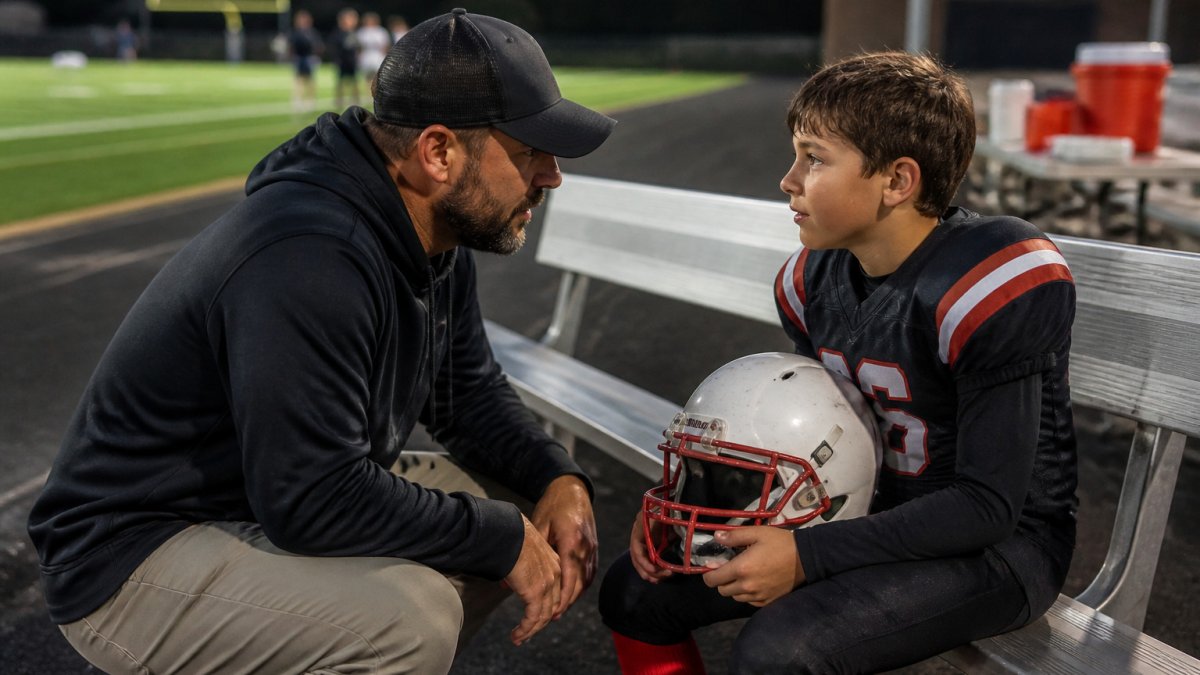
Ages 7-9: Keep everything short and playful. A young child does not need a speech about focus; they need to feel safe and have fun. Try a simple check-in: “What’s one fun thing you want to try today?” Avoid asking about winning or stats. If they seem nervous, offer a quick distraction like a silly handshake or a two-minute joke before warm-ups.
Ages 10-12: This is when routines start to matter. Help them build a three-step pre-game ritual: (1) pack their own bag the night before, (2) eat the same light snack two hours before kickoff, and (3) do one minute of deep breathing in the car. Your job is to remind them of the routine, not to add new instructions. A common pattern is that parents unintentionally increase anxiety by changing the plan week to week.
Ages 13-14: Older players are more aware of stakes, playing time, roster spots, peer comparison. They need to feel heard, not managed. Ask open questions like “What part of today feels most challenging?” and then listen without jumping to solutions.
Physical grounding beyond breathing: Breathing is a start, but many young athletes respond better to somatic techniques. Teach them progressive muscle relaxation: tense each muscle group for five seconds, then release, starting from the toes and moving up. This can be done quietly on the bench or in the car. Another option is sensory grounding: name five things you can see, four you can touch, three you can hear, two you can smell, and one you can taste.
Quarterback Registration (Required) →
What to avoid: Don’t tell a child to “calm down” or “relax”, that can feel dismissive. Instead, acknowledge the feeling: “It’s okay to feel nervous; that means you care.” Also, avoid sideline coaching during the game. Cheer for effort, not outcomes. If you catch yourself shouting instructions, replace them with a simple “Next play!” or “You’ve got this!”
Watch out: A parent who paces, sighs loudly, or critiques calls from the stands will spike a child’s anxiety faster than any pre-game speech can calm it. Your body language is part of the message.
Post-Game Conversations That Build Confidence
The car ride home after a game is where confidence is either built or broken. Most parents default to either silence or a detailed critique, both can feed anxiety. The goal is to help the child process the experience without making them feel judged. Use a structured debrief that matches their age and emotional state.
First, read the child’s mood. If they are angry or tearful, don’t force a conversation. Wait until they are calm. A simple “I’m here when you want to talk” is enough. For younger kids (7-9), keep it to one or two minutes and focus on fun: “What was the best part of the game?” or “Did you have fun with your teammates?” Avoid asking about mistakes or the score.
Ages 10-12: Use a three-question script that balances learning and encouragement:
- “What went well today?” (This forces them to recall a positive.)
- “What is one thing you learned?” (This frames mistakes as growth.)
- “What is one thing you want to try next practice?” (This creates a forward-looking plan.)
Keep the conversation short, under five minutes. If they say “nothing went well,” gently prompt: “I saw you hustle on that one play; that’s something.” End on a specific praise: “I was proud of how you kept your head up after that interception.”
Ages 13-14: Older players need more autonomy. Ask permission before diving in: “Do you want to talk about the game, or do you need some space?” If they want to talk, use a debrief that separates identity from performance:
- “What did you see out there?” (Opens the floor for their perspective.)
- “What would you do differently next time?” (Encourages self-reflection.)
- “What do you need from me this week?” (Shows support without assuming.)
Avoid the temptation to coach from the car. If they made a tactical mistake, let their coach address it. Your role is to listen and reinforce that their worth is not tied to the scoreboard.
Handling a bad game: If your child had a rough outing, resist the urge to fix it. Instead, normalize the experience: “Every player has tough games. What matters is how you respond.” Share a brief story of a professional athlete who struggled and bounced back, but keep it short and relevant. Then pivot to recovery: “Let’s get some food and rest; tomorrow is a new day.”
What not to say: Avoid phrases like “You’ll get ’em next time” (can feel dismissive), “Why did you do that?” (sounds accusatory), or “Don’t worry about it” (minimizes their feelings). Also, don’t compare them to teammates or siblings.
Watch out: A parent who rehashes every mistake on the drive home is essentially training the child to dread the car ride, and the game itself. Keep the debrief forward-looking and brief.
The right post-game approach depends on the child’s age, so here is a quick guide to the debrief.
| Age group | Debrief approach | Length |
|---|---|---|
| Ages 7-9 | Ask about fun and teammates | One to two minutes |
| Ages 10-12 | Three-question script: went well, learned, try next | Under five minutes |
| Ages 13-14 | Ask permission, then reflect and ask what they need | Let them lead |
When Social Media and Outside Pressure Add to the Strain
Today’s players face pressure beyond the field. Highlight clips, group chats, and public rankings can make a rough game feel like it is being watched by everyone.
Help your child set boundaries. Consider limiting how much time they spend reading comments about their performance, and talk through how to handle teammates or strangers who post criticism. Remind them that a few plays do not define their career.
Scheduling Your Next Step With QB Factory Coaches
If your young player keeps struggling with nerves, or you want a structured plan for building both skills and confidence, our coaches can help. Start by contacting QB Factory to ask about what to expect.
When you are ready, you can explore elite football training for quarterbacks, receivers, and linemen.
To apply today, visit the QB Factory news page.
Frequently Asked Questions
How do I know if my child has performance anxiety or is just nervous?
Some pre-game nerves are normal and even useful. Performance anxiety is more likely when the nerves persist for days before games, cause stomachaches or sleep problems, or lead a child to avoid practice or quit. Watch for changes in behavior over several weeks rather than one tense game. If the worry is steady and interferes with daily life, talk with the child’s pediatrician or a sports psychologist. Coaches can also help by noting when a player seems frozen in practice drills compared with earlier in the season.
What breathing technique helps a football player calm down before a snap?
A simple method is slow belly breathing: inhale through the nose for a count of four, hold briefly, then exhale through the mouth for a count of six. Doing two or three cycles while in the huddle lowers heart rate and gives the mind a focal point. Pair the breath with a physical cue such as pressing the feet into the ground. Practice the routine during regular practices so it feels automatic on game day rather than something new under pressure.
What mental preparation techniques work for youth football players?
Mental preparation for youth football works best when it is specific and repeated. Visualization, where a player mentally rehearses a snap or route before the game, builds familiarity. Process-focused goals, such as completing each drop step correctly, reduce the pressure of outcomes like touchdowns or interceptions. Short self-talk phrases, such as a single word that reminds the player of a technique, can replace negative thoughts. Practicing these habits in practice and scrimmages makes them available when the stakes rise.
How can parents support a child struggling with game day nerves without adding pressure?
Keep the focus on effort and learning rather than the score or stats. Ask open questions after games, such as what felt good or what the player wants to work on, instead of asking how many tackles they made. Avoid giving instructions from the stands during the game, since this can add to the child’s load. Agree on a simple pre-game ritual, like a handshake or a few words, so the child knows you are supportive and present.