

Table of Contents
- What 10-Year-Olds Need From Football Training
- Warm-Up and Cool-Down Routines That Prevent Injury
- Dribbling, Ball Control, and First Touch Drills
- Passing and Receiving Techniques for 10-Year-Olds
- Shooting and Finishing Exercises
- Youth Football Agility Drills
- Small-Sided Games and Decision-Making Under Pressure
- Youth Football Practice Plan Template
- Frequently Asked Questions
Last Updated: September 11, 2026
What 10-Year-Olds Need From Football Training
Football training for 10 year olds works best when it builds technical skill through game-realistic repetition rather than isolated drills. At this age, players are in a critical window for skill acquisition, and the coaching approach matters more than the volume of practice.
This guide from QB Factory breaks down what actually develops young players: structured warm-ups, ball mastery work, and small-sided games that force decisions under pressure.
The biggest mistake coaches and parents make is treating 10-year-olds like miniature professionals. Long lines, static drills, and endless laps kill engagement. Instead, USA Football’s player development guidelines emphasize age-appropriate training that prioritizes fun, repetition, and game-based learning.
Three things separate effective sessions from wasted ones:
- Technical repetition with a ball at every station
- Decision-making under pressure built into every drill
- Session planning that balances intensity with recovery
At 10 years old, players need roughly 70% of session time spent with a ball at their feet. If your practice has kids standing in lines, you’re losing development time.
Warm-Up and Cool-Down Routines That Prevent Injury
A proper warm-up for 10-year-olds takes 10-12 minutes and should raise heart rate, activate key muscle groups, and prepare the body for directional changes. Skipping it is the fastest way to nagging injuries.
Start with dynamic movements, not static stretching. Static holds before activity actually reduce power output in young athletes.
Warm-Up Sequence (10 minutes):
- Jog with ball touches (2 minutes)
- Leg swings, hip circles, arm circles (2 minutes)
- High knees and butt kicks (2 minutes)
- Lateral shuffles and backpedals (2 minutes)
- Short sprints at 70% effort (2 minutes)
Cool-Down (5 minutes):
- Light jog to lower heart rate
- Static stretches held 15-20 seconds each
- Deep breathing to signal recovery
The cool-down matters more than most coaches think. It’s when you can address tightness before it becomes a chronic issue.
Dribbling, Ball Control, and First Touch Drills
Ball mastery is the foundation of everything else. A 10-year-old who can’t control a pass under pressure will struggle in every other area of the game.
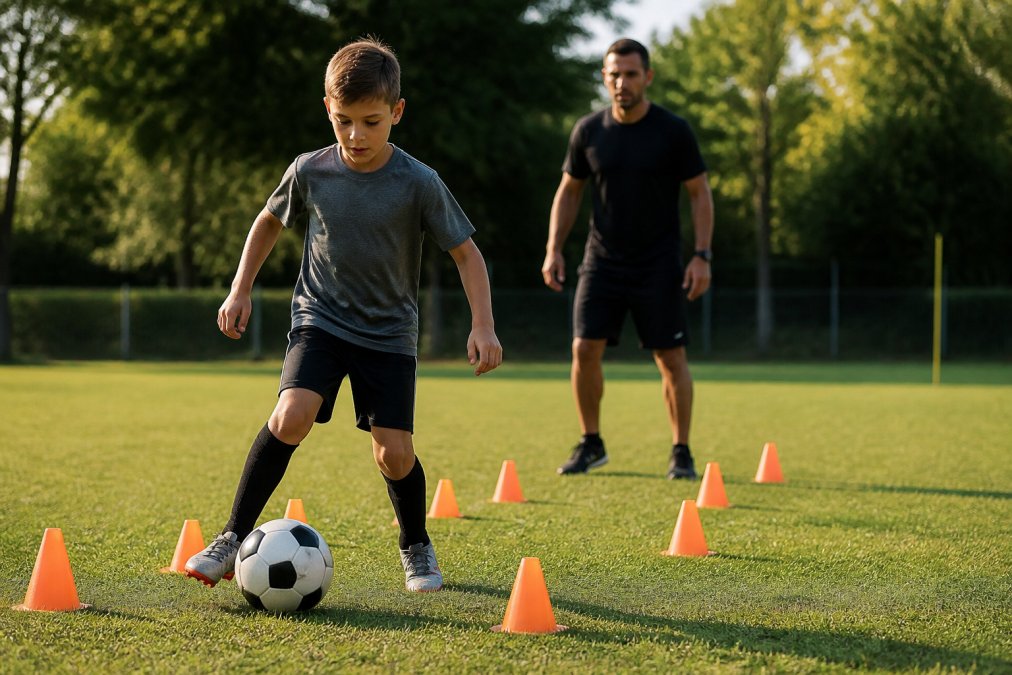
Cone Weave Dribbling (5 minutes)
Set up 6-8 cones one yard apart. Players dribble through using both feet, then accelerate out. Focus on keeping the ball close and head up.
Gate Passing (5 minutes)
Create small gates using cones. Players dribble through as many gates as possible in 60 seconds. This builds spatial awareness and close control.
Wall Ball First Touch (5 minutes)
Players pass against a wall and control the rebound with one touch, then pass again. Alternate feet each repetition.
Film your players during these drills. Most 10-year-olds don’t realize they’re looking down at the ball until they see it on video. Visual feedback accelerates correction faster than verbal instruction alone.
Passing and Receiving Techniques for 10-Year-Olds
Passing accuracy starts with proper technique: plant foot pointing at the target, contact with the inside of the foot, and follow-through toward the receiver. Receiving requires soft first touch and body positioning to shield the ball.
Partner Passing Progression:
- Static passing, 5 yards apart, dominant foot only
- Static passing, both feet alternating
- Moving passing while jogging
- One-touch passing under light pressure
Rondos (4v1 or 5v2)
This is the single best drill for developing passing under pressure. Players keep possession while defenders try to intercept. It teaches quick decisions, first touch, and communication.
US Youth Soccer’s technical development resources outline similar progressions for this age group, moving from unopposed to opposed activities as skills develop.
Shooting and Finishing Exercises
Shooting technique for 10-year-olds focuses on striking through the ball with the laces, keeping the ankle locked, and following through toward the target. Power comes later; accuracy comes first.
Shooting Progression:
- Stationary shooting from 8-10 yards
- Shooting after a pass (first-time finishes)
- Shooting after dribbling around a cone
- Shooting under pressure from a defender
Finishing Drill: Two-Goal Game
Set up two small goals. Players attack one goal, and after shooting, immediately transition to defend the other. This builds shooting technique and transition play simultaneously.
| Drill | Duration | Focus | Repetitions |
|---|---|---|---|
| Stationary shooting | 5 min | Technique | 10 per foot |
| First-time finishes | 5 min | Timing | 8-10 |
| Dribble and shoot | 5 min | Ball control | 6-8 |
| Two-goal game | 10 min | Transition | Continuous |
Youth Football Agility Drills
Agility for 10-year-olds is not conditioning in disguise. It is the ability to change direction, decelerate, and re-accelerate while keeping balance and a ball under control. Because players this age are still growing, long bones lengthen before tendons and muscles fully adapt, the priority is clean movement quality over volume or speed. Most youth strength and conditioning practitioners treat this as a coordination window, not a performance window.
That distinction matters for injury prevention. Growth-plate areas at the heel, knee, and hip are vulnerable to repetitive pounding and to hard stops on unforgiving surfaces. Agility work done well builds the landing mechanics and hip control that protect those areas; agility work done poorly (long reps, fatigued form, hard ground) is where overuse complaints like heel pain and knee soreness show up.
Progression order (teach in this sequence):
- Deceleration first. Sprint 5 yards, then come to a controlled two-step stop with knees bent and chest up. Most 10-year-olds can accelerate; few can stop safely.
- Linear change of direction. The 5-10-5: sprint 5 yards, plant and cut, sprint 10 yards, plant and cut, sprint 5 yards. Keep total reps to 4-6 per player with full rest.
- Lateral movement. Lateral shuffles and the T-drill (sprint forward, shuffle left, shuffle right, backpedal) teach hip control and body positioning.
- Ball-integrated agility. Only after the above look clean, add a ball: dribble through the ladder, dribble the T-drill, receive a pass and cut.
Agility ladder patterns worth teaching:
- One foot in each square (rhythm)
- Two feet in each square (quick feet)
- Lateral in-and-out (hip mobility)
- Icky shuffle (coordination)
Surface and footwear notes:
- Grass or a rubberized track is kinder to growing joints than asphalt or indoor hardwood.
- Cleats on hard ground reduce give; for dry, baked fields, turf shoes or flat-soled trainers are often the safer choice for agility work.
- Rotate direction so players cut off both feet, not just their dominant side.
Don’t turn agility work into conditioning. If players are gasping for air, form breaks down and you’re training fatigue, not speed. Keep reps under 10 seconds with full recovery between, a 1:5 work-to-rest ratio is a reasonable rule of thumb for this age.
A 12-minute agility block that fits any session:
| Minute | Activity | Reps |
|---|---|---|
| 0-3 | Deceleration stops from a 5-yard sprint | 6 |
| 3-6 | 5-10-5 shuttle | 4 |
| 6-9 | T-drill or lateral shuffle pattern | 4 |
| 9-12 | Ball-integrated ladder or cone weave | 4 |
If a player complains of heel or knee pain that lingers past a day, back off the volume and check footwear and surface before adding more. Persistent pain in a growing athlete is a signal to see a physician, not to push through.
Small-Sided Games and Decision-Making Under Pressure
Small-sided games are where technical skills become tactical awareness. Research consistently shows that game-based training produces better decision-makers than drill-only approaches.
Recommended Formats:
- 2v2: Maximum touches, constant decisions
- 3v3: Introduces combination play and spatial awareness
- 4v4: More realistic game scenarios, positional roles emerge
How to Structure SSG:
- Set up multiple small fields (20×30 yards)
- Games run 4-6 minutes with 2-minute rest
- Add conditions: two-touch limit, must pass before shooting
- Let them play free at the end
The Aspen Institute’s Project Play initiative highlights that free play and small-sided games are critical for long-term athletic development in youth sports.
Youth Football Practice Plan Template
A complete 60-minute session for 10-year-olds should follow a predictable shape so players spend their mental energy on the ball, not on figuring out what’s next. Adjust based on space, number of players, and the session goal.
| Phase | Time | Activity | Coaching Focus |
|---|---|---|---|
| Warm-up | 10 min | Dynamic movements with ball | Raise heart rate, activate muscles |
| Technical | 15 min | Dribbling, passing, first touch | Ball mastery, repetition |
| Skill drill | 10 min | Shooting or agility work | Technique under light pressure |
| Small-sided games | 20 min | 2v2, 3v3, or 4v4 | Decision-making, spatial awareness |
| Cool-down | 5 min | Light jog, static stretching | Recovery, review |
Session planning tips:
- Arrive 15 minutes early to set up stations.
- Keep instructions under 30 seconds; demonstrate once, then let them play.
- Use guided discovery, ask questions (“Where was the open space?”) instead of giving answers.
- End every session with a game they’ll remember.
The Home-Practice Gap (What Most Guides Skip)
Most 10-year-olds get two or three team sessions a week. That leaves a lot of days with no ball contact. You do not need a full pitch, a goal, or a partner to keep developing, you need a wall, a small patch of grass or driveway, and 15 minutes.
Solo drills for a backyard, driveway, or park:
- Wall ball first touch. Pass against a wall, control the rebound with one touch, pass again. Alternate feet. 5 minutes.
- Cone or shoe weave. Six objects a yard apart; dribble through with both feet, head up. 5 minutes.
- Juggling progression. Start with thigh, then foot, then alternate. Don’t chase a number, chase clean contact.
- Turns in a tight box. Set four markers in a 5×5-yard square and practice turning with the inside, outside, and sole of the foot.
- Wall passing accuracy. Tape a target on the wall; hit it 20 times with each foot from 5 yards.
A 15-minute home routine:
| Minutes | Drill | Focus |
|---|---|---|
| 0-3 | Dynamic warm-up (leg swings, high knees, skips) | Prepare the body |
| 3-8 | Wall ball first touch | Receiving, both feet |
| 8-13 | Cone or shoe weave | Close control, head up |
| 13-15 | Juggling or turns | Coordination, comfort on the ball |
Fueling and Recovery for Growing Bodies
Training only pays off if the body has what it needs to adapt. For 10-year-olds, that means:
- Water before, during, and after. A water bottle at every session; sports drinks are rarely necessary at this age and add sugar.
- A snack within an hour of training. A mix of carbohydrate and protein, fruit and yogurt, a peanut butter sandwich, or chocolate milk, supports recovery.
- Sleep is the real recovery tool. Most youth athletes this age need roughly 9-11 hours. A late practice plus an early school start is a bigger performance drain than any missed drill.
- Rest days matter. Growing bodies adapt during rest, not during the session. Two or three team sessions plus light home work is plenty; more is not better.
Confidence and the Mental Side of the Game
Skill development stalls when a 10-year-old is afraid of making a mistake. A few habits build confidence faster than any drill:
- Praise effort and decisions, not just outcomes.
- Let players make choices in small-sided games, even bad ones, so they learn to trust their own read of the game.
- Keep the ratio of encouragement to correction high; a common guideline is several positives for every piece of corrective feedback.
- Normalize mistakes: the best players in the world give the ball away. What matters is what happens next.
For families considering specialized development, the NCAA’s guide to college recruitment explains the pathway from youth football to collegiate opportunities. QB Factory has helped develop over 300 full scholarship players through a progressive training formula that combines physical mechanics with classroom-style mental preparation. If you want to see how that approach works in practice, you can Apply today! to get started.
Frequently Asked Questions
What is the best age to start football training?
Most youth football programs begin at age 5 or 6, but age 10 is an ideal time to focus on technical skills like ball mastery, passing accuracy, and first touch. At this age, children have the coordination and attention span to benefit from structured drills. Starting early builds a foundation, but 10-year-olds can still make rapid progress with consistent practice. Focus on fun and fundamentals rather than competition.
What core skills should 10-year-old football players focus on?
Prioritize dribbling, ball control, passing, receiving, and shooting technique. Agility and coordination drills improve footwork and spatial awareness. Small-sided games help develop decision-making under pressure. Introduce basic defensive stance and 1v1 scenarios. Keep sessions game-based and fun. For throwing mechanics, especially for quarterbacks, work on grip, stance, and follow-through. Balanced training prevents burnout and builds all-around players.
How can 10-year-olds improve their agility and footwork for football?
Use ladder drills, cone shuttles, and reaction games to build agility and coordination. Practice lateral movements, quick feet, and change of direction. Incorporate 1v1 scenarios and small-sided games to apply footwork in game-like situations. Aim for 10-15 minutes of agility work per session, two to three times a week. Always warm up first. Consistency matters more than intensity at this age.
How do you balance fun and skill development in youth football training?
Make drills game-based and competitive. Use small-sided games, relays, and challenges that keep kids engaged while reinforcing technique. Set short, achievable goals and celebrate progress. Rotate activities every 10-15 minutes to maintain focus. End sessions with a fun scrimmage. When players enjoy training, they practice more and improve faster. Skill development happens naturally when kids are having fun.
Developing a 10-year-old into a confident, skilled football player takes more than random drills. It requires a structured approach that builds technical foundations while keeping the game fun. QB Factory delivers elite training for quarterbacks, receivers, and linemen through individualized drills, former D1 coaching expertise, and a proven system that prepares athletes for high-pressure situations. Get started with QB Factory and give your athlete the tools to dominate at every level.