
Table of Contents
- The Real Value of Private Football Coaching: A Data-Driven Look
- Private Football Coaching Cost: What You’re Paying For
- Frequency of Private Football Training: Finding the Right Dose
- How to Choose a Private Football Coach: Credentials and Red Flags
- Private Coaching vs. Team Training: Integration, Not Replacement
- Measuring ROI: When Private Coaching Pays Off for Recruiting
- Frequently Asked Questions
Last Updated: September 13, 2026
The Real Value of Private Football Coaching: A Data-Driven Look
Private football coaching is one-to-one instruction focused on position-specific technique, decision-making, and physical mechanics, delivered outside a team practice schedule. The answer depends less on the coach’s résumé and more on whether your athlete has a defined skill gap that team practice cannot close. This guide breaks down cost, frequency, integration, and red flags so you can decide with evidence instead of hope.
What Individualized Feedback Actually Changes
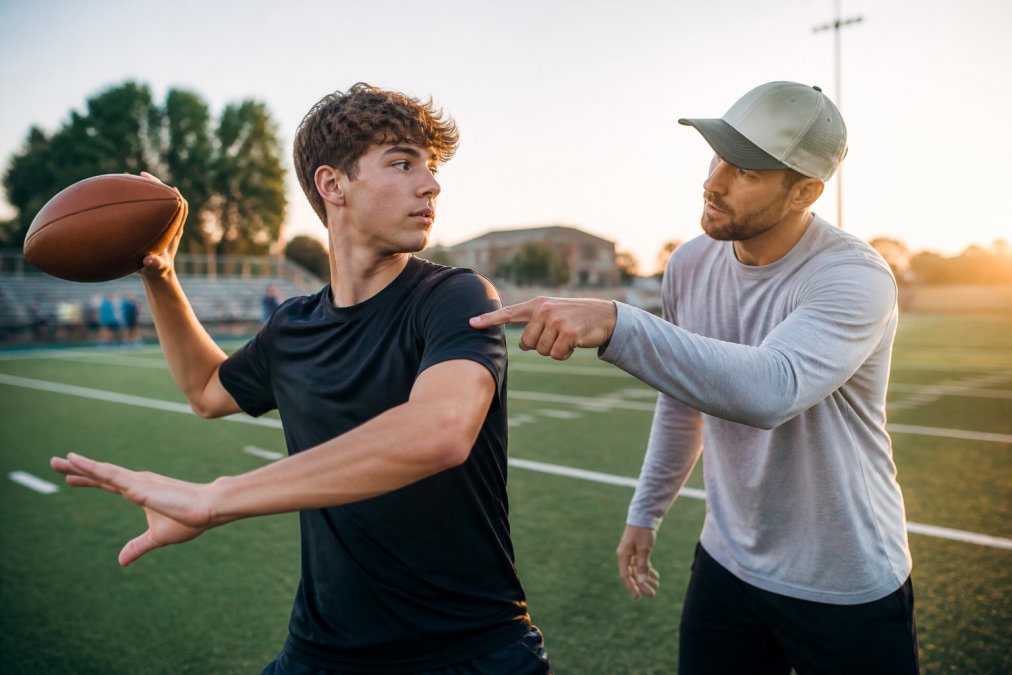
The core difference is repetition volume with correction. In a team session of twenty-plus players, a quarterback might take fifteen live throws while a coach watches five of them. In one-to-one coaching, that same athlete takes sixty throws with feedback on nearly every rep.
- Mechanics: grip, release point, and hip rotation get corrected in real time
- Decision-making: reads and progressions are rehearsed against live looks
- Confidence: game-speed reps in a low-pressure setting reduce panic on Friday nights
A common mistake is treating private football coaching as a cure-all. It refines what team practice builds. It does not replace it.
Private Football Coaching Cost: What You’re Paying For
Private football coaching cost varies widely by region, coach credentials, session length, and whether training is in-person or remote. Most families pay per session or per package, and pricing depends on the coach’s playing and coaching background, group size, and facility access. QB Factory does not publish fixed rates because packages differ by position and program length; check the website for current pricing or a quote.
What the Market Actually Charges
Private one-on-one sessions, group sessions, and remote film-review or classroom sessions vary in cost. Package pricing usually carries a modest per-session discount, but it also locks you in before you’ve seen whether the coach’s method fits your athlete. Ask for a single paid trial session before committing to a package.
Breaking Down the Investment
When you evaluate a price, separate the invoice into four parts:
| Cost Component | What It Covers | Why It Matters |
|---|---|---|
| Coach time | One-to-one instruction | Smaller ratios mean more reps |
| Facility | Turf, nets, film room | Better surfaces reduce injury risk |
| Film and analysis | Video review, cut-ups | Turns reps into correctable habits |
| Curriculum | Position-specific plan | Prevents random drill selection |
A $120 session that includes 20 minutes of film review and a written plan for the next week is often a better value than an $80 session of unstructured throwing. Price per hour is the wrong denominator; price per corrected rep is closer to right.
The Hidden Costs Nobody Quotes
Budget for the line items that don’t appear on the invoice:
- Travel and time. A 45-minute drive each way turns a one-hour session into a three-hour commitment for a parent.
- Gear and recovery. Cleats, a personal ball, resistance bands, and recovery tools add up over a season.
- Opportunity cost. Every private session is an hour not spent on schoolwork, rest, or another sport.
- The upgrade trap. Coaches who upsell “elite” tiers, showcase circuits, or recruiting exposure packages after the first block are common.
Paying a premium rate for a coach who runs the same generic drill circuit for every athlete is the most common waste of money in this market. Ask to see a written plan for your athlete before you pay for a package.
How to Compare Two Quotes
Put both coaches on the same page before you decide:
- Ask each for the per-session rate, package rate, and what happens if you miss a session.
- Ask how much of each session is instruction versus conditioning or warm-up.
- Ask whether film review is included or billed separately.
- Ask for one written benchmark the coach expects to move in 90 days.
If a coach can’t answer those four questions in plain language, the price is irrelevant, you’re buying time, not development.
Frequency of Private Football Training: Finding the Right Dose
Frequency of private football training should match the athlete’s development stage, not their ambition. For most youth athletes, one session per week during the season and two per week in the off-season is a workable baseline. More is not automatically better.
Training Load Management and Burnout Risks
This is the angle most guides skip. An athlete already logging five team practices, a weight session, and a game each week has a full plate. Adding three private sessions on top pushes total training load past what a teenage body and mind recover from.
Signs you’ve overshot:
- Declining performance in team practices despite extra work
- Complaints of persistent soreness or joint pain
- Loss of enthusiasm for the sport itself
- Sleep disruption before game day
Track total weekly hours across team practice, private sessions, and strength training. If the number climbs and performance drops, cut a private session before you cut team practice. Recovery is part of the program, not a break from it.
How to Choose a Private Football Coach: Credentials and Red Flags
How to choose a private football coach comes down to three filters: verifiable credentials, a written development plan, and honest communication. Playing experience helps, but coaching experience matters more. A former college player who has never taught the position is a workout partner, not a coach.
Coaching Credentials That Matter
Look for coaches who have played or coached at the college level, hold position-specific expertise, and can explain their teaching method in plain language. QB Factory’s staff includes former D1 quarterbacks and receivers, two state championship coaches, a college head coach, and current college coaches with Big 10 recruiting experience. If you’re ready to see whether a program like this fits your athlete, you can Apply today! to start the conversation.
Quarterback Registration (Required) →
Red flags to walk away from:
- No film review or feedback structure
- Guarantees about scholarships or starting positions
- No written plan or measurable benchmarks
- Pressure to commit to a large package up front
- No interest in how the athlete performs in team settings
Private Coaching vs. Team Training: Integration, Not Replacement
The best private coaching plugs into team football rather than competing with it. A private coach should ask what your team runs, what the depth chart looks like, and where the athlete is losing reps. Then the private work targets that gap.
For a quarterback, that might mean cleaning up footwork in the pocket so the offensive coordinator’s timing routes actually work. For a receiver, it might mean refining release technique against press coverage the team will face in conference play. When private instruction and team schemes align, the athlete stops playing two different sports on two different fields.
Ask any coach you interview one question: “How will you coordinate with my son’s high school staff?” The answer tells you whether you’re hiring a teacher or a highlight-reel salesman.
Measuring ROI: When Private Coaching Pays Off for Recruiting
Private football coaching pays off when it produces measurable, film-visible improvement that recruiters can evaluate. That means faster forty times, cleaner route stems, more accurate throws under pressure, and better decision-making on tape. QB Factory has developed over 300 full scholarship players, and the pattern is consistent: athletes who train with a defined plan and review their film improve at a rate that shows up in recruiting footage.
A 90-Day ROI Rubric Parents Can Actually Run
Most families judge private coaching by feel. A rubric replaces feel with a decision. Score each metric at the start of a training block and again at day 90.
| Metric | Baseline | 90-Day Target | How to Measure |
|---|---|---|---|
| Throw accuracy | Current completion % | Improve by defined margin | Charted practice reps |
| Route precision | Self-rated | Coach-rated | Film review |
| Decision speed | Average read time | Faster reads | Scrimmage film |
| Recruiter interest | Current contacts | More film requests | Coach outreach log |
| Coach’s eye test | Team coach rating | Team coach rating | Ask the position coach directly |
The last row matters most. If the high school position coach, not the private coach, sees the improvement, the training is transferring. If only the private coach sees it, you’re paying for a comfortable environment, not development.
The Decision Rule
Set the rule before you pay, not after. A workable version:
- Two or more metrics improve and the team coach confirms it: continue, and consider adding a session.
- One metric improves, others flat: continue at the same dose for one more block, then re-score.
- No metric improves after a full 12-week block: change the plan or the coach. Do not simply add more sessions, that is the most expensive way to stay stuck.
- Performance declines while training load rises: cut a private session before you cut team practice. Recovery is part of the program.
The Burnout Check
ROI is not only about skill. An athlete logging five team practices, a weight session, and a game each week, plus two or three private sessions, is past the load a teenage body and mind recover from. Watch for declining performance in team practices despite extra work, persistent soreness or joint pain, loss of enthusiasm for the sport itself, and sleep disruption before game day. Any of those signals means the marginal private session is costing more than it returns, regardless of what the scorecard says.
What ROI Is Not
Private coaching is not a scholarship guarantee, and no honest coach will frame it as one. Recruiting exposure comes from film, camp performance, and coach relationships. Private training can sharpen the tools that make that film worth watching, but it cannot manufacture size, speed, or a recruiter’s need at a position. If a coach promises a scholarship outcome, that is a red flag, not a return.
The athletes who get the most from private football coaching are not the most talented. They are the ones with a specific gap, a written plan, a coach who reviews film with them every week, and a parent who scores the results on a fixed date instead of trusting a feeling.
Frequently Asked Questions
How much does private football coaching cost?
Private football coaching cost varies based on the coach’s credentials, location, and session length. Many programs offer package rates for multiple sessions. QB Factory does not publish pricing, so contact them directly for a quote tailored to your athlete’s needs.
At what age should an athlete start private football coaching?
There is no single right age. Youth athletes as young as 7-10 can benefit from fundamental skill work, but the focus should be on fun and motor skill development. For high school athletes aiming for college recruitment, private coaching becomes more critical for position-specific training and tactical awareness. Evaluate your child’s readiness and goals before investing.
Does private coaching help with college recruiting prospects?
Yes, when done right. Private coaching can improve technical proficiency, game intelligence, and physical metrics that college scouts evaluate. However, it works best when combined with a player development pathway that includes film review, camp exposure, and team success. QB Factory has helped over 300 athletes earn full scholarships, showing that targeted training can make a difference.
What are the signs of a bad private football coach?
Red flags include a lack of coaching credentials, no clear plan for skill acquisition, overpromising recruitment results, and ignoring safety or training load management. A good coach will provide individualized feedback, track progress, and communicate openly with parents and team coaches. Always ask for references and observe a session before committing.