

Table of Contents
- Building Your Target List of Colleges
- How to Email College Coaches for Recruiting
- How to Make a Highlight Film for College Recruiting
- The College Football Recruiting Timeline Every Prospect Must Know
- Understanding NCAA Eligibility and Academic Requirements
- Camps, Showcases, and Getting Noticed by College Scouts in Person
- Mental Health, Burnout, and the Transfer Portal Reality
- Frequently Asked Questions
Last Updated: September 14, 2026
Building Your Target List of Colleges
The fastest way to get noticed by college scouts is to treat recruiting like a search filter, not a lottery. Most families send film to dozens of programs and hear nothing back; the athletes who generate real interest build a target list first.
A target list is a ranked group of 15-25 colleges that match your athletic level, academic profile, and positional need. It has three tiers: reach programs where you’d need a standout camp performance, match programs where your film and measurables fit the roster, and safety programs where you’re a likely contributor. Coaches recruit to fill specific roster spots, so a program that just signed two quarterbacks in your class is not a match no matter how good your film is.
Build the list by position need, not by logo. Check each program’s NCAA recruiting rules and calendar to understand when coaches in your sport can contact you, then sort your list by division, scheme fit, and academic fit.
A common mistake is listing only Power Four programs. Coaches at every division sign players, and a strong offer from a program that actually wants you beats a walk-on shot at a name-brand school every time.
How to Email College Coaches for Recruiting
A recruiting email is a short, specific introduction that gives a coach three things: who you are, why you fit their program, and where to watch your film. Coaches receive hundreds; the ones that get replies are personal, brief, and easy to act on.
Subject Line and Opening Paragraph
Write a subject line a coach can scan in two seconds: 2027 QB | 6'2" 195 | 4.7 40 | [Your High School] | Film Inside. The opening paragraph should name the coach, state your graduation year and position, and give your two or three best measurable stats. Skip the flattery, coaches care about fit and film.
Follow-Up Timing and Etiquette
Send your first email, then follow up once after 10-14 days if you get no reply. One follow-up, not five. If a coach asks for your transcript or game film, send it within 24 hours, prompt follow-through signals the kind of player a staff wants.
How to Make a Highlight Film for College Recruiting
The best highlight film is 3-5 minutes long, opens with your single best play, and shows your position-specific skills in the first 60 seconds. Coaches watch the first play or two and decide whether to keep watching.
Length, Order, and What to Cut
Order matters more than volume. Lead with your best play, then group clips by skill: throwing on the move, reading coverage, footwork in the pocket, blocking technique. Cut anything that doesn’t show a college coach what he needs to see. A 20-play reel of you standing in the pocket beats a 10-minute compilation with shaky camera work and dead time.
Put your name, position, graduation year, height, weight, and contact info on a title card at the start, and host the film on a platform a coach can open in one click. If a coach has to download a file or sit through an ad, you’ve lost him.
The College Football Recruiting Timeline Every Prospect Must Know
The recruiting timeline is the calendar of contact, evaluation, and dead periods that governs when college coaches can reach out. Miss it and your outreach lands in a quiet window; know it and you can time your film and camp schedule to the moments coaches are actually evaluating.
Dead Periods, Contact Periods, and Evaluation Periods
A dead period means no in-person contact and no visits, though coaches can still call and email. A contact period allows in-person meetings and visits, on and off campus. An evaluation period lets coaches watch you compete but not talk to you in person. A quiet period is the one most families miss: coaches can talk to you in person only on their own campus, and can still call, text, and email.
Each sport publishes its own calendar, and the dates shift year to year, so check the NCAA recruiting calendars by sport before you plan anything. What follows is the shape of a typical football calendar so you can see how the windows actually fall.
What a Football Recruiting Year Actually Looks Like
Football runs on a calendar most prospects only learn after mistiming a camp. The broad pattern:
- January: A dead period surrounds the College Football Playoff championship game, then a contact period opens for the final weeks of the month, when coaches make in-home visits with priority prospects.
- February: National Signing Day falls in early February, followed by a dead period. If you are a junior, use this quiet month to update film, not to cold-email.
- March and April: Spring evaluation windows open. Coaches travel to high schools to watch spring practices and games, the best month for an underclassman to get eyes on him in person, because coaches are already on the road.
- May: A dead period typically closes out spring evaluation. Coaches can still call and email, so this is a relationship-building month, not a film-drop month.
- June and July: Summer camps and official visit windows. Most programs run their own camps in June, and rising seniors can begin taking official visits. If you spend money on one camp, spend it on a campus where the staff recruits your position.
- August: Fall camp opens for college teams and a dead period usually applies to prospects. Your job this month is your own season, not outreach.
- September through November: The season. Coaches evaluate senior film in real time, and game-day unofficial visits are in play. Send weekly film updates on Sunday or Monday, when staffs review the weekend.
- December: A dead period surrounds the early signing period in mid-December, then a contact period opens. This is the last high-leverage window for uncommitted seniors.
How to Use the Calendar Instead of Fighting It
The practical takeaway: send your film and emails during evaluation and contact windows, and use dead periods to build relationships by phone and email. A coach who receives your highlight reel on the first day of a dead period cannot invite you to campus, so your email gets filed. The same email sent the week spring evaluation opens lands while the coach is already planning a trip through your area.
Two rules that save prospects a year of wasted effort:
- Never plan a camp without checking the calendar for your sport and division. Division I, Division II, and Division III operate on different contact rules, and the windows do not line up.
- Treat the calendar as a scheduling tool, not a permission slip. Coaches can always read an email. What the calendar controls is whether they can act on it, and acting is what you want.
The recruiting timeline isn’t a suggestion. It’s the rulebook.
Mark the first day of each contact and evaluation window on your phone calendar now, and set a reminder two weeks before. Most prospects find out a window opened after it has already closed.
Understanding NCAA Eligibility and Academic Requirements
NCAA eligibility is a two-part gate: your academic record and your amateur status. You can be the best player on your team and still be ineligible if your core-course GPA or test scores don’t clear the bar, so treat the classroom as part of your training.
Quarterback Registration (Required) →
Register with the NCAA Eligibility Center early in high school, not senior year. Keep your transcript clean, take the required core courses, and track your GPA each semester. Division I and Division II have different academic standards, and the specific requirements change, so confirm current numbers with the Eligibility Center rather than relying on what a friend’s older brother was told.
Waiting until junior year to check your eligibility is the single most common mistake in recruiting. By then, a weak semester can’t be fixed in time, and a coach who was interested moves on.
Camps, Showcases, and Getting Noticed by College Scouts in Person
Camps and showcases are where film gets verified. A coach who liked your highlight reel wants to see you move in person, and a strong camp performance can turn a cold email into a real conversation.
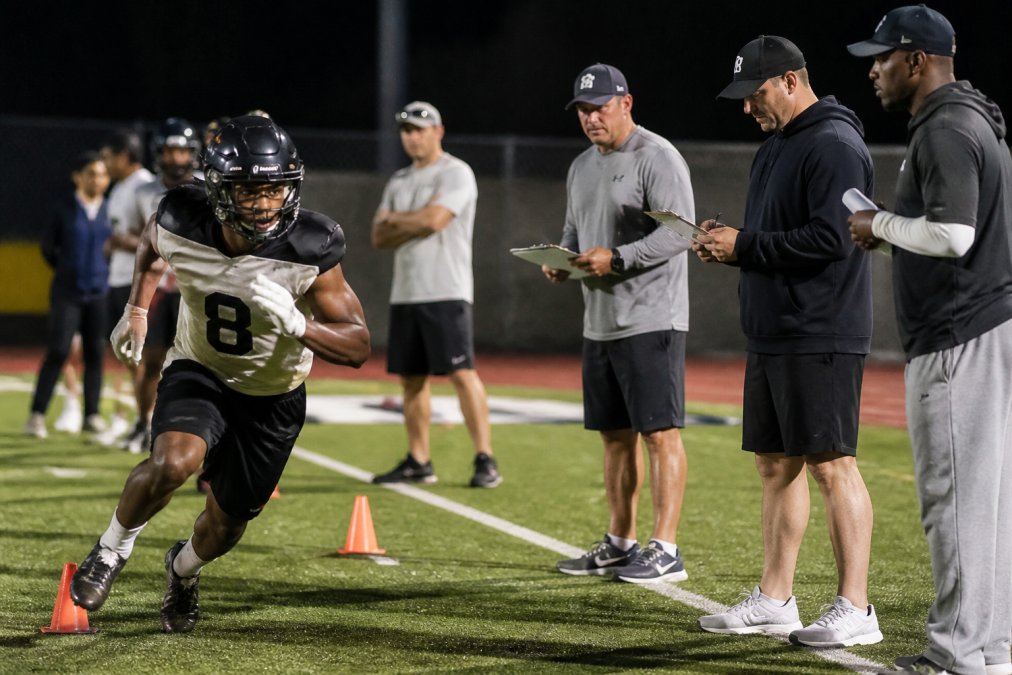
Pick camps where the coaching staff recruits your position, not the biggest-name camp in the region. Send a short email before the camp telling the staff you’ll be there, and follow up afterward with a thank-you note and updated film. A showcase event is a chance to compete against other prospects; a skill assessment at a camp lets coaches see your footwork, mechanics, and how you respond to coaching in real time.
Mental Health, Burnout, and the Transfer Portal Reality
Most recruiting guides tell you to grind harder. Almost none tell you what the grind costs, or how the roster math works against a high school prospect. Families who understand both make better decisions and quit less often.
The Transfer Portal Changed the Math for High School Prospects
The transfer portal lets college athletes enter their name and be recruited by other programs without sitting out a year. That is good news for college players and complicated news for you.
Every program has a fixed number of scholarships and roster spots per year. When a coach fills three of those spots with experienced transfers, those are three spots unavailable to incoming high school seniors. A transfer is a known quantity, game film against college competition, a college-strength body, no adjustment period. A high school senior is a projection. Coaches under pressure to win now often prefer the known quantity.
What that means in practice:
- Roster spots at some programs are tighter than the published recruiting class size suggests. A program that signs 20 players may have taken several of them from the portal.
- Your film has to answer a question the portal cannot. Transfers bring experience; you bring four years of eligibility and a lower cost. Lead with that.
- The portal cuts both ways for you. If you sign somewhere that turns out to be the wrong fit, you have a path to move without losing a year of eligibility, a real safety net that did not exist a decade ago.
- Pick a school for the right reasons, not the logo. If you might be there for one year or four, the academic fit and the position coach matter more than the brand on the helmet.
Burnout Is a Recruiting Problem, Not Just a Personal One
The recruiting process is a grind, and burnout is real. Training year-round, chasing camps, refreshing your inbox, and comparing yourself to strangers on social media takes a toll on teenagers. Burnout does not just feel bad, it shows up in your film as flat effort, and coaches notice flat effort faster than a slow 40 time.
A few patterns that help:
- Schedule an off week every eight to ten weeks. Not a lighter week. An off week. Athletes who never deload tend to lose a season to injury or quit entirely.
- Separate process goals from outcome goals. You control how many coaches you email, how many film updates you send, and how many camps you attend. You do not control whether a coach replies. Track the first list, not the second.
- Cap the inbox. Checking email twice a day instead of twenty times makes the process feel survivable.
- Talk to someone outside the recruiting bubble. A parent, a school counselor, or a coach who is not paid to evaluate you. The recruiting industry has a financial incentive to keep you anxious.
- Know the signs it has gone too far: losing interest in the sport itself, dreading practice, sleep problems, or withdrawing from friends. Those are signals to pull back, not weakness.
The Money Conversation Most Guides Skip
Once a coach is genuinely interested, the conversation turns to money, and almost no recruiting guide prepares families for it. A few things worth knowing before that call:
- Athletic scholarships are not the only money on the table. Academic merit awards, need-based aid, and institutional grants often stack with or exceed a partial athletic offer. A strong GPA can be worth more than a few tenths on your 40.
- Division III and Ivy League programs do not offer athletic scholarships, but they frequently offer academic packages that make attendance possible. Do not rule out a school because it cannot offer an athletic scholarship.
- Ask what the offer actually covers. Tuition only, or tuition, fees, room, board, and books? The gap is often five figures a year.
- Ask whether the offer is guaranteed for four years or renewed annually. Most athletic aid is renewed year to year, and knowing that up front changes how you evaluate a verbal offer.
- It is acceptable to ask for time. “Thank you, can I have a week to talk it over with my family?” is a normal sentence. Coaches expect it.
- Get every offer in writing before you commit. Verbal offers are not binding on either side.
Do not let a scholarship offer pressure you into a decision before you have visited campus and met the position coach. The coach who recruits you is not always the coach who will be there in two years.
Recruiting is a long game played over years, not a single camp or email. Protect your body and your head, understand the roster math you are competing against, and ask the money questions early. The athletes who stay consistent, keep their academics clean, and treat coaches with respect are the ones still standing when the offers come.
Frequently Asked Questions
How do you get scouts to notice you?
Scouts notice players who combine on-field production with proactive outreach. Build a target list of 20-30 schools that match your athletic and academic profile. Send personalized emails with your highlight film, athletic statistics, and transcript. Attend camps and showcases where college coaches evaluate in person. Keep your social media clean and recruiting-focused. Follow up consistently, and ask your high school and travel coaches to make calls on your behalf. The players who get noticed are the ones who treat recruiting like a year-round job.
How do I get my child noticed by college recruiters?
Start early, but stay realistic about the college football recruiting timeline. Freshman and sophomore year, focus on academics and skill development. Build a highlight film by the end of sophomore season. Send direct outreach emails to college coaches at schools that fit your child’s level. Attend camps the summer before junior year, when evaluation periods are active. Parents should handle logistics and encouragement, but let the athlete write the emails and make the calls. Coaches want to hear from the prospect, not just the parent.
How to get noticed by college football scouts?
Getting noticed by college football scouts requires three things: film, exposure, and communication. Your highlight reel should be 3-5 minutes, lead with your best plays, and include your jersey number, position, and graduation year. Attend showcase events and college camps where scouts evaluate live. Send recruiting questionnaire responses and follow-up emails to coaching staffs at your target schools. Update coaches when your athletic statistics improve or you receive new accolades. Consistency matters more than one big game.
How to get D1 coaches’ attention?
D1 coaches receive hundreds of emails weekly. To stand out, send a personal introduction that names their program specifically and explains why you fit their scheme. Include a link to your highlight film, your GPA, and your NCAA eligibility center ID. Attend their camps in person so they can evaluate you. Get your high school coach to call the position coach directly. Follow up every few weeks with updates. D1 roster spots go to prospects who make themselves easy to evaluate and easy to contact.
What do college scouts look for in high school athletes?
College scouts evaluate athletic performance, size, speed, and football IQ. They watch film for technique, reaction time, and how you perform against top competition. They check your academic profile, including GPA and test scores, because NCAA eligibility matters. Character and coachability show up in how you interact at camps and in your social media presence. Scouts also value versatility and leadership. A prospect who runs a fast 40-yard dash but has a 2.0 GPA will struggle. Grades and film open doors.
When should high school athletes start the recruiting process?
The college football recruiting timeline starts earlier than most families expect. Freshman year, create your NCAA eligibility center account and focus on grades. Sophomore year, build your highlight film and attend a few local camps. Junior year is the most important: send direct outreach to college coaches, attend showcases, and take unofficial visits. Senior year, schedule official visits and be ready to make a verbal commitment. Starting late means fewer roster spots and less scholarship leverage.