


Last Updated: November 11, 2026
Quick Summary
Team football practice gives a player reps, teammates and a coach who knows the roster, but one coach managing 40 or more athletes can only give each player a few focused minutes. Private coaching concentrates attention on one athlete, which is why it works best for quarterbacks and skill players who need detailed correction of footwork and throwing mechanics.
- Team practice typically involves 40 or more athletes per coach.
- Team practice excels at conditioning, team concepts and game-day familiarity.
- Reps without correction tend to reinforce bad habits.
- Private sessions allow repeated, individual correction of a single flaw.
- Pair private sessions with enough team reps to apply what is learned.
Table of Contents
- What Team Practice Does Well and Where It Falls Short
- What Private Coaching Adds for Quarterbacks and Skill Players
- How Your Player’s Age and Experience Change the Choice
- Finding Private Football Coaching in Crofton, MD
- How Football Training Sessions in Crofton, MD Are Structured
- Questions to Ask Before You Book a Coach
- Booking Your Player’s First Session at QB Factory
- Frequently Asked Questions
What Team Practice Does Well and Where It Falls Short
Team practice is the default for most youth and high school football players. It gives a player reps, teammates, and a coach who knows the roster. But one coach managing 40 or more athletes can only give each player a few focused minutes, and that gap matters for quarterbacks and skill players who need detailed feedback on footwork and throwing mechanics.
Team practice works well for conditioning, team concepts, and game-day familiarity. It falls short when a player needs repeated, individual correction. A common mistake is assuming that more team reps automatically build better technique. Reps without correction tend to reinforce bad habits.
The article contrasts team practice with private coaching across several dimensions, summarised below.
| Aspect | Team practice | Private coaching |
|---|---|---|
| Athletes per coach | 40 or more | One athlete |
| Individual feedback | A few focused minutes each | Repeated, individual correction |
| Best for | Conditioning, team concepts, game familiarity | Footwork, throwing mechanics, position skills |
| Main risk | Reps without correction reinforce bad habits | Drill-room skill that doesn’t transfer to games |
What Private Coaching Adds for Quarterbacks and Skill Players
Private coaching concentrates attention on one athlete. The coach can watch a single drop, pinpoint the flaw in the plant foot or the release point, and drill that exact fix. That focus is the main difference from team practice.
For quarterbacks, this means work on footwork, throwing mechanics, and reading pass defenses. For receivers and linemen, it means route precision, hand technique, and position-specific movement. We build individualized drill sets around each athlete’s strengths and gaps.
How Your Player’s Age and Experience Change the Choice
Age and experience should drive the decision more than convenience. The right mix depends on where the player is in their development, and in Crofton that means weighing local team options against private coaching.
For players ages 7 to 10, the priority is fun, fundamentals, and broad athletic movement. Crofton’s recreational leagues and flag football programs give young players team reps and social engagement. A small amount of private work on stance, grip, and footwork can help, but heavy private training at this age risks burnout without much gain.
For middle school players ages 11 to 13, technique starts to matter more. Crofton Middle School and local club teams provide structured practice, but roster sizes often limit individual correction. This is the age where a private coach can clean up throwing mechanics or route running before bad habits harden.
For high school players, the question becomes more specific: is the player’s current limit technique, or simply opportunity? A varsity starter getting game reps may only need private work on a specific flaw, such as footwork under pressure or reading coverages. A player stuck behind a deeper depth chart may need private coaching to build a recruiting film that team practice alone won’t produce. Ask the question directly and let the answer point toward the right mix.
Watch out: parents often book private coaching as a cure-all before confirming whether the player is getting enough team reps to apply what they learn. Private sessions without game-speed reps tend to produce drill-room proficiency that doesn’t transfer to Friday nights.
A practical decision framework for Crofton families:
- If the player is new to football or under age 10, start with a recreational or flag team and add private work only for a specific fundamental.
- If the player is in middle school and serious about a position, combine team practice with weekly private sessions focused on that position.
- If the player is in high school and aiming for college, use team practice for game-speed reps and private coaching for the technical details recruiters evaluate on film.
- If the player is recovering from an injury or returning after time off, prioritize a gradual return with a coach who coordinates with the team trainer.
This framework is not a rulebook. It is a starting point for a conversation with the player and, where possible, the team coach.
Finding Private Football Coaching in Crofton, MD
Parents searching for private football coaching in Crofton, MD will find options ranging from individual trainers to position-focused programs. Start with a clear list of goals: skill position development, D1 recruitment preparation, or foundational technique for a younger player.
Our private quarterback coaching program for D1 scholarships is built for athletes targeting college opportunities. If you are comparing options in the area, our step-by-step guide to choosing a football training program in Crofton covers what to check before committing.
How Football Training Sessions in Crofton, MD Are Structured
Private sessions in Crofton are often run in focused blocks. A well-structured session can start with a dynamic warm-up, move into footwork and mechanics work, and finish with simulated reps under game-like conditions. The best coaches explain the plan before the first rep so the athlete knows what is being fixed and why.
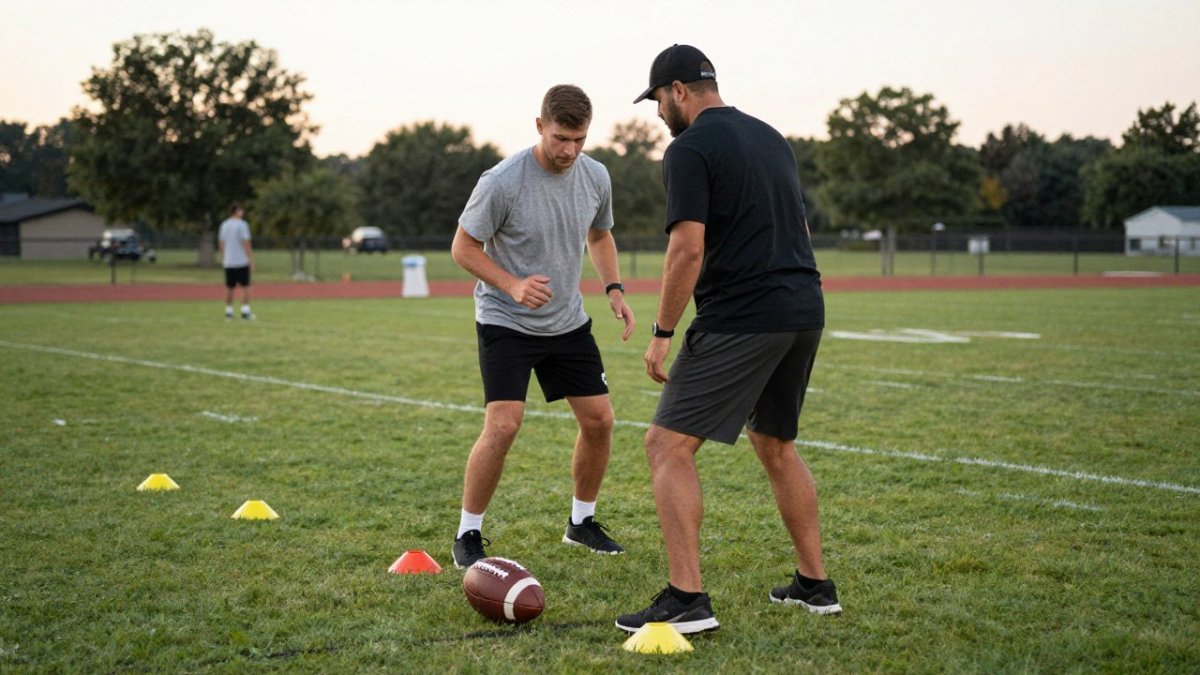
Session length, frequency, and intensity should match the athlete’s age and workload. For youth players, a 45-minute session with plenty of water breaks and skill variety is usually more productive than a longer grind. For high school athletes, 60 minutes allows time for position-specific drills and conditioned reps. The right number of private sessions depends on how much team practice the player is already doing.
Safety and workload deserve as much attention as technique. Football is a contact sport, and private coaching should not add unnecessary wear and tear. Ask any coach how they manage rest, hydration, and recovery, and whether they coordinate with the player’s team coach or athletic trainer. Age-appropriate training means avoiding heavy contact drills in private sessions and focusing on movement quality, technique, and controlled speed work. Private sessions should complement team practice, not replace conditioning or contact preparation.
A sample 60-minute session might look like this:
- 10 minutes: dynamic warm-up and mobility
- 15 minutes: position-specific footwork and mechanics drills
- 15 minutes: route or throwing reps with corrective feedback
- 10 minutes: simulated game-speed reps
- 10 minutes: cool-down, review, and homework for the next session
Watch out: a session that is all drills and no game-speed reps can leave the player unprepared to apply technique under pressure. Ask the coach how much of the session is live or simulated.
Before committing, ask any provider to walk you through a sample session plan and explain how they track progress from week to week. A coach who can describe measurable checkpoints, such as completion percentage under pressure or route timing, is easier to evaluate than one who only promises improvement.
Questions to Ask Before You Book a Coach
Before booking, ask these questions:
- What is the coach’s playing and coaching background, and at what level?
- How do you measure progress for a player at my child’s age and position?
- How is the session structured, and how much of it is individual versus group?
- What is the cancellation and rescheduling policy?
- Can you share examples of players who have improved and moved to the next level?
A good coach will answer each of these plainly. Vague answers are a warning sign.
Our breakdown of whether private football coaching is worth it in 2026 walks through these tradeoffs in more depth.
Booking Your Player’s First Session at QB Factory
Booking a first session is straightforward. Choose the program that fits your athlete’s position and goals, then schedule quarterback sessions directly through our site. Our step-by-step guide to booking elite football training sessions explains each stage, from registration to the first on-field session.
For current availability and next steps, apply today through our news page. QB Factory focuses on individualized development, and first sessions are built around your athlete’s current level.
Frequently Asked Questions
Is private football coaching worth it?
It depends on the player’s goals and position. Private coaching gives one athlete repeated reps on footwork, throwing mechanics and reads that a team practice rarely has time for, especially when a group of 40 players shares a few coaches. For a quarterback or receiver aiming at college recruitment, that focused time is often the reason to add it. For a younger player still learning fundamentals, team practice may cover most of what he needs. Ask any provider how the session is built and what the player will work on before committing.
What is the difference between football training and private coaching?
Team practice is built around the whole roster: installing schemes, running group periods and scrimmaging. Private coaching is built around one player’s weaknesses, with the coach watching every rep and correcting mechanics immediately. Team practice shows a player how the offense fits together, while private work changes how he moves, throws or reads a defense. Many players use both, with team practice for game-speed context and private sessions for targeted skill work.
How often should a football player train outside of team practice?
Most players benefit from one or two focused sessions a week in addition to team practice, scaled to age and workload. Younger athletes aged 7 to 14 usually need less, with more emphasis on fun, varied fundamentals and rest. High school players in the off-season often add sessions to build footwork and mental preparation. Keep total weekly load in mind, especially during the school season, and watch for signs of fatigue or soreness that suggest a rest day is needed.