


Last Updated: November 21, 2026
Quick Summary
Professional wide receiver training is worth the cost for most committed athletes when the program delivers structured, position-specific coaching with individual correction rather than generic conditioning. The value comes from coached feedback on route precision, release technique, and coverage recognition that athletes cannot self-correct alone.
- Self-guided training wins on cost and convenience, while professional coaching wins on accountability, correction, and game understanding.
- Off-season wide receiver training should land at two to three quality sessions per week, with in-season work focused on maintenance.
- Juniors are the sweet spot for professional training because film from that year matters most in recruiting.
- A focused 60-minute coached session beats two hours of unsupervised drill work.
- Ask any program how it measures improvement; a vague answer tells you something about the training value.
Table of Contents
- What Professional Wide Receiver Training Actually Delivers
- Professional Coaching vs. Self-Guided Training: Pros and Cons
- Wide Receiver Training for High School Players: Where the Value Shows Up
- Wide Receiver Route Running Drills That Justify the Investment
- Wide Receiver Training Frequency: How Often It Takes to See Results
- How NFL Wide Receivers Train and What Youth Programs Borrow From It
- Measuring Progress: How to Know the Training Is Working
- Evaluating a Wide Receiver Coach Before You Commit
- Frequently Asked Questions
What Professional Wide Receiver Training Actually Delivers
Is professional wide receiver training worth it? For most committed athletes, yes, provided the program delivers structured, position-specific coaching rather than generic conditioning.
That distinction matters. A trainer who runs you through cone drills for an hour is selling sweat. A real program sells mechanics, film study, and feedback you cannot get working alone in your backyard.
Here is what most guides miss: the value is not in the drills themselves. You can find route running drills for free online. The value sits in the correction.
Wide receiver is a position built on fundamentals that degrade quietly. Bad habits feel fast because they are familiar. Only individual feedback breaks them.
Professional Coaching vs. Self-Guided Training: Pros and Cons
Self-guided training wins on cost and convenience. Professional coaching wins on accountability, correction, and game understanding. The honest tradeoff comes down to how much structure an athlete can genuinely impose on themselves, and whether the athlete’s current skill level and goals justify outside help.
A common pattern among athletes who plateau: they practice what feels comfortable, not what needs work. Without outside eyes, receivers tend to rehearse their strengths and avoid their weaknesses.
Use this decision framework to judge whether paid coaching fits your situation:
- If you are a beginner (youth or first-year high school): Group or team practice may be enough to learn the basics. Private coaching can help, but the priority is getting reps in any structured setting. Self-guided drills for footwork and catching are low-risk and effective at this stage.
- If you are an intermediate athlete with clear weaknesses (e.g., you struggle against press coverage or drop contested catches): Individual coaching delivers the highest return because a coach can diagnose and correct specific mechanical flaws that team practice cannot address.
- If you are an advanced athlete with college aspirations: The value shifts to film study, coverage recognition, and fine-tuning release mechanics against varied looks. This is where professional coaching is most justified, as generic drills no longer move the needle.
- If you are a senior with limited time and no recruiting traction: Be cautious. Coaching can help polish film, but it will not create offers overnight. Weigh the commitment against realistic outcomes.
When training may not be worth it:
- The athlete is not doing any independent work between sessions.
- The program cannot articulate how it measures progress.
- The coach has no experience playing or coaching at a level above the athlete.
- The athlete’s schedule is already overloaded with team and academic commitments.
Alternatives to consider:
- Team practice: Built into the season, but limited individual attention.
- Small-group academies: Some individual feedback in a group setting.
- Camps and clinics: Short-term exposure to structured coaching.
- Online instruction and film breakdown: Affordable or free, but requires self-discipline.
- Self-directed drills: Zero cost, but rely on the athlete’s ability to self-correct.
If you are weighing whether paid coaching is worth it, our breakdown of whether private football coaching is worth it covers the decision in more depth. For a straight comparison of formats, see the differences between team football training and private coaching.
Wide Receiver Training for High School Players: Where the Value Shows Up
High school is where wide receiver training for high school players pays off most clearly, but not uniformly. The value depends on the athlete’s age, experience, and goals. College recruiters evaluate film, and film exposes route precision, release quickness, and contested catch ability in a hurry. An athlete with raw speed but sloppy breaks gets overlooked.
The value shows up in three places. First, route precision: sharp cuts and consistent stems make a receiver look open even against tight coverage. Second, ball skills: catch radius and hand placement on contested catches separate scholarship candidates from roster fillers. Third, game understanding: knowing how to read a safety’s use changes where a receiver sits in a zone.
But the return on investment varies by stage:
- Freshmen and sophomores: Focus on fundamentals. Private coaching can accelerate mechanical development, but group training and self-guided drills are often sufficient. The priority is building clean habits before bad ones set in.
- Juniors: This is the sweet spot for professional training. Recruiting attention begins to build, and film from this year matters most. Individual coaching on release technique, route precision, and contested catches can directly impact scholarship opportunities.
- Seniors: The window is narrower. Coaching can help polish existing film and prepare for late recruiting looks, but it is unlikely to transform a raw athlete into a scholarship candidate in one off-season. Be realistic about the timeline.
A common mistake is waiting until junior year to start. Fundamentals take repetitions to rebuild, and athletes who arrive with clean mechanics move faster once recruiting attention begins. However, starting too early with high-volume private coaching can lead to burnout and diminishing returns. The key is matching the intensity and cost to the athlete’s stage.
Measurable outcomes to track:
- Route precision on film, reviewed side by side over time
- Release success against press coverage in live reps
- Catch rate on contested throws
- Acceleration and change of direction in tested drills
Ask any program how it measures improvement. If the answer is vague, that tells you something about the training value.
Wide Receiver Route Running Drills That Justify the Investment
The drills that justify paid coaching are the ones you cannot self-correct. Route running drills matter most when a coach is watching the details: the first step off the line of scrimmage, the hand swipe at the release, the drop of the hips at the break.
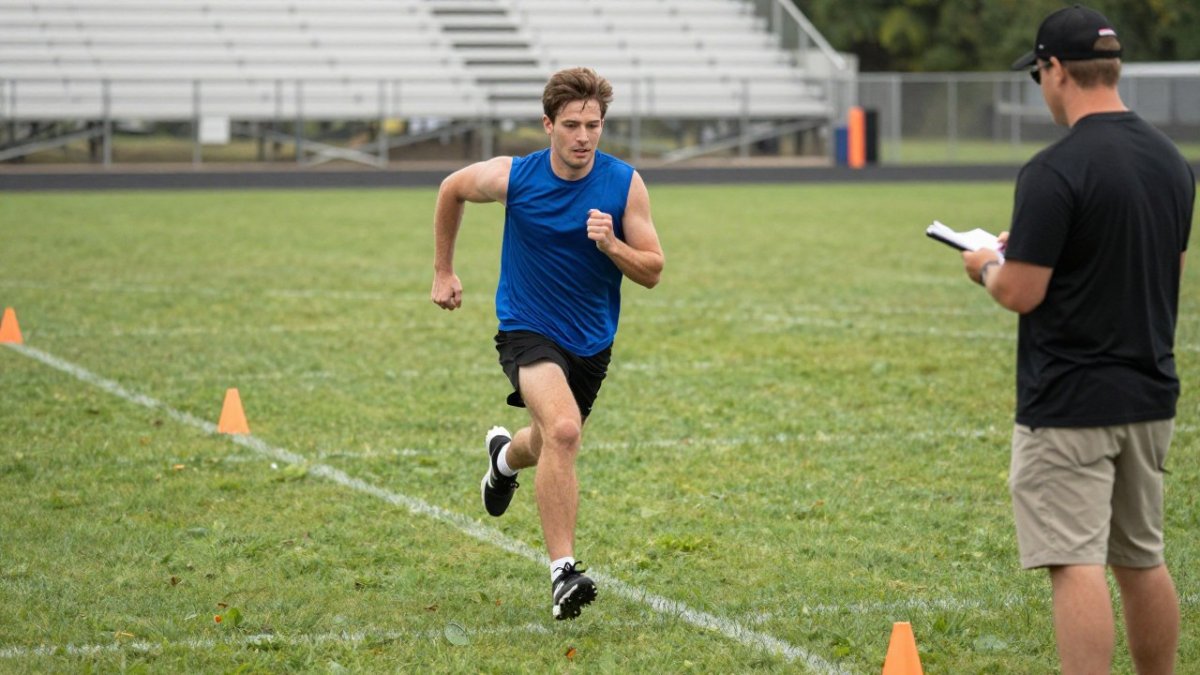
Three drill categories earn their keep:
- Release technique: beating press coverage with a plan, not a guess
- Stem and break: selling the vertical before cutting under
- Contested catch work: hand placement and body positioning at the catch point
Advanced route concepts build on these fundamentals. If you want to see what paid coaching actually teaches beyond the basics, review advanced wide receiver route running techniques.
Wide Receiver Training Frequency: How Often It Takes to See Results
Wide receiver training frequency should land at two to three quality sessions per week in the off-season, with in-season work focused on maintenance. More is not automatically better. Repeated sloppy reps reinforce sloppy habits.
The key word is quality. A focused 60-minute session with a coach correcting each rep beats a two-hour session of unsupervised drill work.
Progress comes from spaced repetition with correction. Skill development follows a simple rhythm: introduce the mechanic, drill it slowly, add speed, then test it under pressure. Rushing that sequence is the most common reason athletes feel busy without improving.
Here is the training frequency guidance the article lays out for off-season and in-season work.
| Training Period | Recommended Frequency | Note |
|---|---|---|
| Off-season | Two to three quality sessions per week | More is not automatically better |
| In-season | Focused on maintenance | Keeps skills sharp during competition |
| Without feedback | Four or five times a week | Athletes often plateau practicing same errors |
| Quality benchmark | Focused 60-minute coached session | Beats two hours of unsupervised drill work |
How NFL Wide Receivers Train and What Youth Programs Borrow From It
How NFL wide receivers train is not mysterious. The professional model emphasizes precise route detail, film study, and recovery, and youth programs borrow the structure rather than the volume. Professionals spend significant time on release mechanics and coverage recognition because those skills decide whether a route works against elite defenders.
The borrowed pieces that help young athletes:
- Breaking down film to recognize coverages and defensive reads
- Drilling releases against varied use instead of one look
- Separating speed work from skill work so each gets full attention
- Tracking progress across weeks rather than judging one session
Advanced speed and agility work fits into this model. For the next step in that area, our guide to advanced receiver drills for speed shows how to build explosiveness without sacrificing technique.
Measuring Progress: How to Know the Training Is Working
Progress in wide receiver training should be measurable, not just felt. Athletes and parents deserve concrete markers, and a serious program tracks them.
What to track:
- Route precision on film, reviewed side by side over time
- Release success against press coverage in live reps
- Catch rate on contested throws
- Acceleration and change of direction in tested drills
The most underrated marker is game understanding. When an athlete starts identifying coverage before the snap and adjusting the route, the coaching is translating. That is the difference between drill work and on-field performance.
Ask any program how it measures improvement. If the answer is vague, that tells you something about the training value.
Evaluating a Wide Receiver Coach Before You Commit
Evaluating a wide receiver coach starts with experience and proof, not marketing. Ask who coached the athletes, where they played, and what recent results look like.
Use this checklist before you commit:
- Coach experience: college-level playing or coaching background
- Individual feedback: does every rep get corrected?
- Position-specific coaching: dedicated receiver work, not shared general drills
- Film review: is game understanding taught, not just drilled?
- Progress tracking: are outcomes measured over time?
- Recent proof: can they show athletes who advanced to the next level?
At QB Factory, our staff includes former D1 players and championship-level coaches, and we have developed over 300 full scholarship players. We coach receivers with the same depth we bring to quarterbacks, because route precision and ball skills decide games.
If you are ready to see what a serious program looks like, apply to our Open Receiver Skills Program. It is free to apply, and we are looking for offensive skill players who want to become high-level receivers.
The gap between a good high school receiver and a recruitable one usually comes down to mechanics nobody has corrected.
Frequently Asked Questions
How often should a high school wide receiver train outside of team practice?
Most athletes see the best return from two to three focused sessions per week during the off-season, plus one during the season to protect recovery. Wide receiver training frequency matters less than the quality of each repetition: route running, release technique, and catching drills done with full focus beat daily unfocused work. Build in at least one rest day between high-intensity sessions, and track progress every four to six weeks so you can adjust the plan.
Can wide receiver training really improve route running?
Yes, when the drills are specific. Wide receiver route running drills that isolate release technique, footwork at the line of scrimmage, and hand placement teach an athlete to run the same route the same way every time. Route precision comes from repetition with feedback, which is exactly what private training provides and what a crowded team practice often cannot. The gains show up fastest in timing-based routes and contested catches.
Is private football coaching better than team practice?
They serve different purposes. Team practice builds scheme knowledge, conditioning, and chemistry with the quarterback. Private coaching can deliver individual feedback on fundamentals such as catching technique, ball skills, and defensive reads that is harder to give in a large team setting. The strongest athletes use both: team practice for live reps, private sessions to fix the specific mechanics holding them back.
What should you look for in a wide receiver coach?
Look for position-specific experience, not just general football knowledge. Ask whether the coach played or coached receivers at a competitive level, how sessions are structured, and how progress is measured. A good coach provides individual feedback, films drill work, and can explain how coverage recognition and defensive reads connect to route running. Ask for examples of athletes they have developed and how long those athletes trained before seeing results.