

Table of Contents
- Why High School Football Footwork Matters
- The Biomechanics of Footwork: Foundation for Speed and Agility
- Football Agility Drills for Speed and Acceleration
- Ball Mastery and Touch Development
- Football Footwork Training Schedule for High School Athletes
- Best Equipment for Football Footwork Drills
- Common Footwork Mistakes and How to Fix Them
- Frequently Asked Questions
Last Updated: September 18, 2026
Why High School Football Footwork Matters
The difference between a college recruit and a benchwarmer often comes down to footwork. Not talent. Not size. Footwork.
High school football footwork is the foundation for every position on the field. Quarterbacks need precise drops and pocket movement. Receivers need explosive cuts and route precision. Linemen need lateral quickness and balance. Without solid footwork, even gifted athletes plateau.
Most high school programs treat footwork as a warm-up drill, not a core skill. Coaches run ladder drills for five minutes, then move on, that’s checking a box, not training.
At QB Factory, we’ve worked with hundreds of high school athletes. The ones who improved fastest treated footwork like a sport itself: practicing daily, filming themselves, and fixing breakdowns immediately.
This guide breaks down exactly how to build elite footwork. We’ll cover the biomechanics, the drills, the progression system, and the common mistakes that hold athletes back.
The Biomechanics of Footwork: Foundation for Speed and Agility
Your footwork starts with how your body moves. Speed and agility aren’t about running fast in a straight line. They’re about controlling your center of gravity and striking the ground efficiently.
Center of Gravity and Body Control
When you move laterally or change direction, your center of gravity shifts. Athletes with poor body control chase it, hips lag, shoulders leak forward, power and speed suffer.
Proper body control means keeping your shoulders over your hips and hips over your feet. This alignment lets you accelerate and decelerate explosively by reducing ground contact time.
Elite high school football footwork requires you to stay low and balanced. Your knees should bend. Your weight should sit on the balls of your feet, not your heels. This position gives you the ability to move in any direction instantly.
Foot Strike and Ground Contact Time
A proper foot strike means landing on the ball of your foot with toes forward and ankle stable, transferring power from your leg muscles to the ground.
Ground contact time, how long your foot stays on the ground per step, determines speed. Elite athletes minimize it through explosive push-off and quick foot turnover.
High school football footwork improves by increasing stride frequency (steps per second) without sacrificing power through explosive ground contact and rapid foot recovery.
Video Self-Analysis: Identifying Your Mechanical Flaws
Most athletes can’t see their own movement breakdowns until they watch film, the fastest path to correction.
Film yourself performing footwork drills from two angles: a side view (to catch hip lag, forward lean, and heel striking) and a front view (to catch foot crossing, uneven weight distribution, and shoulder rotation).
Use this checklist when reviewing your footage:
Deceleration phase (planting):
- Does your outside foot plant firmly, or do you slide?
- Are your hips square, or do they rotate early?
- Does your torso stay upright, or do you lean forward?
- Is your plant foot pointed in the direction you’re cutting, or is it angled?
Acceleration phase (push-off):
- Do you explode off your planted foot, or do you step into the cut?
- Does your inside knee drive up, or does it stay low?
- Are your arms driving forward, or are they passive?
- Does your head stay level, or does it bob?
Lateral movement (shuffling):
- Do your feet stay shoulder-width apart, or do they narrow?
- Does your trailing foot meet your lead foot, or does it cross over?
- Are your shoulders square to the direction of movement, or do they rotate?
- Do your knees stay bent throughout, or do they straighten between steps?
Record yourself weekly and compare to elite athletes at your position (college or NFL clips on YouTube). Identify one mechanical flaw per week and drill it in isolation before adding it back to game-speed movements.
Athletes using video feedback improve 2-3 times faster than those relying on feel alone.
Football Agility Drills for Speed and Acceleration
Agility drills teach your nervous system to control your body during rapid changes of direction, they’re skill acquisition, not just exercises.
Ladder Drills for Stride Frequency
Ladder drills train rapid foot turnover and consistent rhythm. Run through a flat ladder placed on the ground, placing one foot in each square.
Basic ladder drill progression:
- Single-foot forward – One foot in each square, moving forward
- Lateral shuffle – Feet together, moving side to side
- High knees – Driving knees up while moving through squares
- In-and-out – Both feet in each square, then both feet outside
Start slow, focusing on rhythm and control; speed comes later. Run 3-4 times per week: 6-8 sets of 20-30 seconds with 30 seconds rest between sets. Ladder drills improve stride frequency, proprioception, and neuromuscular coordination.
Cone Drills for Change of Direction
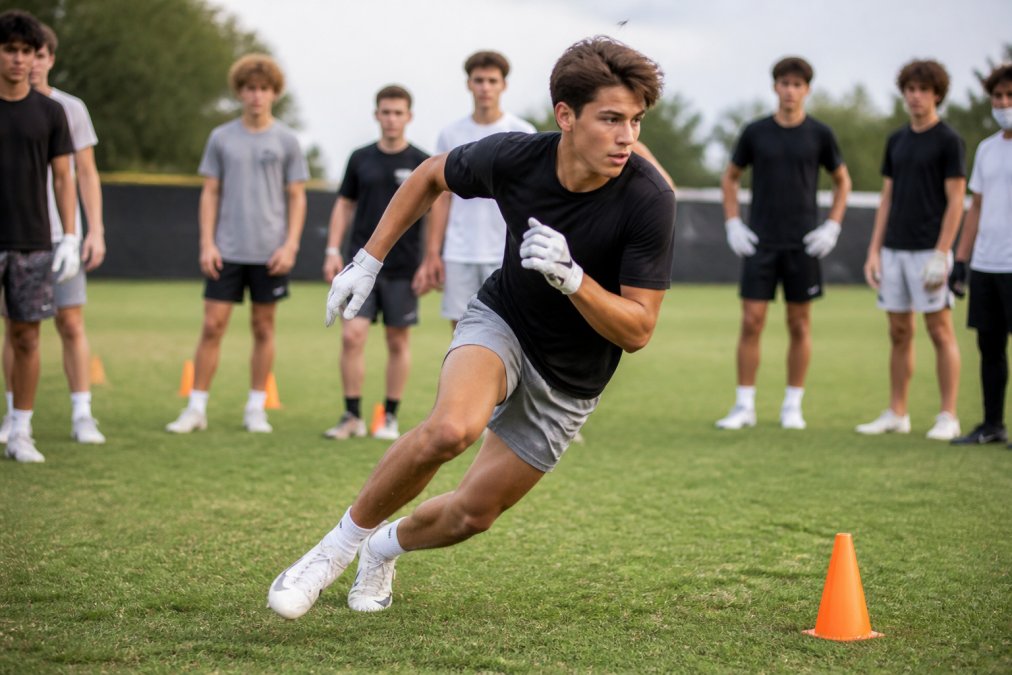
The T-drill is the foundation. Place four cones in a T shape: one at the start, one 10 yards forward, and two more 5 yards to each side of the top cone.
Quarterback Registration (Required) →
T-drill execution:
- Sprint forward to the top cone
- Shuffle left to the left cone
- Shuffle right past the center to the right cone
- Shuffle back to center
- Backpedal to the start
Complete 4-6 reps. Rest 60 seconds between sets. Run this drill 2 times per week.
The L-drill: sprint forward 10 yards, plant hard, and cut 90 degrees for another 10 yards. Cone drills build change of direction ability, teaching you to plant your outside foot and drive through cuts.
Jump Cuts and Lateral Movement Techniques
A jump cut is an explosive lateral movement: plant your outside foot firmly, drive your inside knee up, explode laterally, and land on the opposite foot. Practice 3 sets of 10 reps per side, 2 times per week.
Lateral movement drills teach side-to-side movement without crossing your feet, critical for receivers and defensive backs. Stay low with bent knees, keep shoulders square, step laterally, and bring the trailing foot to meet it. Practice 20-30 seconds at a time in your dynamic warm-up.
Back-pedal by pushing off your toes, keeping hips square, and maintaining downfield vision. Back-pedal 10-15 yards, then plant and accelerate forward.
Ball Mastery and Touch Development
Ball mastery is controlling the ball with precision and feel. For receivers, this means catching away from your body and adjusting to different trajectories. Do 10 minutes of ball-handling drills before every practice: one-handed catches, high-point catches, catches in stride, catches from different angles, and catches while moving laterally or backpedaling.
For quarterbacks, ball mastery means footwork and the football are synchronized. Practice footwork without the ball first, then add it to build neural pathways between feet and hands. Do ball mastery drills 3 times per week to build proprioception and hand-eye coordination.
Football Footwork Training Schedule for High School Athletes
A proper training schedule balances intensity, volume, and recovery while accounting for neuromuscular fatigue, when most footwork breakdowns and injuries occur in games.
Weekly Training Structure
Footwork drills should be distributed across the week, with intensity and fatigue state varying by session:
Monday: Foundational drills at full focus, ladder drills (6-8 sets of 20-30 seconds) and ball mastery (10 minutes). CNS is fresh; prioritize perfect form and speed.
Tuesday: Change of direction at game pace, cone drills and jump cuts (4-6 reps per drill) and lateral movement techniques when energy is high.
Wednesday: Recovery and light footwork, dynamic stretching, mobility work, and slow-motion drills (50% intensity).
Thursday: Fatigue-state footwork training, ladder drills after conditioning and cone drills after strength work.
Sunday: Complete rest.
Session Structure: Warm-Up vs. Performance Drills
Dynamic warm-up drills (5-10 minutes): Low intensity, moderate speed. Activate nervous system, increase body temperature, prepare muscles. Examples: slow ladder drills, walking cone patterns, light lateral shuffles.
Progression Drills for Beginners to Advanced
Beginners should focus on movement quality over speed.
Beginner (weeks 1-4): Ladder drills at 50% intensity, cone drills at walking pace, basic lateral shuffles, stationary ball mastery. All drills when fresh. Rest 90 seconds between sets.
Best Equipment for Football Footwork Drills
Essential equipment: speed ladder ($20-40), cones ($15-25), football, agility poles or PVC pipes, resistance bands, and flat open space. The best equipment is free, a flat field and your body weight. Master bodyweight movements first, then add equipment.
Common Footwork Mistakes and How to Fix Them
Most high school athletes make the same footwork mistakes. Here’s how to fix them.
Film yourself doing footwork drills. Compare your movement to elite athletes. Most athletes can’t see their own mistakes until they watch video. This is the fastest way to improve.
Frequently Asked Questions
How often should high school football players train footwork?
High school athletes should dedicate 3-4 training sessions per week to footwork development, with each session lasting 30-45 minutes. This frequency allows sufficient repetition volume for neuromuscular adaptation while preventing overtraining. Off-season training can increase intensity, while in-season work focuses on maintaining mechanics. Recovery between sessions is critical for skill acquisition and athletic performance.
What’s the difference between warm-up drills and performance footwork drills?
Warm-up drills prepare your body for high-intensity work through dynamic movement and elevated heart rate, while performance drills build specific athletic skills like acceleration and deceleration. Warm-ups typically include high knees and side shuffles at controlled speeds. Performance drills demand maximum effort, precise technique, and focus on explosiveness. Both are essential, never skip the warm-up phase before executing demanding footwork training.
How can video analysis improve my high school football footwork?
Recording yourself during drills reveals mechanical flaws invisible during live training, poor foot placement, inconsistent stride frequency, or weak hip mobility. Review footage in slow motion to identify where your center of gravity shifts incorrectly or where ground contact time is too long. Compare your mechanics to game film to spot patterns under pressure. Self-correction through video feedback accelerates skill acquisition and builds body awareness.
What role does core stability play in football footwork?
Core stability directly impacts your ability to maintain body control during rapid changes of direction and explosive movements. A strong core keeps your center of gravity stable, reduces wasted energy, and improves deceleration mechanics. Weak core strength forces compensatory movements in your legs and hips, increasing injury risk and slowing lateral movement. Dedicate 10-15 minutes per session to core work, planks, rotational exercises, and anti-rotation movements strengthen this foundation.