
Table of Contents
- What Makes Elite Private Quarterback Coaching Programs Stand Out
- Best Quarterback Camps for High School Quarterbacks
- High School Quarterback Recruiting: What College Coaches Actually Evaluate
- College Football Recruiting Highlight Video: Creating Content That Gets Noticed
- How to Choose a Quarterback Coach That Fits Your Goals
- 1. Athlete Age and Development Stage
- 2. Current Ability and Specific Weaknesses
- 3. Location and Training Format
- 4. Budget and Total Cost
- 5. Learning Style and Coaching Approach
- 6. Recruiting Timeline and Goals
- Evaluating Coaching Credentials and Track Record
- Red Flags to Watch For
- A Practical Decision Process
- The Role of Private Coaching in Scholarship Preparation
- Frequently Asked Questions
Last Updated: October 13, 2026
What Makes Elite Private Quarterback Coaching Programs Stand Out
Finding the right private quarterback coaching program can be the difference between a high school athlete who plateaus and one who earns a D1 scholarship.
Three elements separate top-tier programs: coaching credentials, individualized instruction, and structured game preparation.
At QB Factory, our staff includes former D1 quarterbacks and championship-level coaches with direct recruiting experience. We combine advanced mechanics training with classroom-style mental preparation that replicates high-pressure game scenarios.
The athletes who succeed aren’t just the ones with the strongest arms.
Best Quarterback Camps for High School Quarterbacks
The best quarterback camps for high school quarterbacks blend on-field mechanics with mental preparation. Look for programs that separate athletes by skill level rather than age alone, a freshman with advanced footwork shouldn’t train alongside a senior still learning fundamentals.
On-Field Training and Mechanics Development
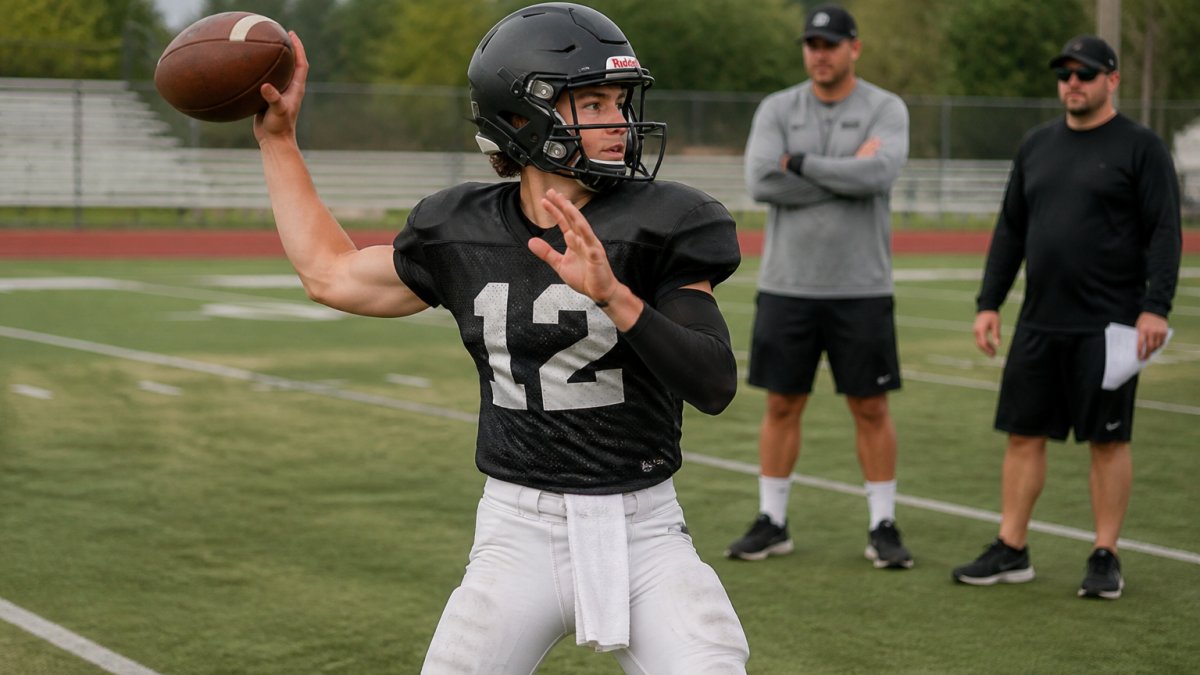
Throwing mechanics are foundational but easy to get wrong.
Elite programs use video analysis and repetition drills to correct mechanical issues: footwork progressions, release timing, footwork-to-arm integration.
The best programs also develop pocket footwork and decision-making speed. A quarterback who steps up, senses pressure, and delivers on time beats one with a cannon arm who holds the ball too long.
Mental Preparation and Game Scenario Training
This is where many programs fall short. They build strong arms but don’t prepare athletes for the mental demands of D1 football.
The best quarterback coaching programs use classroom-style instruction to teach quick information processing.
Mental preparation also includes leadership presence. College coaches evaluate how a quarterback communicates, handles adversity, and commands the huddle. Programs that teach vocal leadership give athletes a recruiting advantage.
High School Quarterback Recruiting: What College Coaches Actually Evaluate
College coaches don’t evaluate high school quarterbacks the way fans do.
First, they evaluate arm talent, but strength alone isn’t enough.
Second, they evaluate decision-making and processing speed.
Finally, coaches evaluate intangibles: leadership, competitiveness, coachability, and how an athlete handles pressure.
High school quarterback recruiting is increasingly competitive.
College Football Recruiting Highlight Video: Creating Content That Gets Noticed
A recruiting highlight video is often a college coach’s first impression.
The best college football recruiting highlight videos are concise, well-edited, and showcase relevant plays.
Video quality matters. A grainy, poorly-edited video signals an athlete doesn’t take recruiting seriously.
Include film study or breakdown footage if possible.
Most importantly, highlight video should be position-specific.
How to Choose a Quarterback Coach That Fits Your Goals
Not every quarterback coach or program is right for every athlete. The decision depends on your situation, timeline, and development needs.
Start by clarifying your goal. Fixing mechanics? Preparing for recruiting? Developing leadership?
Use this six-dimension framework to evaluate fit, the same structure independent evaluators use, to avoid choosing a coach on reputation alone.
1. Athlete Age and Development Stage
A 14-year-old needs foundational footwork and throwing mechanics; a 17-year-old with a live arm needs recruiting exposure and advanced read progressions. Programs that group by age rather than skill level waste reps for advanced athletes and overwhelm beginners. Ask how athletes are separated and whether a clear progression path exists.
2. Current Ability and Specific Weaknesses
Be honest about what needs fixing. Mechanical flaws, inconsistent release point, poor weight transfer, happy feet, usually require individualized instruction before group work helps. If the athlete is fundamentally sound and needs to refine decision-making against elite competition, a high-level group setting may be more valuable. Ask for a skills assessment before placement.
Quarterback Registration (Required) →
3. Location and Training Format
In-person training allows hands-on mechanics correction and immediate feedback; online instruction offers flexibility for busy or distant athletes. Travel time cuts into training time, a program 30 minutes away is more sustainable than a two-hour drive each way. Ask whether you can attend part-time and whether the program accommodates athletes also playing high school football.
4. Budget and Total Cost
Cost is a real constraint for most families, and programs rarely publish rates. When you inquire, ask for the full picture: per-session rates, package discounts, camp fees, travel costs for showcases, and any required equipment or video services. Compare the total investment over 12 months, not the sticker price of a single lesson.
5. Learning Style and Coaching Approach
Some athletes respond to direct, demanding coaching; others need patient, technical instruction. Observe a session before committing. Watch how the coach gives feedback, specific and actionable, or vague and discouraging? Does instruction adjust to the athlete’s learning style? The best programs work around the athlete’s needs, not the other way around.
6. Recruiting Timeline and Goals
If the goal is a D1 scholarship, the recruiting timeline matters, college coaches begin evaluating quarterbacks earlier than most families realize. Ask how the program supports athletes through recruiting: highlight film help? Relationships with college coaches? Camps where coaches evaluate? A quarterback coach can develop skills and provide exposure but cannot guarantee a scholarship offer.
Evaluating Coaching Credentials and Track Record
Coaching credentials matter. Look for coaches with direct D1 experience, former players or coaches who’ve worked in college programs.
Ask specific questions about track record. How many athletes has the program developed into D1 scholarships? Can they provide verifiable examples?
Look for coaches who understand your state’s recruiting landscape. College coaches recruit regionally.
Red Flags to Watch For
Be cautious of programs that promise scholarships, use high-pressure sales tactics, or refuse to let you observe a session. Legitimate programs are transparent about methods, results, and limitations, and they welcome questions and provide references. If a program can’t explain its development philosophy clearly, keep looking.
No private coach or program can guarantee a D1 scholarship. Any program that does is either misleading you or misunderstanding the recruiting process. Use guarantees as a signal to look elsewhere.
A Practical Decision Process
- List your top three goals for the next 12 months.
- Identify two or three programs within a reasonable drive or with a strong online option.
- Ask each program the six fit questions above.
- Observe a session or request a sample training plan.
- Check references from families at a similar stage.
- Compare total time commitment over a full year.
- Choose the program that best matches your goals, not the loudest marketing.
The right program will challenge your athlete, communicate clearly, and provide a realistic path forward. If it doesn’t, it’s not the right fit, no matter how impressive the credentials look on paper. If you’re ready to explore what a structured program can offer, Apply today!
The Role of Private Coaching in Scholarship Preparation
Private quarterback coaching isn’t a shortcut to scholarships, it’s an investment in accelerated development. Athletes who train seriously gain advantages in three areas, but those come with caveats about evidence, workload, and what coaching can realistically deliver.
What Private Coaching Can and Cannot Do
Private coaching can accelerate skill development, provide individualized feedback, and offer exposure to recruiting networks. It cannot guarantee a scholarship, replace a high school program, or compensate for a lack of game film and on-field production. College coaches recruit players they can see performing in games, training supplements that performance, it doesn’t substitute for it.
The Three Real Advantages
First, athletes develop faster. Elite coaches who understand the game at a high level speed up learning.
Second, they develop more comprehensively. Private coaching addresses technical skills, mental preparation, and game understanding simultaneously, individualized attention high school coaches managing 40-50 athletes can’t provide.
Third, they develop more visibility.
How to Verify Scholarship and Placement Claims
Programs often claim they’ve helped athletes earn D1 scholarships. Those claims are hard to verify and easy to exaggerate. Before you invest, ask for specific evidence:
- Names and graduation years of athletes who received D1 offers.
- The schools that offered and whether the athlete signed.
- The athlete’s role in the program, did they train there for one session or multiple years?
- Contact information for references you can speak with directly.
A legitimate program will provide this. One that deflects or offers only vague testimonials is a risk. According to the NCAA, fewer than 2 percent of high school football players compete at the D1 level, and recruiting is competitive and unpredictable. Treat any program implying otherwise with skepticism.
Safety, Workload, and Athlete Well-Being
High school athletes are still growing, and overtraining can cause injury or burnout. A responsible program will:
- Limit throwing volume, especially in the offseason, and build in rest days.
- Teach proper warm-up and recovery routines.
- Monitor mechanics to reduce stress on the shoulder and elbow.
- Coordinate with the athlete’s high school coach to avoid conflicting training loads.
- Have a plan for addressing pain or injury, including referral to a medical professional.
Ask how the program manages throwing volume in-season versus offseason, and what happens if an athlete reports soreness. A program that pushes through pain or ignores recovery isn’t looking out for long-term health.
The American Academy of Pediatrics and other sports medicine organizations recommend that young athletes avoid specializing in a single sport year-round and take breaks from repetitive throwing. A good quarterback coach will support that guidance, not work against it.
The Commitment Factor
Private coaching works only when the athlete is committed. The coach can teach mechanics, but the athlete must execute the reps. The coach can teach concepts, but the athlete must study film. The coach can provide opportunity, but the athlete must take advantage of it. The most successful athletes treat private coaching as an extension of their high school program, not a replacement.
A Realistic Timeline
Most athletes who earn D1 scholarships have been playing and training for years. Private coaching accelerates development but isn’t a shortcut. A realistic timeline for significant recruiting attention is two to three years of consistent training, game film, and camp participation. Families should plan for that timeline rather than expecting immediate results after a few sessions.
Questions to Ask Before You Commit
- How many athletes have you trained who went on to D1 programs, and can you provide references?
- What is your approach to throwing volume and injury prevention?
- How do you coordinate with high school coaches?
- What does a typical training week look like in-season versus offseason?
- What is included in your program, and what costs extra?
- What happens if my athlete is injured or needs to miss sessions?
The answers reveal whether a program focuses on long-term development or short-term sales. Choose the one that puts the athlete’s health and realistic goals first.
Frequently Asked Questions
How can a private quarterback coach help with college recruiting?
Private coaching accelerates skill development in passing mechanics, footwork, and decision-making, areas college coaches evaluate during recruitment. Experienced coaches provide feedback on film, help quarterbacks understand defensive reads, and prepare them for the intensity of college-level play. They also guide athletes on what to include in recruiting highlight videos and how to present themselves to college programs. Many programs track player progression over time, which builds credibility with recruiting coordinators.
What should high school quarterbacks look for in a training program?
Look for programs with coaching staff that includes former D1 players or college coaches who understand recruiting standards. The program should offer individualized instruction tailored to your specific weaknesses, not just group drills. Verify that the coaching philosophy combines physical mechanics (throwing, footwork, arm strength) with mental preparation for high-pressure game situations. Ask about their approach to film study and whether they help athletes prepare recruiting highlight videos. Finally, confirm the program can accommodate your schedule and location needs.
How often should a high school quarterback train with a private coach?
Training frequency depends on your current skill level and recruitment timeline. Athletes serious about D1 scholarships typically benefit from consistent, year-round coaching, whether weekly sessions during the off-season or more intensive camps during key recruiting periods. Many programs offer flexible schedules combining on-field training with classroom-style mental preparation. The key is consistency: sporadic sessions won’t build the muscle memory and decision-making speed that college coaches expect. Discuss frequency options with your coach based on your goals and competition level.
What questions should parents ask before choosing a quarterback coach?
Ask about the coach’s playing and coaching background, including college experience and any championship-level credentials. Request recent examples of athletes who progressed through the program and were recruited to college programs. Understand exactly what the program includes: on-field mechanics work, film study, recruiting support, and mental preparation. Ask how they handle individualized instruction and whether they track athlete progression over time. Finally, clarify the program format, whether it’s in-person or online, and how they communicate progress to parents and athletes.