

Table of Contents
- What Elite Quarterback Training Actually Delivers
- Quarterback Footwork Drills That Build Foundation
- Football IQ Training for Quarterbacks: Beyond Mechanics
- Quarterback Decision-Making Drills Under Pressure
- Quarterback Training for Young Players: Starting Right
- How to Choose the Right Training Program for Your Goals
- The Role of Film Study and Game Preparation
- Conclusion: Building the Complete Quarterback
- Frequently Asked Questions
Last Updated: October 12, 2026
What Elite Quarterback Training Actually Delivers
Elite quarterback training isn’t just about throwing harder or running faster. It’s about building a complete player who understands the game at a different level. When we talk about elite quarterback training, we’re describing a system that combines precise physical mechanics with tactical decision-making under pressure.
Most high school quarterbacks plateau because they optimize for one thing: either mechanics or reads. They get comfortable in practice, execute plays the way they’ve rehearsed them, and then freeze when the pocket collapses or a defense shows something unexpected. Real elite quarterback training bridges that gap. It teaches athletes to move with intention and think in real time.
At QB Factory, we’ve built our approach around this exact principle. Our training combines classroom-style mental preparation with individualized footwork drills, so athletes develop the kind of confidence that shows up on Friday nights. Over 300 athletes who came through our program went on to earn full scholarships, which tells you something about the consistency of the system.
The foundation of elite quarterback training rests on three pillars: mechanics that hold up under pressure, decision-making speed that improves with volume, and the mental resilience to execute when it matters most.
Quarterback Footwork Drills That Build Foundation
Your footwork is your foundation for everything that happens next. A quarterback with poor footwork will never be accurate consistently, no matter how strong the arm is.
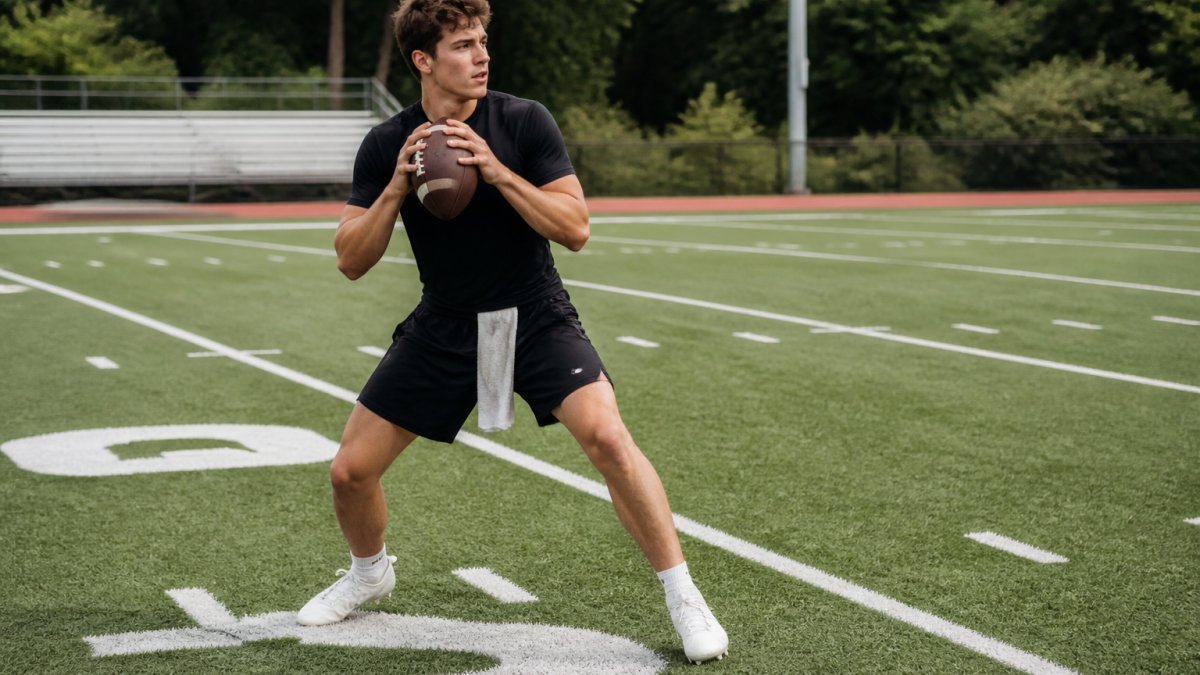
The most common mistake young quarterbacks make is taking too long to set their feet. They drift backward, lose their balance, and end up throwing off their back foot. Effective footwork drills isolate these movements so they become automatic.
Here’s what separates good footwork from elite footwork: consistency under fatigue and pressure. A quarterback can look sharp in an empty stadium during a Wednesday practice. The real test is executing the same footwork when you’re tired, when the pocket is collapsing, and when your receiver is covered. That’s where volume matters.
Key footwork fundamentals to emphasize:
- Heel-to-toe weight transfer: Your weight should move from your back heel to your front toe as you stride into your throw
- Hip and shoulder alignment: Your hips and shoulders stay square to your target throughout the motion
- Stride length consistency: Each step in your drop should be measured and repeatable
- Balance through release: Your base stays stable even as your upper body rotates through the throw
The quarterback footwork drills that work best combine movement patterns with decision points. Don’t just practice the drop. Practice the drop, then react to a simulated read. That’s when footwork becomes football.
Football IQ Training for Quarterbacks: Beyond Mechanics
Football IQ separates good quarterbacks from elite ones. You can have perfect mechanics and still make poor decisions. Conversely, a quarterback with slightly imperfect mechanics but sharp decision-making will outperform a mechanically pristine player who doesn’t understand what he’s looking at.
Football IQ training teaches you to see the game the way coaches see it. Before the snap, you’re reading the defense’s alignment and anticipating what they’ll do. Post-snap, you’re executing your read progression and knowing when to get off your primary read.
The classroom-style mental preparation that QB Factory uses is built around this principle. We don’t just show film and talk about what happened. We teach athletes to recognize defensive patterns, understand coverage rotations, and develop the decision speed that separates college-ready quarterbacks from the rest.
What most guides miss about football IQ is that it’s not just knowledge, it’s pattern recognition under pressure. You can know intellectually that a safety is rotating over the top, but can you recognize it in real time when you have two seconds to make a decision? That skill only develops through deliberate practice.
Film study should always have a specific focus. Don’t just watch tape. Watch your own throws and identify one mechanical flaw or one decision you’d make differently. That targeted approach builds faster than passive viewing.
Quarterback Decision-Making Drills Under Pressure
Decision-making drills separate elite quarterback training from standard coaching. The best drills simulate game pressure by forcing you to make reads quickly while your mechanics are challenged.
A simple but effective drill is the two-minute drill simulation. You get limited plays, a specific score to achieve, and real-time pressure. Your decision-making gets tested because you can’t afford to miss a read or hesitate. Over time, this builds the kind of decision speed that translates directly to games.
Another high-impact drill is the progression read under movement. Your coach calls a play with a specific read progression. The defense shows coverage, and you have to identify it, move in the pocket if needed, and hit your progression within the allotted time. This drill combines footwork, decision-making, and pressure management into one integrated skill.
The quarterback decision-making drills that produce results share a common feature: they force you to commit to a decision. In games, you don’t get the luxury of second-guessing yourself. Elite quarterbacks make their read, trust their footwork, and deliver the ball. Drills should build that same decisiveness.
Avoid drills that reward hesitation. If a drill teaches you to hold the ball and wait for a receiver to get open, you’re building bad habits. Game situations demand quick decisions. Your training should reflect that.
Quarterback Training for Young Players: Starting Right
The fundamentals you build at age 10 or 12 shape your entire career. Young quarterbacks who develop solid footwork early don’t have to rebuild their mechanics later. Those who skip the fundamentals often spend high school trying to fix bad habits.
Quarterback training for young players should emphasize footwork, basic read concepts, and confidence. The goal isn’t to turn a 10-year-old into a Division 1 prospect. It’s to build a foundation that allows growth.
The most important thing for young quarterbacks is consistent, age-appropriate coaching. Young athletes learn through repetition and clear feedback. They need to understand why they’re doing something, not just how to do it. A coach who explains that the three-step drop is shorter because you’re throwing to a receiver who’s cutting underneath is teaching more than mechanics, they’re teaching football IQ.
Quarterback Registration (Required) →
Young players also benefit from training that emphasizes decision-making at their level. Don’t teach a 12-year-old a college read progression. Teach them to identify single-high versus two-high safeties and know which receiver is open based on that read. Build from there.
The best investment in a young quarterback’s development is consistent coaching that builds confidence alongside mechanics. A player who believes in themselves and understands the game will outwork and outperform peers who are just going through the motions.
How to Choose the Right Training Program for Your Goals
Choosing a quarterback training program depends on your current level, your goals, and what you’re trying to improve. A high school quarterback aiming for a Division 1 scholarship has different needs than a youth player learning fundamentals.
Start by identifying your specific weakness. Are your mechanics inconsistent? Do you struggle with decision-making? Are you physically strong but mentally unprepared for pressure? The best training programs address your actual gaps, not generic skill development.
Look for programs that combine individualized assessment with structured progression. A coach should evaluate where you are, identify what needs work, and build a plan that challenges you appropriately. Generic group training can be valuable, but elite quarterback training includes personalized drills tailored to your strengths and weaknesses.
Consider the coaching staff’s experience. Former Division 1 players and championship-level coaches bring credibility and real-world perspective. They’ve played the position at a high level. They understand what separates good from elite.
Evaluate whether the program integrates footwork and football IQ or treats them separately. The best programs don’t compartmentalize these skills. They teach you to move with purpose and think with clarity simultaneously.
| Evaluation Criteria | What to Look For | Why It Matters |
|---|---|---|
| Coaching credentials | Former D1 players, championship coaches | Experience at elite levels translates to better instruction |
| Training approach | Integrated footwork + decision-making | Siloed training produces incomplete development |
| Assessment process | Individualized evaluation before training | Custom programming beats generic drills |
| Progression structure | Clear advancement from fundamentals to advanced | Appropriate challenge prevents plateaus |
| Pressure simulation | Game-realistic scenarios in drills | Transfer to actual game performance improves dramatically |
The Role of Film Study and Game Preparation
Film study is where football IQ gets built. You can drill footwork and mechanics on the practice field, but you understand the game by watching it. Elite quarterbacks spend significant time studying film, not casually, but with specific questions and a systematic approach.
Effective film study starts with understanding your own tendencies. Watch your games and identify patterns. Do you lock onto your primary receiver? Do you miss open receivers because you’re not hitting your progression? Do you hold the ball too long? Honest self-assessment through film is uncomfortable but essential.
Next, study opposing defenses. Learn to recognize coverage rotations, blitz patterns, and safety rotations. When you understand what a defense is trying to do, you can anticipate it. That anticipation becomes the foundation of elite decision-making.
Game preparation combines film study with visualization and mental rehearsal. Before Friday night, you’ve already played the game mentally. You’ve seen the coverages you expect, visualized your reads, and rehearsed your decision-making. That preparation shows up in your performance.
Film study is most effective when you watch with a specific question in mind. Don’t just rewatch the game. Watch to answer one question: “How did I handle this coverage?” or “What did this defense show pre-snap?” Targeted study builds faster than passive viewing.
Conclusion: Building the Complete Quarterback
Elite quarterback training produces complete players, athletes who move with precision and think with clarity. The integration of physical footwork and tactical football IQ is what separates championship-level quarterbacks from everyone else.
Building this kind of quarterback requires more than individual drills or isolated coaching. It requires a system that develops mechanics and mental preparation simultaneously, with coaches who understand both the technical and tactical sides of the position. Research on athletic skill development shows that integrated training approaches produce faster improvement and more durable performance than compartmentalized methods.
The athletes who succeed at the highest levels, whether in college or beyond, are those who committed to elite quarterback training early and stayed consistent. They invested in footwork precision, studied film systematically, and practiced decision-making under pressure. That commitment compounds over years.
If you’re serious about playing at the next level, the question isn’t whether you need specialized training. It’s whether you’re ready to commit to the kind of training that actually works. QB Factory’s approach combines individualized footwork drills, classroom-style mental preparation, and real-time decision-making scenarios.
Apply today! and start building the foundation that transforms good quarterbacks into elite ones.
Frequently Asked Questions
What age should you start elite quarterback training?
Youth athletes can benefit from foundational quarterback training as early as age 7-8, focusing on basic throwing mechanics and footwork fundamentals. Specialized elite quarterback training typically becomes most effective in high school when athletes have developed sufficient strength and can grasp tactical concepts. However, starting early builds solid habits and confidence. The key is matching the training intensity and complexity to the athlete’s age, experience level, and physical development stage.
How can quarterbacks improve their football IQ?
Football IQ improves through structured film study, learning read progressions, and practicing decision-making under game-like pressure. Elite quarterback training programs teach athletes to recognize defensive formations, anticipate coverage changes, and process information quickly. Classroom-style instruction combined with on-field drills that simulate real game scenarios accelerates this development. Regular analysis of game film and repetition of decision-making drills builds the mental patterns that transfer directly to Friday night performance.
What’s the difference between high school coaching and elite quarterback training programs?
High school coaches manage entire teams across multiple positions and game situations. Elite quarterback training programs provide individualized, position-specific instruction focused exclusively on quarterback mechanics, footwork, arm strength, and tactical decision-making. These specialized programs employ former college and professional coaches who use progressive drills, film study, and scenario-based training to accelerate skill development and prepare athletes for recruiting evaluation and competitive performance.
Can elite quarterback training work online, or does it require in-person coaching?
Both formats can be effective depending on the program structure. In-person training excels at refining footwork mechanics, arm angle, and release through direct observation and hands-on correction. Online coaching works well for film study, decision-making drills, and mental preparation. The most comprehensive elite quarterback training programs combine both: individualized in-person sessions for mechanics refinement plus remote film review and tactical instruction. Ask programs about their specific delivery model and how they measure progress across both physical and mental development.