

Table of Contents
- What Separates Elite Football Training Camps
- Quarterback Mechanics Drills That Build Foundation
- Mental Preparation for Football Players Under Pressure
- Football Situational Awareness Drills for Game Day
- Private vs. Group Football Training: Which Model Works
- How to Evaluate Camp Coaching Quality and Track Record
- Integrated Training: Why Mechanics and Mental Skills Matter Together
- Frequently Asked Questions
Last Updated: October 15, 2026
What Separates Elite Football Training Camps
The difference between a good football training camp and an elite one isn’t always obvious. Most camps teach fundamentals; the ones that produce scholarship players integrate technical mechanics with mental preparation in ways that transfer directly to game day.
When you’re evaluating football training camps, you’re really asking two questions. First, can the coaching staff actually teach the mechanics that matter, footwork, throwing angles, defensive reads, body control under pressure? Second, do they prepare athletes mentally for the moments when those mechanics matter most?
At QB Factory, we’ve built our entire approach around this integration. Our coaching staff includes former D1 players and championship-level coaches who understand that technique without mental resilience falls apart on Friday night. Athletes who dominate in high-pressure scenarios have rehearsed their decision-making under fatigue, practiced focus routines, and built the confidence to execute when everything’s on the line.
The best football training camps don’t separate these two elements. They’re woven together from day one.
Quarterback Mechanics Drills That Build Foundation
Quarterback mechanics start with footwork, not because it’s the most important thing, but because everything else depends on it. A quarterback with poor footwork can have perfect arm mechanics and still miss open receivers; solid footwork can compensate for minor arm issues and still deliver accurate passes.
The foundation drills that matter most build muscle memory for consistency: three, five, and seven-step drops, hitch steps, weight transfer, and the ability to reset your feet and throw from different arm angles when the pocket breaks down. They aren’t flashy, but they’re the difference between a quarterback who can execute in structure and one who only performs when everything goes right.
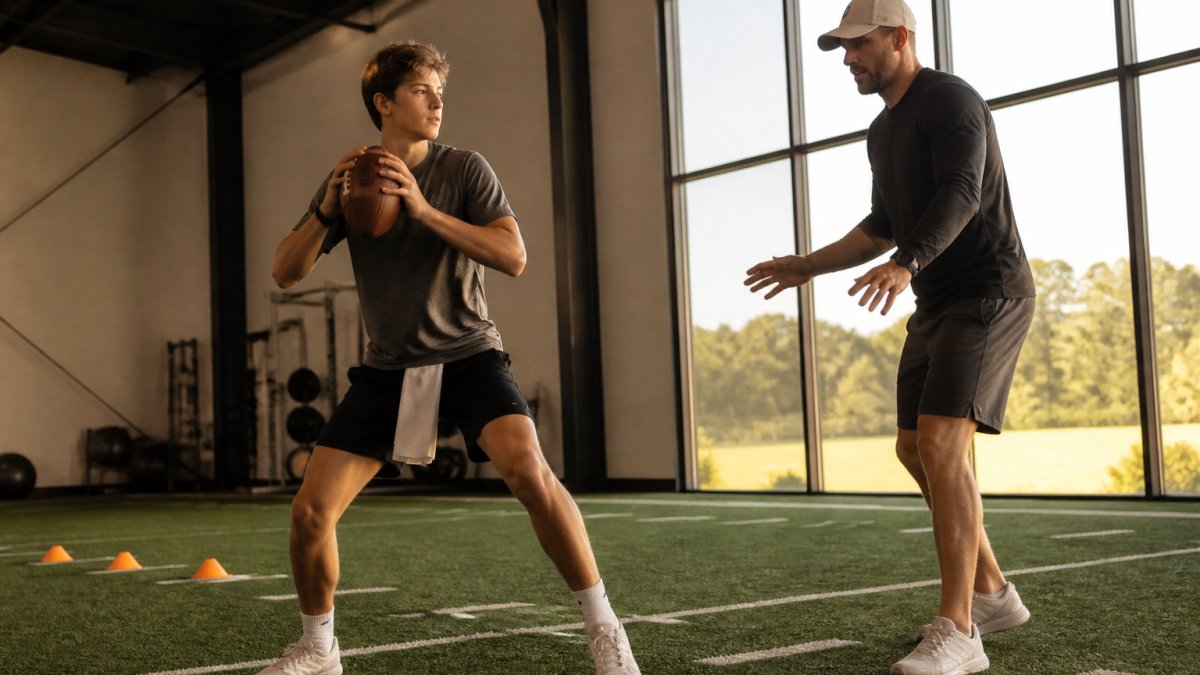
Good football training camps spend significant time on these foundation mechanics. They use video feedback so athletes see exactly what they’re doing wrong, and isolate specific movements, just the footwork, arm slot, or release, so athletes fix one thing at a time instead of overhauling everything at once.
The camps that stand out also teach athletes to maintain these mechanics under fatigue. Perfect footwork is easy when you’re fresh; it’s much harder after twenty plays in a row with tired legs and an elevated heart rate. The best camps simulate game-speed conditions so athletes build the resilience to stay technically sound when it matters.
Film study isn’t separate from mechanics work, it’s part of it. Athletes who understand WHY a specific footwork pattern creates a throwing lane tend to execute it more consistently than those who just repeat the drill.
Mental Preparation for Football Players Under Pressure
Mental preparation is where most youth football programs fall short. High school coaches are stretched thin managing rosters, practices, injuries, and games, so individual mental skills training often gets squeezed out.
Elite football training camps treat mental preparation with the same rigor as physical training, teaching athletes to manage focus in high-pressure moments, recognize when anxiety is affecting their decision-making, and use breathing and self-talk to stay composed when the game is close.
The athletes who perform best under pressure aren’t necessarily the most talented, they’re the ones who’ve practiced their mental routines as much as their physical ones. They know their calm breathing pattern, have a self-talk script rehearsed hundreds of times, and have visualized the scenario ahead as a realistic mental rehearsal of execution, not a fantasy of success.
Football training camps that excel at mental preparation teach athletes to recognize pressure as information, not a threat. A tight fourth quarter isn’t something to fear, it’s the exact scenario you’ve prepared for. Your heart rate rises and your muscles tighten; that’s expected. You’ve been here before in practice, so now you execute what you’ve rehearsed.
The mental skills that matter most in football are learnable. Focus, resilience, and confidence aren’t innate talents, they’re skills you develop through deliberate practice.
Football Situational Awareness Drills for Game Day
Situational awareness in football means understanding what’s happening around you and making decisions based on that information. For quarterbacks, that’s recognizing coverages and knowing where the hot route is; for receivers, adjusting your break to the coverage; for linemen, reading the defense and understanding your assignment against different looks.
The best football training camps teach situational awareness through game-speed drills that force athletes to make decisions under pressure. Not in a classroom setting. Not on a whiteboard. On the field, at speed, with real consequences for poor decisions.
These drills work best when they’re progressive. Start with one defender and one option so the athlete learns to recognize the trigger and react correctly, then add complexity: two defenders, multiple options, forcing them to read the first defender, understand what that tells them about the second, and execute the right decision.
The camps that produce the most game-ready athletes use film of actual opposing defenses. Instead of generic “cover 2” or “man coverage” drills, they prepare athletes for specific tendencies and personnel: a coordinator who loves to blitz on third-and-long, a safety who always rotates late, a corner who presses on one side of the field.
This level of preparation requires coaching staff who understand the game deeply, not just the rules, but the strategic chess match that unfolds on every play. The best camps have coaches who’ve played at a high level and know how to teach decision-making under pressure.
Private vs. Group Football Training: Which Model Works
Private and group training serve different purposes, but the real question is which model better develops the integration of technical mechanics and mental preparation for high-pressure game scenarios. Most camps offer one or the other, and few explain how to choose based on an athlete’s needs.
Group training camps build team culture and expose athletes to different coaching perspectives. Training alongside competitive peers teaches you to handle feedback, stay focused when you’re not the center of attention, and compete in a structured environment. These settings naturally create pressure, limited reps, public evaluation, performing in front of others, which becomes a powerful mental-skills rehearsal if the camp intentionally debriefs those moments.
Private training allows for individualized feedback and customized progression. A coach can identify exactly what’s holding you back and design drills to address it, with no waiting for your turn or adapting to the group’s pace. However, private sessions often lack the chaotic, unpredictable elements of a game, crowd noise, fatigue, live decision-making, unless the coach deliberately builds them into the plan.
Quarterback Registration (Required) →
The best approach usually combines both, but sequencing matters. Many serious athletes use group camps in the off-season to build fundamentals and compete, then shift to private training to refine technique.
When evaluating any camp, ask how they structure pressure within each model. In a group setting, do they simulate game-like consequences for poor decisions? In private training, do they add a timer, a defender, or a fatigue element to test whether the new mechanic holds up? The camps that produce game-ready athletes deliberately blur the line between technical work and mental rehearsal, regardless of format.
Group training works best for athletes aged 10-14 who are still building fundamentals and learning how to compete. Private training becomes more valuable for high school athletes preparing for college recruitment, where individual performance matters more than team results. The ideal camp offers both and can explain when to use each.
How to Evaluate Camp Coaching Quality and Track Record
The coaching staff is everything. Great facilities, organization, and curriculum mean nothing if the coaches can’t teach. Most camp websites list credentials without context, so a transparent evaluation framework helps you separate real development from marketing.
Start with coaching credentials, but look beyond the logos. Where did they play, at what level, and how long have they coached?
Coach-to-player ratio is another concrete metric. A 1:8 group ratio means more individualized feedback than 1:20. Private training is 1:1 by definition, but ask how long each session lasts and whether the coach provides video review or a written plan.
Feedback quality is harder to assess from a brochure. Ask how coaches deliver corrections: do they use video, explain the “why” behind a mechanic, and tie technical adjustments to game scenarios?
Curriculum matters more than camp length. A well-designed camp sequences technical mechanics and mental skills progressively: day one on footwork and breathing routines, day two adding a defender and a timer, day three introducing crowd noise and fatigue.
Mental-skills instruction should be explicit, not incidental. Does the camp teach visualization, self-talk, and arousal control, and are those skills practiced in drills or only discussed in a classroom?
Finally, look for independent verification. Ask for contact information of past campers or parents, and check recruiting forums or social media where athletes share honest reviews. A claim of 300 full scholarship players is impressive, but ask how many athletes attended, over how many years, and what percentage that represents.
When you’re evaluating any football training camp, demand specifics, not vague claims about “elite coaching” or “proven results,” but actual examples of athletes who’ve improved, what they improved, and how the camp measured it.
Create a simple scorecard before you call any camp. Rate them 1-5 on: coaching credentials, coach-to-player ratio, feedback specificity, curriculum sequencing, mental-skills integration, and transparency of results. Ask the same questions to every camp and compare the scores side by side. This turns a subjective decision into an actionable comparison.
Integrated Training: Why Mechanics and Mental Skills Matter Together
The most important insight about football training camps is this: mechanics and mental skills aren’t separate elements. They’re integrated from the beginning.
When an athlete practices footwork while fatigued, they’re also practicing the mental skill of maintaining focus when their body wants to quit. When they visualize a high-pressure scenario before a drill, they’re building the confidence that comes from having rehearsed the moment.
This integration separates camps that produce good athletes from those that produce championship-level performers. Elite camps understand these elements are inseparable.
A quarterback with perfect footwork who panics in the fourth quarter will make poor decisions; one with great mental toughness but sloppy mechanics will miss open receivers. The quarterback who dominates has practiced both so thoroughly they work together automatically.
The best football training camps structure every drill with this integration in mind. Every repetition practices both technique and mental resilience; every high-pressure scenario is a chance to execute mechanics under stress. That’s why athletes at elite camps often see dramatic improvements, they’re not just learning new techniques, but how to execute them in the moments that matter most.
Choosing the right football training camp means looking beyond surface-level factors like facility quality or camp size. The camps that produce the most game-ready athletes integrate technical mechanics with mental preparation, taught by coaches with real experience at high levels of the game. If you’re serious about improving your game, Apply today! to see how our integrated approach can help you reach your goals.
Frequently Asked Questions
How do football training camps actually teach mental preparation for high-pressure situations?
Elite camps use classroom-style instruction combined with pressure-simulation drills. Athletes learn visualization techniques, breathing control, self-talk strategies, and decision-making frameworks. They then practice these mental skills during game-speed scenarios, simulating third-down conversions, two-minute drills, and defensive reads under fatigue. The repetition transfers mental preparation into automatic reactions on game day.
What’s the difference between private and group football training at camps?
Group training builds team chemistry and competitive energy while reducing individual cost. Private training offers personalized feedback on mechanics, tailored drill progressions, and one-on-one coaching focused on position-specific weaknesses. Many athletes benefit from both: group sessions for situational awareness and team strategy, private sessions for technical refinement and individualized game-plan preparation.
How do I know if a football training camp’s coaching staff is actually qualified?
Evaluate coaching credentials: former Division 1 players, college or professional coaching experience, and documented success developing athletes into higher levels of competition. Ask for recent examples of players recruited to college programs. Check whether coaches provide classroom-style mental preparation alongside physical drills, this signals comprehensive training philosophy. References from current and former families reveal whether coaching translates skill development into real performance gains.
Can younger athletes (ages 10-12) benefit from football training camps focused on technical mechanics?
Yes, but the approach matters. Age-appropriate camps teach fundamental footwork, body control, and basic decision-making without overloading young athletes with advanced tactics. At this level, camps should emphasize correct mechanics, agility, balance, and building confidence. Mental preparation for younger athletes focuses on focus, resilience, and self-talk rather than high-pressure game scenarios. Proper foundation at this age prevents bad habits and accelerates progress in high school.