

Last Updated: November 14, 2026
Quick Summary
Youth quarterbacks build arm strength safely by training at the right dose for their age, using bodyweight and play at ages 7-10, bands and light medicine balls at 11-14, and controlled power work at 15-18. Arm strength is built through the whole body, loaded gradually, and protected with rest.
- Kids ages 7-10 should use bodyweight only, with no added load.
- Ages 11-14 can add bands and 2-6 lb medicine balls twice per week.
- Keep at least one full day off from throwing each week.
- A lighter week every third or fourth week cuts throwing volume by about a third.
- Measure progress with accuracy and consistency, not max distance.
Table of Contents
- Why Safe Arm Strength Training Starts With Age
- The Quarterback Shoulder Warm Up Every Young Athlete Needs
- Best Shoulder Exercises for Quarterbacks at Every Stage
- QB Workouts at Home: Building Arm Strength Without a Gym
- What a Safe Quarterback Strength Training Program Looks Like
- How to Measure Progress Without Overtraining
- Register Your Athlete for Structured Quarterback Development
- Frequently Asked Questions
Why Safe Arm Strength Training Starts With Age
Learning how to increase arm strength for youth quarterbacks safely starts with one truth: a young throwing arm is not a small version of an adult arm. Growth plates near the shoulder and elbow are still open, and they respond to stress differently than mature tissue. For more on readiness, read our guide to when to start specialized training.
That is the whole argument of this guide. Arm strength is built through the whole body, loaded gradually, and protected with rest. Skip any of those three and you get a sore shoulder and a stalled athlete.
Here is what most guides get wrong: they hand a 9-year-old the same medicine-ball routine as a varsity starter. Age changes the plan. The table below outlines a general progression for deciding what a young quarterback is ready for. It is a guide, not a prescription, a qualified coach or athletic trainer should confirm readiness before load is added.
| Stage | Ages | Primary Goal | Strength Work | Throwing Volume | Progression Criterion |
|---|---|---|---|---|---|
| Movement | 7-10 | Coordination and clean mechanics | Bodyweight only; no added load | Short tosses, 15-25 minutes, 2-3 times per week | Can throw with a smooth, repeatable motion for 10 consecutive tosses |
| Foundation | 11-14 | Build a base without burnout | Bands and 2-6 lb medicine balls, 2 times per week | 20-30 minutes, 2-3 times per week, with at least one full day off between throwing days | Completes all sets with clean form and reports no next-day soreness |
| Development | 15-18 | Add controlled power | Bands, medicine balls, and light dumbbells, 2-3 times per week | 30-45 minutes, 3 times per week, never on back-to-back days | Two consecutive weeks of no pain and stable accuracy before adding volume |
Ages
Ages 7-10: Movement First, Strength Second
Kids this age build arm strength through play and coordination, not resistance. Focus on:
- Throwing light balls of different sizes
- Bodyweight movements like push-ups from the knees
- Balance and footwork games
- Short, easy tosses with clean mechanics
The goal is efficient movement. A smooth throwing motion at age 8 becomes arm strength at age 16. Do not add bands or weights at this stage, bodyweight and play are enough.
Ages 11-14: Building the Base Without Burnout
This is when structured work starts to pay off, but volume still rules. Add band work, light dumbbells, and medicine balls two to three times per week. Keep throwing sessions short and spaced out.
A common pattern that works: two strength sessions per week (bands and bodyweight on one day, light medicine balls on the other) and two or three short throwing sessions, with at least one full day off from throwing between each. Watch out: a common mistake is stacking a heavy practice week on top of a heavy training week. The arm only gets stronger between sessions, not during them.
Ages 15-18: Adding Power Without Chasing Velocity
Older youth quarterbacks can handle more volume and slightly heavier medicine balls, but the same rules apply. Keep strength work to two or three sessions per week, never on consecutive days, and keep at least one full day off from throwing each week. Add load only when the athlete completes the current stage with clean form and no next-day soreness.
A qualified coach should check mechanics at every stage. If an athlete cannot complete a set with a smooth motion, the load or volume is too high, drop back a step rather than pushing through.
The Quarterback Shoulder Warm Up Every Young Athlete Needs
A quarterback shoulder warm up is a five-to-eight minute routine that raises blood flow to the throwing arm before any hard throw. It is not stretching. It is activation.
Run this sequence before every practice and game:
- Jog and arm circles (2 minutes): small to large circles, both directions
- Band pull-aparts (10 reps): squeeze the shoulder blades together
- Band external rotations (10 reps per arm): elbow at your side, rotate outward
- Wall slides (10 reps): back flat, arms sliding overhead
- Short toss to medium toss (5 minutes): build distance gradually
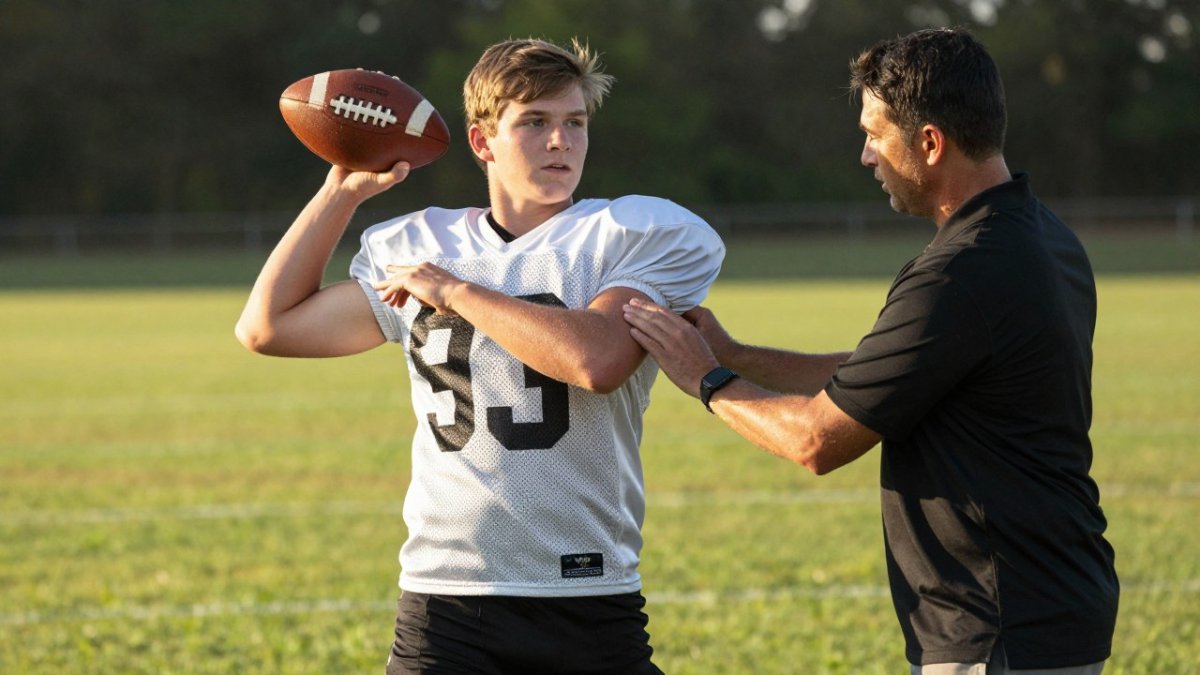
The short-to-medium throw progression matters most. Going from cold to a deep out is how arms get hurt.
For a deeper look at the mechanics behind safe, accurate throwing, see our guide to QB mechanics for accuracy.
Best Shoulder Exercises for Quarterbacks at Every Stage
The best shoulder exercises for quarterbacks train the chest, shoulders, and triceps while teaching the arm to move fast under control. Two categories do most of the work: bands and bodyweight, then medicine balls.
Band and Bodyweight Work for the Throwing Arm
These need no gym and no spotter:
- Band external rotations: 2 sets of 12 per arm
- Band rows: 2 sets of 12, squeeze at the back
- Push-ups: 2 sets of 8-15, knees down if needed
- Triceps dips on a bench: 2 sets of 10
Push movements build the chest and triceps that drive the ball. Keep the reps clean. Sloppy reps train sloppy mechanics.
Medicine-Ball Throws for Explosive Power
Medicine-ball throws build explosive power through the whole body, not just the arm. Use a light ball, 2 to 6 pounds depending on age.
- Rotational throws against a wall: 2 sets of 8 per side
- Overhead slams: 2 sets of 8
- Chest passes: 2 sets of 8
- Step-behind throws: 2 sets of 6 per side
Move fast on every rep. Power comes from speed, not from a heavy ball.
QB Workouts at Home: Building Arm Strength Without a Gym
A QB workout at home can build real arm strength with a band, a light medicine ball, and a wall. That is the entire equipment list.
Here is a simple weekly plan for a youth quarterback:
| Day | Focus | Exercises | Time |
|---|---|---|---|
| Monday | Band and bodyweight | Rotations, rows, push-ups | 20 min |
| Tuesday | Throwing mechanics | Short and medium throws | 20 min |
| Wednesday | Rest and mobility | Light stretching, easy movement | 10 min |
| Thursday | Medicine ball | Rotational throws, slams | 15 min |
| Friday | Throwing mechanics | Route tree, footwork, accuracy | 25 min |
| Saturday | Rest | Full day off the arm | 0 min |
| Sunday | Light band work | Rotations and pull-aparts | 10 min |
Pair this with age-appropriate guidance for younger athletes. Our football training guide for 10-year-olds covers fundamentals that fit alongside at-home arm work.
What a Safe Quarterback Strength Training Program Looks Like
A safe quarterback strength training program follows three rules: it progresses slowly, it limits throwing volume, and it includes qualified supervision. Everything else is detail. Most drill-focused guides stop at the exercises; the plan below is what makes the exercises safe.
Throwing Volume, Rest, and Recovery Limits
Track throws the way you track reps in the weight room. Count every throw in a session, including warm-up tosses, and cap hard throws well below the total.
A practical weekly structure looks like this:
- At least one full day off from throwing each week
- No back-to-back heavy throwing days
- A lighter week every third or fourth week (reduce throwing volume by about a third)
- Sleep and food treated as part of training
Watch out: a common mistake is counting only practice throws and ignoring warm-up tosses and backyard throws. Those add up, and they are the ones most often missed when a parent or coach estimates weekly volume.
Qualified Supervision and Technique Checks
A young quarterback should not run a strength program alone. A qualified coach, athletic trainer, or physical education professional should check the following before load is added:
- The athlete can perform each movement with a smooth, repeatable motion
- The elbow stays below shoulder height on band external rotations
- The athlete reports no pain during or after a set
- Throwing mechanics stay consistent as fatigue sets in
If any of these fail, drop back a step in the progression rather than pushing through. Supervision is not about intensity, it is about catching form breakdown before it becomes an injury.
Warning Signs a Young QB Is Overusing the Arm
Stop throwing and see a doctor or athletic trainer if your athlete shows:
- Pain that persists after throwing
- A drop in velocity or accuracy that lasts more than a week
- Swelling or tightness in the shoulder or elbow
- A change in throwing motion, like dropping the arm angle
These are signs of overuse, and they are not normal.
How to Measure Progress Without Overtraining
Measure progress with accuracy and consistency, not with max distance. Distance chasing pushes young arms past safe limits.
Track these instead:
- Completion rate: throws on target in a set drill
- Accuracy at short and medium range: 10 throws, count the hits
- Velocity, measured sparingly: once every few weeks, never weekly
- How the arm feels the next day: a simple 1-10 rating
Log each session in a notebook. A trend line over a month tells you more than any single test.
If you want a structured path from beginner to advanced, our complete guide to specialized quarterback training camps walks through what good programming looks like.
Register Your Athlete for Structured Quarterback Development
Safe arm strength work is simple, but it is not easy to run alone. A young quarterback needs a coach who can see mechanics, adjust volume, and progress the plan week by week. That is what we do at QB Factory. Our coaching staff includes former D1 players and championship-level coaches, and we have a track record of developing over 300 full scholarship players.
We build individualized drills around each athlete’s strengths, and we use classroom-style teaching to prepare athletes for game-day reactions. Register your athlete for structured quarterback development.
If your athlete is ready to train with structure and supervision, we would like to see them on the field. QB Factory offers progressive training for quarterbacks, receivers, and linemen, with a proven formula that combines physical mechanics, tactical footwork, and mental preparation. Register your athlete and start building a stronger, safer throwing arm.
Frequently Asked Questions
How can a youth quarterback build arm strength safely?
Start with a full shoulder warm up before every session, then use bodyweight, band, and light dumbbell work for the chest, shoulders, and triceps. Add medicine-ball throws for explosive power, and keep throwing volume age-appropriate with scheduled rest days. Focus on clean throwing mechanics and footwork so the arm is not doing all the work. A structured quarterback strength training program that progresses from beginner to advanced, with qualified supervision, keeps youth quarterbacks building arm strength without overuse.
What shoulder exercises are best for quarterbacks?
The best shoulder exercises for quarterbacks target the muscles that stabilize and decelerate the throwing arm. Band external rotations, scapular squeezes, Y raises, and light dumbbell presses build shoulder health, while push-ups and medicine-ball throws develop pressing and explosive power. Pair these with grip and triceps work so the whole throwing arm is conditioned. Keep loads light for younger athletes and prioritize controlled reps over heavy weight.
How often should a young quarterback practice throwing?
Young quarterbacks should throw in short, focused sessions with full rest days in between rather than long daily sessions. Build a weekly plan that mixes throwing days with strength and recovery days, and reduce volume during the season. Watch for soreness, dropping accuracy, or a tired arm, which are signs to back off. Quality repetitions with good mechanics beat high-volume throwing for youth quarterbacks every time.
Can you do QB workouts at home without equipment?
Yes. QB workouts at home can use push-ups, band external rotations, core work, and footwork drills in a driveway or garage. A light medicine ball adds explosive throwing power, and a resistance band covers most shoulder exercises for quarterbacks. Keep sessions short, warm up fully, and progress the reps gradually. Home training works best when it follows a written quarterback strength training program rather than random workouts.