

Quick Summary
Improve throwing mechanics for quarterbacks by building a balanced stance and base, setting up clean footwork and a consistent dropback, and keeping a compact arm slot. Drive the throw with hip rotation and weight transfer, then track accuracy through short, focused drills and video review.
- Stand with feet about shoulder-width apart, knees bent, and hold the position for 10 seconds, repeated 5 times.
- Choose a 3-step drop for quick timing routes that release in under 2.5 seconds, and a 5-step drop for deeper concepts.
- Keep the ball high near your ear and your arm slot between ear and shoulder height for a compact release.
- Rotate your hips toward the target before your shoulders so power comes from the legs rather than arm strength alone.
- Record video from the side and behind each week to compare clips and spot one mechanical change to work on.
Table of Contents
- Start With a Balanced Stance and Base
- Footwork and Dropback Mechanics That Set Up Your Throw
- How to Throw a Football With Proper Ball Carriage and Arm Slot
- Hip Rotation, Weight Transfer and Lower-Body Drive
- QB Throwing Mechanics Drills for Accuracy and Repetition
- Quarterback Throwing Accuracy Drills With Measurable Checkpoints
- Building Your Weekly Practice Plan and Tracking Progress on Video
- Frequently Asked Questions
Start With a Balanced Stance and Base
Every throw starts before the ball leaves your hand. Your feet, knees and hips set the platform for everything that follows, so a shaky base will undermine even a perfect arm motion.
A balanced stance means your weight sits evenly over both feet, knees slightly bent, and your chest up. Think athletic, not stiff. From this position you can move in any direction, and your throwing shoulder stays free to rotate.
Practice this stance with a simple drill:
- Stand with feet about shoulder-width apart
- Bend your knees and hinge slightly at the hips
- Hold for 10 seconds without rocking forward or back
- Repeat 5 times before every practice session
!
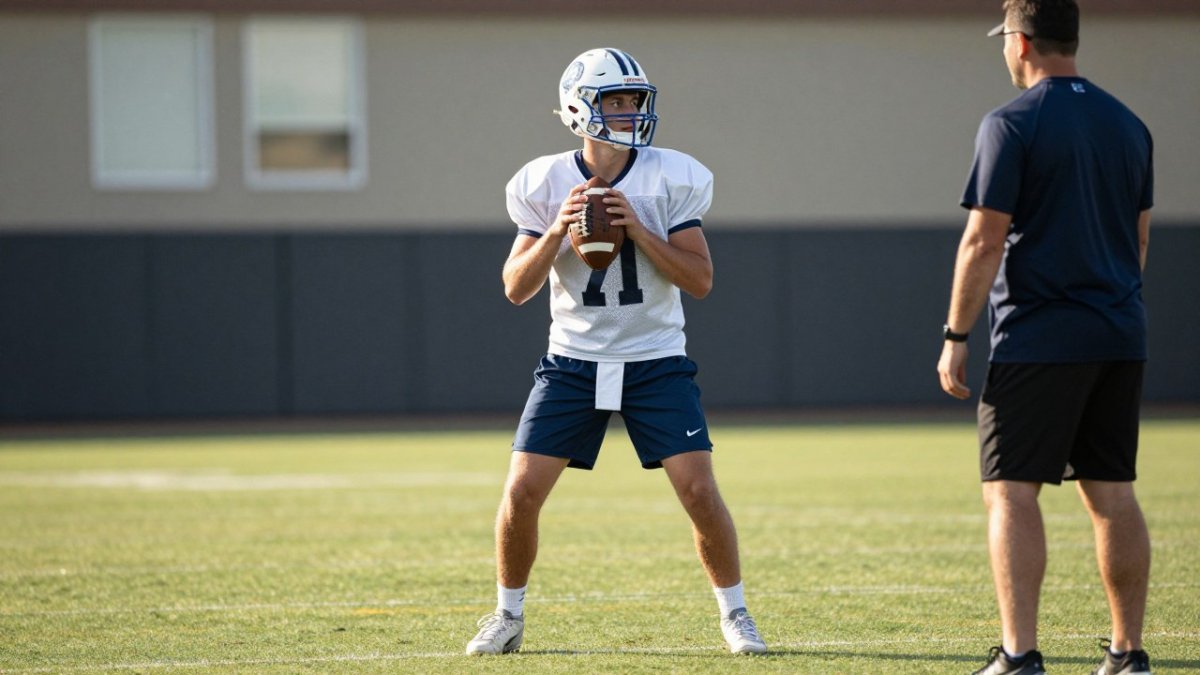
A common mistake is standing too upright. That posture feels comfortable, but it locks your hips and forces your arm to do all the work. Lower your base slightly and let your legs drive the throw.
Footwork and Dropback Mechanics That Set Up Your Throw
Good footwork gets you into throwing position on time. Poor footwork rushes the throw, and rushed throws sail high, short or wide. Mastering the dropback is the first step toward consistent mechanics, but the drop itself is only half the job, the other half is matching your feet to the route and the pass rush.
Most quarterbacks use either a 3-step or 5-step dropback. The 3-step drop works best on quick timing routes like slants, hitches and quick outs, where the ball must come out in under 2.5 seconds. The 5-step drop gives you more depth and time to read the defense on intermediate and deeper concepts, but it also asks more of your protection. Pick the drop your offense calls and drill it until the rhythm feels automatic.
- 3-step drop: Short, quick steps backward, landing on the back foot to set up the throw. The plant foot hits the ground as the receiver breaks, so the ball can come out on time.
- 5-step drop: Longer, controlled steps that build depth before you plant. The fifth step is a gather step, not a drift, your feet should be set when your read is complete.
- Plant foot: Your front foot lands firmly, pointed toward your target. A common pattern is for the plant foot to land slightly across your body on in-breaking routes, which helps you throw across the middle without opening your hips early.
Watch out: Backpedaling with your shoulders turned or your eyes on your feet. Keep your chest facing downfield and your eyes up so you can see the field while you drop. Another common error is drifting past the top of your drop, extra steps waste time and let the pass rush close in.
Once the drop is clean, add pocket movement. A simple drill is to drop back, have a coach point left or right, and slide in that direction while keeping your shoulders square and the ball high. This teaches you to reset your feet and throw on the move, which is how most throws actually happen in games. For a structured progression, start with stationary drops, then add a slide step, then add a throw to a partner at 10 to 15 yards.
!
How to Throw a Football With Proper Ball Carriage and Arm Slot
Your grip and arm angle decide how the ball spirals. Hold the ball with your fingers across the laces, your throwing hand near the back third of the ball. Keep the ball high and close to your ear.
Your arm slot should stay consistent, usually between your ear and shoulder height. A compact motion gets the ball out faster and reduces the chance of a sidearm or dropped release.
- Grip the ball with your index and middle fingers on the laces
- Keep your elbow up and your forearm close to your head
- Bring your throwing hand forward in a short, straight line
- Release the ball out in front, with your thumb pointing down
!
Hip Rotation, Weight Transfer and Lower-Body Drive
Power starts from the ground up. Your legs and hips generate force, and your arm carries it through the throw. Quarterbacks who rely only on arm strength tire quickly and lose accuracy.
Rotate your hips toward the target as you throw, then let your shoulders follow. This separation between hips and shoulders stores energy, like a spring. Shift your weight from your back leg to your front leg as the ball releases.
Try this drill to feel the sequence:
- Stand in your stance with the ball at your ear
- Step toward your target with your front foot
- Rotate your hips first, then your shoulders
- Finish with your weight on your front leg and your back heel lifted
QB Throwing Mechanics Drills for Accuracy and Repetition
Repetition builds muscle memory. Use short, focused sets rather than long sessions where form breaks down. Quality reps beat high volume every time. You can also try a set of youth quarterback fundamental drills to reinforce these mechanics.
- Wall throws: Stand close to a wall and throw softly, focusing on grip and elbow position
- Partner target throws: Throw to a partner at 10 yards, then 15, then 20
- Stationary to moving: Start in your stance, then add a dropback before throwing
Keep sessions focused on quality over volume. Stop when your form slips, not when your arm gets tired.
Quarterback Throwing Accuracy Drills With Measurable Checkpoints
Accuracy improves faster when you track it. Set simple targets and record your results so you can see progress week to week.
| Drill | Target | Checkpoint |
|---|---|---|
| Wall throws | 10 clean throws | Elbow stays above shoulder |
| 10-yard partner throws | 8 of 10 on target | Feet set before release |
| 15-yard moving throws | 6 of 10 on target | Hips rotate before shoulders |
| 20-yard drop and throw | 5 of 10 on target | Balanced finish on front leg |
When you hit the checkpoint for a drill two sessions in a row, move to the next distance or add a defender.
Building Your Weekly Practice Plan and Tracking Progress on Video
Consistency wins, but only if the plan is structured. A structured week with three focused practice days and one video review session works well for many quarterbacks. Keep sessions to 45 to 60 minutes to protect your arm and avoid overuse.
Here is a sample week that builds in measurable checkpoints:
- Day 1, Footwork and dropback: 10 minutes of warm-up, 15 minutes of 3-step and 5-step drops without a ball, 15 minutes of drops with throws to a partner at 10 yards, 10 minutes of pocket-movement slides. Checkpoint: five consecutive drops where your plant foot lands pointed at the target and your eyes stay downfield.
- Day 2, Accuracy and ball placement: 10 minutes of wall throws focusing on elbow position, 20 minutes of partner throws at 10, 15 and 20 yards, 10 minutes of throws on the move. Checkpoint: 8 of 10 on target at 10 yards, 6 of 10 at 15 yards, 5 of 10 at 20 yards.
- Day 3, Full-speed reps and video: 10 minutes of warm-up, 20 minutes of full-speed throws with a dropback and a read, 10 minutes of cool-down throws. Record from the side and from behind. Checkpoint: compare this week’s clip to last week’s and note one mechanical change to work on next week.
When you hit a checkpoint two sessions in a row, move to the next distance or add a defender. If you miss a checkpoint three sessions in a row, drop back one level and rebuild the rep.
Workload management matters as much as the drills. Throwing volume should ramp up gradually. Stop immediately if you feel pain in the shoulder or elbow, and take at least one full rest day between throwing sessions. A warm-up that includes arm circles, band work and short tosses before any full-speed throw is a simple way to reduce strain.
Video review is the fastest feedback loop you have. Learn how to handle pressure as a quarterback so your drills translate to game reps. Record from the side to check your stance, arm slot and follow-through, and from behind to check your hip rotation and plant foot. Compare clips over time to spot changes. Video shows what you feel is wrong versus what actually happens.
Mental preparation matters too. Round out your schedule with mental preparation drills for quarterbacks. Before each session, picture the read you want to make and the throw you want to deliver.
If you’re ready to work with coaches who have trained former D1 players, Apply today! to start building your throwing mechanics with the QB Factory program.
Frequently Asked Questions
What are the proper throwing mechanics for a quarterback?
Proper throwing mechanics for a quarterback begin with a balanced base, with feet about shoulder-width apart and weight on the balls of the feet. The lead shoulder points at the target, the ball is carried high near the ear, and the throwing arm moves in a compact motion. Hips and shoulders rotate together, weight shifts from the back foot to the front foot, and the eyes stay downfield through the release and follow-through. Practicing each piece separately before combining them makes the full motion more consistent under pressure.
What drills help improve quarterback throwing mechanics?
Useful drills for quarterback throwing mechanics include stationary throws focused on hip-shoulder separation, three-step and five-step dropback reps to groove footwork, and step-up drills that teach you to throw with weight moving into the target. Repeat each drill with a focus on one cue, such as a balanced base or a compact arm slot, before adding speed or distance. Recording reps on video lets you compare your mechanics from week to week and spot where your front side or lead arm drifts.
How often should quarterbacks practice throwing mechanics?
Short, focused mechanics sessions are often more productive than one long session. A productive session might include 20 to 30 minutes of footwork and stationary throws, followed by a few sets of full-speed throws. Workload matters, so monitor arm fatigue and avoid high volumes of max-effort throws on consecutive days. Rest and recovery support consistency, and a coach can help adjust volume for a younger or less experienced athlete.
What are common quarterback throwing-mechanics mistakes?
Common mistakes include throwing with an unbalanced base, dropping the ball below the shoulder before the throw, and using only the arm without rotating the hips and shoulders. Many quarterbacks also lose their front-side alignment, which pulls the throw off target, or lock their eyes on the ball instead of the target. Fixing these issues usually starts with slowing the motion down, filming the reps, and rebuilding one element at a time until it becomes automatic.